Friday, October 30, 2015

Wednesday, October 28, 2015

Forgotten Brewery Caves - Prairie du Chien Wisconsin

For a town in Wisconsin, or for that matter, anywhere in America, Prairie du Chien is pretty darned old.  The first French explorers arrived there in 1673, and a presence there of fur traders began almost immediately.  The place has a long history indeed, and was actually the site of a battle during the War of 1812.

Soldiers and beer going together so naturally there must have been small scale brewing there quite early, but beer manufacturing on a commercial scale did not materialize until the mid 19th century.

Records are sketchy but two brewing concerns began around 1850.  Georgii and Company and one run by a man named Schibb.  The former became more prominent.

The storage cave of the Georgii Brewery, later Georgii and Schuman pops up here and there in later newspaper accounts.  In 1934 I found a reference that suggested it was being used by a beer distributor who installed steel doors and was planning to store their inventory down there. It is mentioned that the cave was excavated in 1858 and that an early newspaper described it as being "big enough to float a packet".  (A packet was a small steam boat btw). It was said to be capable of storing 15 car loads of beer.  Presumably this would be rail cars full.

In 1942 the cave gets another brief mention.  Three brothers, Don, Elmer and Virgil White, had taken over the site and started an apiary.  20 bee hives were set up outside and the plan was to winter the bees over in the controlled climate of the cave.  The brothers "hope to harvest a crop of honey to alleviate the sugar shortage".  This of course was a significant consideration during the War Years.

Finally in 1949 we get an in depth look.  A company called Badger Wholesale took it over and used it for cold storage of fruits and vegetables.  Helpfully the article gave a good fix on its location, on the edge of town and running under Highway 27.  The cave was described as being 78 feet long, 18 feet wide and 18 feet tall.  A very blurry photo shows white wooden (?) doors, apparently in a structure built onto the cave face.  One of the owners of the company is standing at the entrance.  It seems as if he is on a step down.

Here is the site today, right where it had to be based on the description.


This cave is quite odd.  Note the steeply sloping roof.  It dives down to a dirt floor.  Clearly the cave has been filled in, but what was its original form?


I can certainly imagine steps going down into a deeper space, but the angle is so steep.  And wouldn't this make use as a later storage facility a real pain?  Yet this is certainly the location given for the cave and the poor quality newspaper photo has enough similarity that I don't question the call here.

Could the slanting roof be part of the later sealing up procedure?  I doubt it as the stone work looks old and that would seem a very peculiar way to go about such a task in  the 1950s.  Or perhaps later.

No, this cave dives deep.  The entrance is certainly smaller than the main cavern, but what you can see for an opening here is maybe five feet tall, with some of the doorway now below ground level. An 18 foot ceiling from a cave that went straight in would just be a big hole in Highway 27.

 I wonder if later users of the cave installed some kind of ramps or rails?

This cave is on the north side of the road.  On the south side and a little closer to town I was surprised to find this: 


Another cave, with the brick work much newer than the stone.  Given the location, running into a cliff face and just outside the city limits, it is probably another brewery cave.  Perhaps from the Schibb brewery?   Records on the early breweries of Prairie du Chien have to date proven maddeningly incomplete!

Monday, October 26, 2015

CCC News from the Northern Pine Whisper

CCC camps are an oddity.  They are in a sense archaeological sites, places where the works of man are reverting quickly to nature.  But they are not all that old.  The living memories of them are just now slipping away, but there is plenty of documentation to supplement it.

While nosing about in search of information on Camp Smith Lake I learned that the local college had a few editions of the camp newspaper.


It is faded, tattered and was in the first place nothing more than a mimeographed publication with hand drawings.  But it makes for a fascinating read.  I wonder which of the confusing roads and tumbled down foundations actually went with this view?

This first edition of The Whisper is from June of 1935.  It has a lot of little flourishes including a history of the camp to date.

I learned that the first commander, Captain Crehan, actually got to go to Washington DC to receive a gold medal when his company was named best in the region.  And that all the men got to wear a special "honor button".

I learned that Captain Robert W. Fisher of the 32nd Cavalry Reserve was the second in command of the company until he took over in November of 1933.  This would have been the father of Donald Eugene Fisher .

The paper contained an account of a fire in January of 1935 that consumed five buildings and threatened the rest.  The Rec Hall, Mess Hall and Bath House at least were saved and pressed into temporary barracks.

I read about the construction of the baseball field, said to be a ten minute walk from the camp.  It sounds like some effort, with quite a lot of dynamite being needed to blast out stumps, and extensive use of "the cat and the kitten" which I assume to be large and small bulldozers.

A lot of the news is what you would expect from a camp publication.  Lots of sports scores, the occasional admonition from the brass, plenty of kidding about much of it inside jokes that no longer resonate.

But I was not expecting this:


A Romance column!  I mean, how much romantic life would a bunch of late teenaged guys have out in the middle of the woods?

A fair amount it seems.  Remember that after the initial draft of city slickers many of the CCC recruits were local lads in the first place.  And in hard times the guy working for a dollar a day was a better catch than those who had no money.  At the dances and other social occasions it seems that the local ladies turned out in good numbers.

You learn things that can't be discovered elsewhere.  For instance that CCC men were often called out to conduct searches for individuals lost in the woods.  Sometimes the publications will give you a historic clue that you are thinking is wrong....was the camp orchestra really called The Rhythm Jestors or was that a typo?  We may never know.

The newsletters for Camp Smith Lake came out monthly, and seem to have been written in large part by the permanent staff.  As there was more going on in the summer than the winter those editions are larger.  But there was activity in the cold weather months...


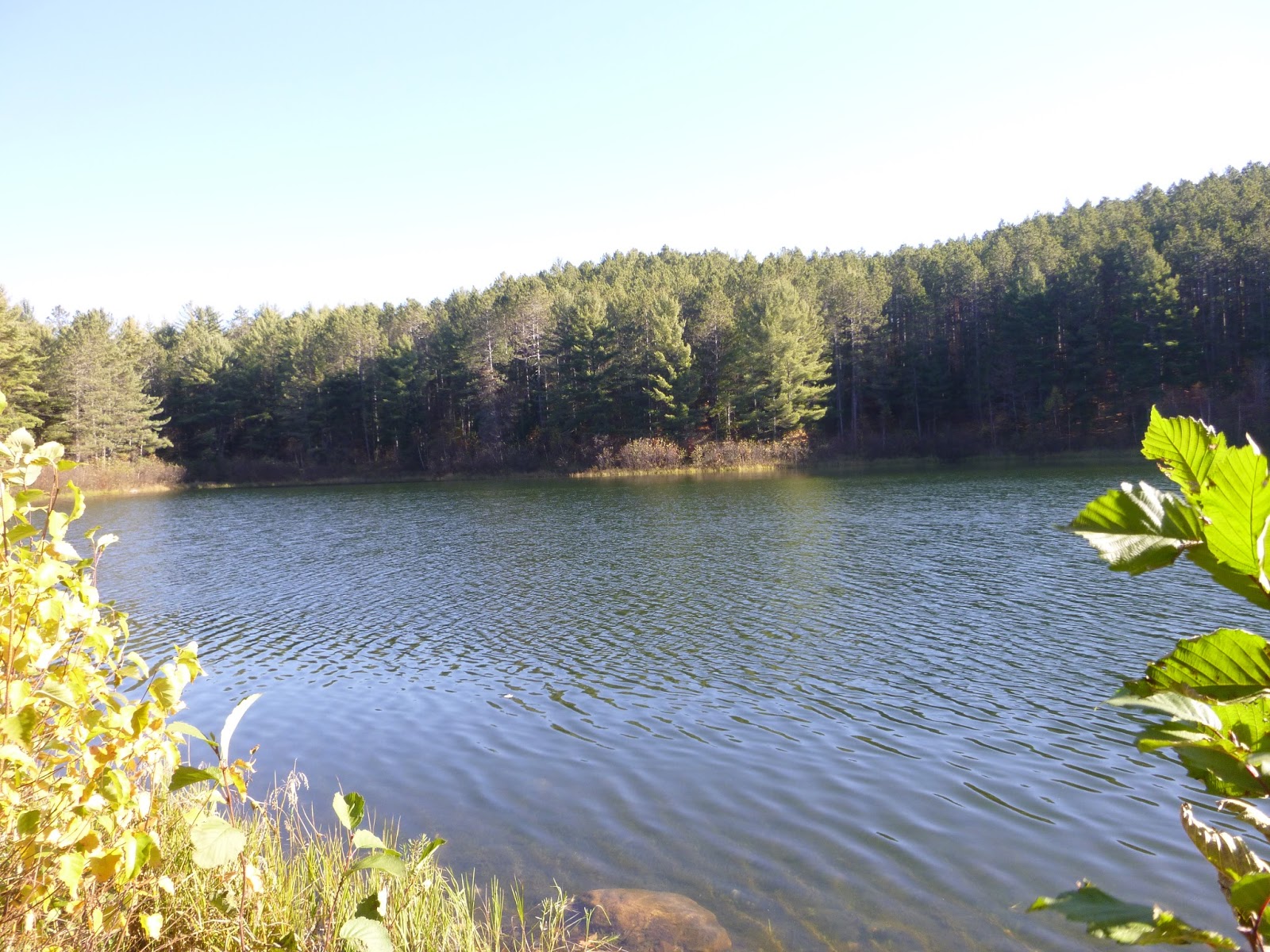
And Camp Smith Lake today, probably from the same perspective:


A pretty little hidden spot.  But I have it on reliable authority that the fishing is not as marvelous today as it was described in The Northern Pine Whisper.  Perhaps that was a bit of editorial license?
-------------
Later this week:  Brewery caves of Prairie du Chien Wisconsin.  Also a peculiar business model....

Friday, October 23, 2015

Combat Robotics 2015 - Third Report

The kids have conferences or some such so a week without our after school class.  Here are a few machines from the Tuesday section that are coming along rather nicely.


Your basic four wheel drive pusher robot.  Thin polycarbonate strips on the front as a wedge.  Bits of sandpaper glued onto the styrofoam wheels.


Two wheel drive wedge design.  Oh, also a rapidly spinning steak knife on the front.  It is not an effective weapon but it does look cool.


If this works it will be cool.  I just noticed that the pointy part of the weapon is in the wrong direction.  It will have to be removed and reversed.


This student opted to go for defense.  Should be fairly safe inside a sheet metal cylinder.

Overall a reasonably functional group of machines with two or three build sessions left to go.

Thursday, October 22, 2015

A Boyhood in the CCC

It's been fun poking around at the documentary evidence and the physical remains of a couple of CCC camps up north.  While doing so I ran across, of all things, an obituary that was relevant.

Donald Eugene Fisher was born in Beloit, Wis., on June 1, 1925. The son of a career Army officer, he moved frequently with his father's changing duty stations. He spent his youth in northern Wisconsin where his father was commanding officer of depression-era CCC (Civilian Conservation Corp) camps at Cable, Wis. (Camp Cable); Seeley, Wis. (Camp Smith Lake); and Townsend, Wis. (Camp Boot Lake). Don attended Madison West High School when his father became executive officer of Camp Madison (now the University of Wisconsin Arboretum).

On his 17th birthday in 1942, Don joined the Navy and volunteered for PT boat service. He saw action on D-Day in the English Channel during the Normandy invasion and later in the South Pacific until the Japanese surrender. During his service he earned three Purple Heart medals for injuries sustained in combat as well as numerous other awards for the actions in which his boat and squadron were engaged.
His later life was quite distinguished as well, he became President and CEO of an insurance company.
When I went looking for a photo of him, perhaps of his boyhood growing up in the CCC camps of northern Wisconsin, I found this:

His US Navy pants are now at the Wisconsin Veterans Museum in Madison which mentions in the associated notes that Mr. Fisher was wounded three times in 1944 including on D-Day.  
I wonder if somewhere in the background of my pictures of Camp Cable and Camp Smith Lake we might spy a gangly youth who looks just a little young to be a CCC recruit?


Wednesday, October 21, 2015

CCC Camp Smith Lake

The story of Camp Smith Lake, east of Seeley Wisconsin, is available in fairly complete form.

Company 647 was formed in May of 1933 at Fort Sheridan Illinois.  The first commander was a Captain J.P. Creshaw, a World War One vet who served as a Reserve officer in the 3rd Field Artillery.  Everything seemed to happen quickly in the world of the CCC.  Perhaps government agencies were more nimble back then.  So in mid June of '33 they were already encamped in a temporary base near Seeley in Sawyer County.  For the next four months they worked on road building and reforestation projects, in addition to constructing an elaborate new, semi permanent home some 5 miles east of Seeley.

For their efforts the 647th was named outstanding camp in the Sixth Corp area in October of 1933.

Their new home was on the shores of a small lake, so Camp Smith Lake it became.

Unusually it had two story barracks.  Also mentioned in descriptions are a pump house, bath house, forestry office, mess hall and baseball field.

Camp Smith Lake was in service for quite a while, a history of Wisconsin CCC camps indicates that over its life of service 1080 men passed through it.  The same history has some tantalizing little photos of life at the Camp.


Taking a look in October of 2015.....

The CCC camps used the available materials.  Timber and rock.


I don't know why there was a series of oil drums sunk into the ground.  I shall try not to speculate.


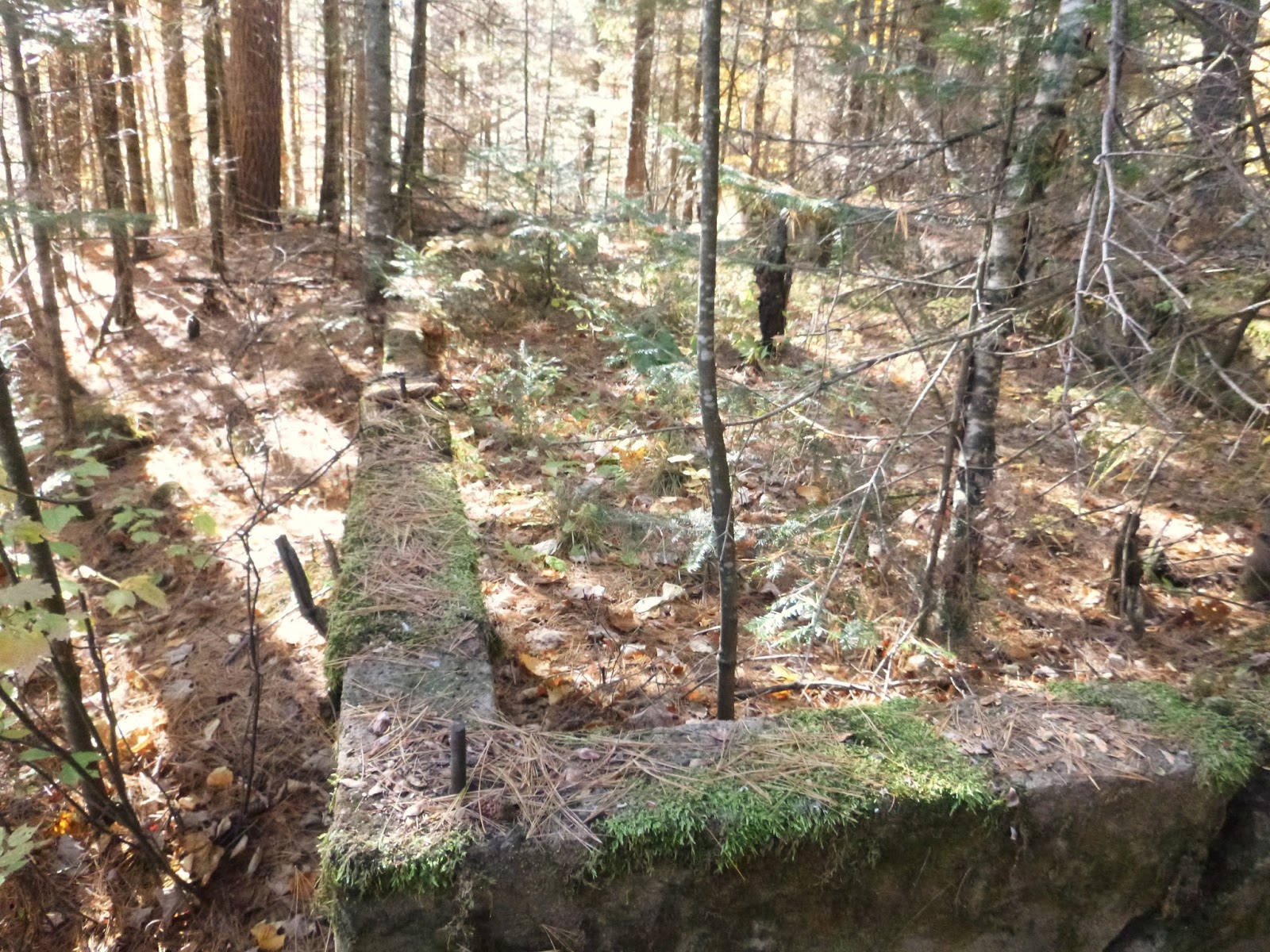
 CCC also used a lot of cement.  I don't understand this substantial structure with a narrow trench in the center.  It almost suggests an auto repair facility with a grease pit.


Also peculiar were quite a few of these stone pedestals.  They look like tomb stones but I think marked intersections of roads within the camp.


CCC construction methods were rather rough and ready.  I think I mentioned the stone and cement thing.


I had to work a bit to find the camp, and was rewarded with quite an array of remains.  I never did find the baseball field but I understand it is still recognizable.  If you fancy a look yourself forget Google Maps.  Even the county map was not very helpful.  I suggest you go east of Seeley Wisconsin on Boedecker Road.  Ignore Google Maps that has non existent name changes.  About five miles in you hit a stop sign and a T.  Go left towards Lake Helene Road.  When you see the sign that says Camp Smith Access you have gone too far.  This refers to the lake, not the camp.  The CCC camp is back a few hundred yards on both sides of the road where it takes a jog.  I saw the first hint of structures behind the big yellow sign with an arrow on it.  There is a convenient parking place there too.

My GPS claimed that the camp is at this location.  I don't think I trust it.


Monday, October 19, 2015

CCC Camp Cable


In an antique store last year I ran across a foot locker that had once held the belongings of a man in a CCC camp.  For those unfamiliar with the Civilian Conservation Corps program of the mid to late 1930s it was a very popular element of Franklin Delano Roosevelt's "New Deal" initiatives designed to help pull the US out of the Great Depression.

Young men from families "on relief" were recruited to go work on natural resource related programs in rural, often wilderness, areas.  They were housed in camps that were usually build on the spot and along military lines.  Barracks, mess hall, etc.  The CCC companies were commanded by military officers from the Reserve ranks.

The benefits were many.  Unemployment was reduced.  Young men developed useful skills - although as a concession to labor unions they were not taught advanced things like machining and so forth.  And when World War Two came along a few years later America had a cadre of men accustomed to a regimented life.  In fact, CCC alumni were usually tapped for slots as corporals or sergeants in a rapidly expanding military when the draft began in 1940.

As to the camps themselves, most were allowed to revert to nature.  But you can still find traces of them here and there.

Lets visit a couple this week.  First up:

This sign is actually a little deceptive.  Company 3653 was only formed in June of 1935. The earlier date above likely refers to the establishment of the "parent" company from which it was split off as the CCC program enlarged.  Their main jobs included fire fighting, tree planting and construction of public works.  After spending 17 months at a variety of camps in northern Wisconsin Company 3653 moved to Camp Cable in November of 1936.  In May of 1937 they moved away.

It seems likely that Camp Cable had an earlier occupation as it is described as being one of the most modern camps in the area with extensive facilities including class rooms.  A bit much to have constructed over the course of a single, chilly winter!

A look around in the early fall of 2015:

A road through the woods, trees growing in the middle.


The archaeological rule of thumb is that a right angle suggests a building foundation.  This one was raised up fairly high and looks to have been substantial.


Oil cans.  Might be from the 1930s but it is not as if people have gotten tidier since then.


There is not much that will give you a deep depression like this. Either a well or more likely a latrine pit.  Perhaps archaeologists in the distant future will consider it an important feature to excavate!


A last look at some of the men of Company 3653 in an undated photo.  The fellows in uniform show up well, the men in the back are washed out ghosts, probably wearing the white shirts of either the cook staff or of the civilian advisers.  In a way I suppose these men, future heroes of The Greatest Generation, are almost all ghosts now.  They have passed from among us, but for a small and dwindling band of survivors in their 90s.


---------
Addendum.  Camp Cable was built in the fall of 1934 by company V1676.  The V designation indicated that the men were entirely World War I veterans.  Among the features of the newly constructed camp were a pair of ornamental stone pillars at the entrance.  Buried under one was a bottle containing a list of the names of the original builders of Camp Cable.  No trace of the pillars is now to be seen.