Life was pretty good for Winslow. He built this swell house, still standing, in Eau Claire. He added a side line - selling wallpaper - that sounds boring but as it turns out was a good hedge against his main line of merchandise not doing well. The newspaper suggests that he had a theatrical group of some sort in the early 90's although whether the Winslow Medicine Company did classic Medicine Shows out on the road or were a less interesting amateur theatrical society in not clear. It's frustrating when the newspaper just assumes you know such things already. He married the daughter of a lumber baron/mill owner.
Wandering unsupervised in various real and imaginary places. Detritus reflects my interests in robotics, travel, history and the odder aspects of the world around me.
Wednesday, March 6, 2024
Winslow and his Wonder Worker
Life was pretty good for Winslow. He built this swell house, still standing, in Eau Claire. He added a side line - selling wallpaper - that sounds boring but as it turns out was a good hedge against his main line of merchandise not doing well. The newspaper suggests that he had a theatrical group of some sort in the early 90's although whether the Winslow Medicine Company did classic Medicine Shows out on the road or were a less interesting amateur theatrical society in not clear. It's frustrating when the newspaper just assumes you know such things already. He married the daughter of a lumber baron/mill owner.
Friday, February 16, 2024
The Implausible Life of Frank Powell
In my survey of patent medicine companies in my part of the world I've had to leave this one to near the end.
In many ways the industry was an over the top parody of American capitalism in the great age of expansion that came post Civil War. Mass advertising, expansive promises....the whole Snake Oil Industry was predicated not so much on fooling the rubes as in getting them to admire the sheer audacity of it all. And in that world David Frank Powell, aka White Beaver, was almost a parody of a parody. He was way over the top even for his day.
Wednesday, February 14, 2024
Patent Medicines of Black River Falls, Wisconsin
The story of patent medicine manufacturing in Black River Falls Wisconsin is probably synonymous with the story of J.W. Cole. But there is a frustrating lack of detailed information within easy reach, and as such I'm left with loose ends.
Bottles like the one below are fairly common. 1900 give or take a bit, and with side panels embossed J.W.Cole and Co on the top and Black River Falls, Wis on the bottom.
I think Cole may be an anglicized version of a German name. Kohl perhaps. The company did go in for medicines with a German theme. Here's a rare one, Blud Bilder, or Blood Builder. It's really a horrid translation as Bilder in German actually means "picture", and blood should be Blut.
After starting in a smaller space J.W. Cole moved into a substantial building in the 1870's. A close up view shows he was not averse to selling other people's medicines, as the Kick-a-Poo line that was manufactured by an outfit called Healy and Bigelow out of Boston.
This last bottle lists the town of origin but not the company that made it. Was this another German themed J.W. Cole product? Or was there another small time medicine manufacturer in the little town of Black River Falls?
Wednesday, January 17, 2024
L.C. Millard
The study of small town/small time patent medicine companies almost always leaves you shorthanded. Usually you have information and no artifacts. Sometimes it is an artifact and little info. That's the case with L.C. Millard and his Magic Oil, aka The Great Pain Exterminator.
Here's the bottle. Paper label only. I have photos but have not actually seen the item in person. The style looks late, probably 1910 or so. But if you look closely you'll see a possible clue.....
Wednesday, January 10, 2024
H.W. Barker does not approve of Short Sheeting!
Sometimes you get remembered for things other than what you'd predict.
H.W. Barker of Sparta Wisconsin turned out this swell looking patent medicine.
This one is so clean it is almost harder to read than usual. "H.W. BARKER'S COUGH REMEDY 50 cents".
He appears to be a likeable old coot, whose great accomplishment in life was sponsoring a bill that required hotels to use nine foot long bedsheets! Hotel patrons with nice warm toes are an appreciative group.
Wednesday, December 20, 2023
Darius Bent - Soldier and Settler
Continuing my survey of Western Wisconsin patent medicine men I must give brief recognition to a man who has almost entirely vanished from history despite an extravagant name and significant Pioneer cred. Darius E. Bent.
He was living in Eau Claire in 1876 when he copyrighted a medicine called "Dr. Mathew's Great Idaho Indian Compound". The reference to Idaho made me think it was a reference to Chief Joseph of the Nez Perce, but that conflict did not start until 1877. Indian themed medicines were pretty common in this era. Idaho, well Darius might have just picked a place at random.
Mr. Bent seems to have been very well thought of in the community. A lengthy biography written shortly before his death tells his story.
Born in 1820 he came to Eau Claire in 1855 "....when there was scarcely a house in the place and only one between here and Menomonie...". He tried his hand at farming - didn't go well - then joined the Union army in February of 1862. He was at the Battle of Shiloh. Assigned to attending the wounded he injured his back in the process of lifting them. The injury was permanent.
He made his way laboriously home by steam boat. Six months in bed. A year to relearn how to walk. He worked in a shoe store for a while. Then a grocery. His longest employment was with G. Tabor Thompson, an Eau Claire druggist. Probably his venture into patent medicines was at about this time. Thompson was in business starting in 1871, having also been discharged from Civil War service due to illness. Incidentally, we've run across him BEFORE.
Darius Bent had married pre-war. He had three children, and although he seems to have suffered greatly in life it is said that: "Mr. Bent's sickness and trouble cost him several thousand dollars, and time has helped to whiten his locks, but he is yet cheerful and contented and always ready to do a kind act to help any one unfortunate like himself."
Bent, literally, but unbowed. Admirable.
Friday, December 8, 2023
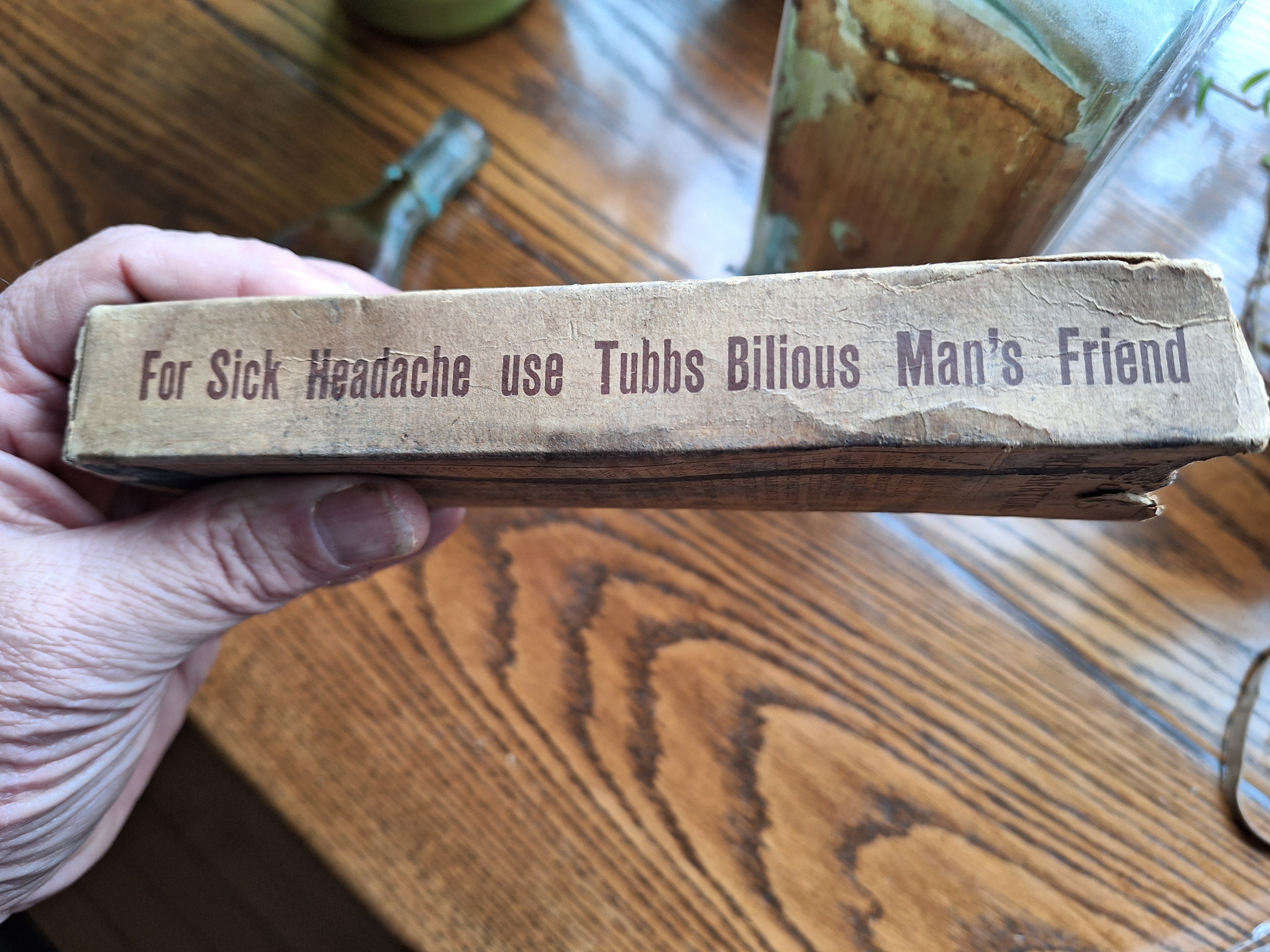
Tubbs and the Bilious Man's Friend
Continuing my survey of 19th century patent medicine companies from Western Wisconsin. Why? I suppose the answer could either be Why Not? Or, who else is gonna do it?
Today we visit the Tubbs Medicine Company of River Falls, Wisconsin.
Yes, their logo was a wooden tub and their flagship product Bilious Man's Friend. Notice that it is touted for Bad Colds, Bad Stomachs and Bad Tempers. With that combination a man might not have many actual friends.
Thomas Emerson Tubbs was born in Vermont in 1836. As a young man he "Went West", driving a team out to the frontier town of Prescott Wisconsin in 1854. He liked what he saw and staked out a claim in an area called Glass Valley. His first business was a small wagon and sled manufacturing business which he moved to River Falls in 1866.
Tubbs was a very enterprising young man. In addition to the wagon and sled trade he ran eleven different insurance companies and also peddled, "Babcock Fire Extinguishers", fire and burglar proof safes and a complete line of school, church and farm bells.
Some time in the early 1870s he added patent medicines to his portfolio. Supposedly he brought with him from Vermont certain formulas including an "Elixir of Life".
In 1876 the Tubbs Block, from which he ran his many enterprises burned to the ground. Reappraising his situation Tubbs decided to focus on the medicine business, although he still ran his various insurance agencies. The product line was the usual array of nostrums for Man and Beast.
Tubbs proved to be a good businessman. He made distribution arrangements with a major Minnesota wholesaler and also recruited a local traveling sales force for closer to home. He made a wide array of medicines....and a fair bit of money.
T.E. Tubbs died in 1894, handing the business off to his son Willard. The good times kept rolling on. Bottles of syrups and elixirs, advertising almanacs in many languages, pills and plasters, went out the door in their thousands. Many have survived as you'll see below.
Eventually the Pure Food and Drug Act of 1906 started to put a crimp in things. No longer could you keep the ingredients secret. Or make outlandish claims for curing human ills. Veterinary products remained fairly unregulated.
Willard passed on in turn in 1931. Around that time the company was sold to outside interests and does not seem to have survived for long thereafter.
The commonest Tubbs items you run across are these little guys. TUBBS is embossed on each side. They have many different labels.
The side panels tout their flagship brands, one of which was Bilious Man's Friend.
I actually have a bottle of the stuff. Unlike the 1900 era bottle above, this goes back to the 1880s at least in terms of bottle style. The label is fading and there might not be many more examples in existence, so I'll show as much as I can.
No post 1906 hedging here. IT CURES a wide array of problems. Costiveness, Heart-Burn, Nervous Disorders, Nightmares, Scrofula. Like most such patent medicines it had a good wallop of alcohol in it. Probably not good for the Heart-Burn but it would at least make you worry less about all the other stuff.
Back panel.
About those almanacs. This one has a blank space at the bottom. Usually the druggist or merchant who sold the medicines would stamp their name there. The military scene depicting the Victory of General Health is generic. Vaguely Civil War in its imagery but more contemporary with the Spanish American conflict.
Chock full of pictures of suffering people.
As such things are figured, the TUBBS company was small potatoes by the standards of the great patent medicine millionaires like Dr. Kilmer. But it was an enduring enterprise that did a profitable trade for roughly six decades. Not a bad track record.
Wednesday, December 6, 2023
The Inventive Mind(s) of Menzo Gates
Perhaps unwisely I have agreed to do a presentation in a few months on the topic of "Patent Medicine Men of Western Wisconsin". It is an obscure subject, and while it affords plenty of opportunity to tell stories I'm not sure how general the interest will be.
But I agreed to do it, so it was off to my files. I have notes on the subject going back decades. And in some cases the random loose ends can now be better addressed with the wonders of this here Internet.
Consider the curious case of Menzo Gates.
I knew him from a passing reference on a roll of microfilm giving assorted copyright data. Evidently he was marketing something called "Gate's Remedy for Diptheria" back in 1885. At that time he was living in Cadott, Wisconsin. This is a sleepy little village about ten miles east of where I live.
Usually a small town patent medicine will be put up by the local druggist. But applying for a copyright was quite unusual. In general they just mixed things up, stuck a label on a generic bottle and called it good.
Imaging my surprise when a search for the highly distinctive name Menzo Gates came up with this 1899 US Patent. Why, our pal Menzo looks to have upped his game over the intervening 14 years!
This seems like a terrible concept. You teach your kid how to swim by setting up a guy wire across a body of water, then have the tyke go back and forth with some sort of ring around them. The tyke on the left looks he has the harness around his neck!Alas for my narrative there amazingly were two men named Menzo Gates. The man who manufactured the obscure patent medicine died in Cadott Wisconsin in 1890. He had one child, but it was a daughter, so there is no evident link to the inventor living over in Copemish, Michigan.
Monday, September 26, 2022
The Elusive Madam Rose
Here is an unusual artifact. I've had it so long I can't remember where I got it.
The style of the bottle puts it somewhere around 1910, a date also suggested by the presence of a Food and Drug Act stamp from 1906. Before that legislation you could put anything you darn well pleased into a bottle and sell it. But who was D.I. Jones?
Most bottles of this type were put up by pharmacists as a sort of side line. But recently when I decided to compile a list of early drug stores in my town I realized that the name Jones was nowhere to be found. Something else going on here.
Mrs. D.I. Jones was a milliner. She sold ladies hats. From newspaper ads I can place her on Bridge Street in down town Chippewa Falls and date her enterprise from late 1901 to a known departure - both from the business and from town - in early 1913. In a sense this would be a very reasonable side line for her. Sell fancy hats to the ladies of the town and naturally they'd be interested in a nice complexion to go with them. Who prepared the product for her is unclear.
Women in business in that era were uncommon. Mostly they stayed home, took care of the household, raised the kids. What women there were in the business community were often there out of financial need, and had constrained roles. Nurse, governess, seamstress. Maybe running a boarding house if you were a respectable widow type. Millinery fits the pattern. But who really was she?
The common last name combined with the now outdated practice of adopting a husband's name did make it a bit of a challenge, but I discovered that her name was Rose. This of course makes sense given the name on the cosmetic bottle, and Madam would be a common title for someone in the beauty business.
She was married to David. Now he's an interesting character. In the 1900 census he is listed as being an electrician. But a few years later, and styling himself as "Major" Jones, he was in partnership with a certain "Colonel" Richard H. Cosgriff and doing business as the Twentieth Century Amusement Company. The 1910 census lists D.I. Jones with the occupation "Carnival Company". They had a Ferris wheel and a merry go round along with other amusements and took them to county fairs and such around the state. Oh, and they had a sideline that links to some of my other research.
I've previously written about the Gem Theater. Well, this item appeared in a local paper: "Richard Cosgriff and D.I. Jones are making the Gem a real family theater and it is proving a great success." It does make sense, these guys were in the Amusement business and that tends to be rather seasonal. Also D.I. being an electrician by trade would be a help. I'm not sure what role Mrs. D.I. Jones played in the theater. Her store was on Bridge street (so far I'm not sure where....Chippewa Falls had three milliners on that street in 1910!) I guess ladies hats were a bigger business then than now. I'd like to think she picked the name. Some of the earliest ads for her establishment circa 1901 describe it as "A Gem of a Store".
I assume that the Face Lotion was sold at the hat shop. But it is worth noting that it is D.I. not Mrs. D.I. that is listed on the bottle. Was he selling this concoction at county fairs?
I'd also like to think that the unlikely marriage of the Milliner and the Carney was a success. But I'm thinking maybe not. The 1910 census has them living at her father's house (her maiden name was Erickson and the census indicates her family was Norwegian). She and David appear to have had two children, a boy and a girl.
But three years later the part of the paper that deals with local doings reported that she'd sold her millinery shop and was moving to Minneapolis. No mention of her husband. Well maybe it was to be expected. Throughout history itinerant performers have been regarded with a degree of suspicion. Even in their modern incarnation as "Carneys" they are figures outside the realm of polite society. I say this by the way not in judgement but affectionately and based on my brief experiences in that world......
Regards the Twentieth Century Amusement Company I have found some very saucy information that will turn into another post in the near future. There will be snakes involved.
A couple of images of the box for that Lotion. Not in the best condition but as it is likely the only surviving example it warrants remembering.
Monday, November 1, 2021
Mary McMath's Medicine
Today a little artifact that is certainly rare and probably unique.
It is a patent medicine bottle, paper label only, the bottle style suggests circa 1890 give or take a few years. Here's the other two sections of the label.
As you can see it comes from Saint Paul Minnesota, and has a female proprietor.
Women's names do turn up on patent medicine bottles with some regularity, but the companies were in almost all cases run by men. The women, Lydia Pinkham comes to mind, were just fronts. This worked especially well in nostrums for "female complaints".
But Mary A. McMath seems to have been a genuine small time patent medicine manufacturer. So what can we learn about her?
This is a tough one. Usually I can zip through census information and archived newspapers and get the rough outlines of someone's life. But for Mary McMath the pickings are slim.
In 1878 she was embroiled in a lawsuit against a certain William Parsons. The details are sketchy but it is described as an "action for rent", suggesting she was a land lord. It took a year but she won $30, costs and interest. In 1882 I find mention of her paying for sidewalk assessments in the Woodland Park Addition to St. Paul. And in 1888 a list of undelivered letters includes one to "Dr. Mary A. McMath".
I have a fairly comprehensive listing of pharmacists from St. Paul in that era, she does not appear on it. Patent medicine companies ran from the gigantic to the one person operators. She is unknown in that list as well. Shortly before his untimely death I asked my old friend Boyd Beccue about Ms. McMath. He'd never heard of her. And between Boyd and I we knew most of what there was to know about the arcane world of Minnesota patent medicines.
Next I scanned digital copies of St. Paul City Directories from 1880 to 1896. No mention of Mary McMath at all. That's unusual. Similarly the Minnesota State Historical Society has no mention of her in their online catalog.
Casting a wider net of locations for searches only gave me a few crumbs. An obituary for a Betty Laura McMath (born 1926) said she was the 5th daughter of Thomas and Mary McMath. Although this was in a suburb of St. Paul I can't make the, er, math work. If you were a property owner in 1879 you were not having babies 50 years later!
Somewhat more definitively I ran across a reference in a San Francisco paper from 1884. It was a list of people enjoying nearby summer resorts. At "The Geysers" we find Dr. Mary A. McMath of St. Paul. Most of the other leisure seekers were married couples and families. Dr. Mary is listed alone.
I tried a few other long shots. I have a trade journal for upper midwest pharmacists from the late 1890's that lists an extensive compendium of all patent medicines wholesaled by the biggest supply house in Minnesota. All manner of odd and obscure things turn up there including some much older patent medicines that were still being made on a small scale by somebody. No McMath products.
I could dredge up US Census information or perhaps pursue one of the various Genealogy web sites (they all promise a free trial but sure want your credit card!) but I doubt I would find more.
So we are left with an enigmatic woman. Apparently single. Evidently of sufficient means to travel across the country for leisure. But also it seems a one woman patent medicine business. It is a curious and incomplete tale. If I find more I'll publish an update.
Wednesday, February 24, 2021
Dr. Towns Cures Epilepsy. And a bunch of other stuff.
This post will only make sense if you first read my admittedly lengthy history of the W. Towns Medicine Company. The business meandered through 65 years and four locations, and that tends to leave behind a few artifacts.
In my initial post I discussed the first medicine of Wyman Towns, his Vegetable Blood Purifier. This was an 1870's and 80's product line, although I still find it listed in an 1897 wholesale drug catalog alongside Towns' Cough Killer, Towns' Healing Snuff, and Towns' Rheumatic Liniment. No mention of the product that would raise them above the status of small time, small town medicine company, Towns' Epilepsy Cure.
The Epilepsy Cure dates from at least the mid 1890's. It is mentioned in an 1896 advertisement and from about this date the "pitch" steers partially away from the generic "chronic and nervous diseases" line. Below is a preserved specimen of the box. It is from the Fond du Lac period of the company and presumably pre-1906. After the Pure Food and Drug Act you would not have been allowed to use the term Cure.
Notice that it was good not only for epilepsy, but for opium addiction, hysteria, sleeplessness and alcoholism. Ah and that old standby, Errors of Youth. The hint of venereal disease has carried over from the Blood Purifier era. The material printed on the right is also fascinating. Who knew that bathing the spine with two or three gallons of cold water had some impact on epilepsy?
Here's a side by side comparison of the Cure and Treatment versions from Fond du Lac.
Notice that Dr. W. has vanished from the embossing. This makes me think the bottle on the right was actually quite a bit later. Wyman was said to still be alive when the company moved operations to Baltimore circa 1909.
This is not a comprehensive collection. There are also aqua versions of some of these. They are less interesting visually but probably a whole lot easier to photograph. There is also a variant with straight line embossing and no city listed. Perhaps in all the moving back and forth there were times when even Dr. Towns, and his sons who succeeded him in the business, did not know where they were operating out of!
Monday, February 22, 2021
Dr. Towns casts out the Demon Epilepsy
It's odd how some stories unfold over many years. In the curious tale of the Dr. W. Towns Medicine company my starting and ending points are separated by more than three decades!
I have been interested in archaeology and local history for many years, and "back in the day" we used to excavate trash pits and privies from the 19th century. Circa 1987 I dug up this bottle in my town of Chippewa Falls.
It is a nice item, which by style and by other items found seems to be from the 1880s, although occasionally older items would kick around a while before being discarded. At the time I was probably the leading expert on 19th century patent medicines from Wisconsin and I'd never seen one of these. In fact, I've also not seen one since. But Dr. W. Towns was fairly well known for his other products, with assorted Epilepsy medicines being the main business of his company. It's quite the tale, and only now in 2021 am I getting closer to a definitive history.
Wyman Towns appears to have been born in 1837. The 1860 census lists him as being 27 years old and residing in Oasis Township, Waushara County Wisconsin. * There are only a few hundred people living in this isolated township today, and in pioneer days it must have been even fewer. So his early life is obscure. The next trace of him is found in this news article/ad from the Wisconsin State Journal (Madison) of 08 July 1875:
This appears to near the beginning of his patent medicine career, as it refers to introducing his "Celebrated Vegetable Blood Purifier". George Schlotthauer incidentally, ran the Barber Shop and Bathing Establishment at the Park Hotel in Madison in 1871. This might have been renamed The Lake House by '75, as his 1886 obituary mentions him as the proprietor of The Lake City House. In my next post I'll talk about Towns' epilepsy medicines at length. Oddly baths turn up there as well....
You wonder if Dr. Towns was just a nosey voyeur, but if his response to one such questionnaire is representative he did have a kind of pompous sincerity about him.
"I am no longer a young man. My years have been spent in the treatment of this one disorder. What the future holds in the way of reward or punishment I cannot know - but this is certain - I have too honorable a name in the world to cloud it with deceptive or dishonorable practices. If I have been fortunate in securing my share of this world's goods it has been solely because I have been successful in curing the most stubborn and chronic cases of epilepsy....I have never taken a dollar that I have not honestly earned. I never shall so long as I live."
In the first few years of the 20th century the Dr. Towns Medical Company went nationwide. It's ads turn up in papers everywhere. And the above sentiments aside, its business practices seem to have had a nasty streak to them. Like all such outfits they accumulated customer lists. These poor souls, suffering from epilepsy - which had considerable stigma back then - or whatever other maladies were hinted at; had their names later sold to other charlatan firms once the Towns company was done with them. And you thought this sort of thing was only invented in the Internet Age!
But the prevailing cultural winds were against them. 1906, only a year after the company was incorporated, saw the passage of the first Pure Food and Drug Act. This was landmark legislation, that demanded publication of things like alcohol and opioid content, and banned the use of some words like "Cure".
This had been building for a while. The Pure Food part of it was inspired by Upton Sinclair's novel The Jungle (1906) that documented horrendous conditions in the meatpacking industry. And the sections that eventually destroyed the patent medicine industry were a direct result of the exposes of journalists such as Samuel Hopkins Adams, who published a series of articles in 1905 called The Great American Fraud, laying bare many of the shocking abuses of both business models and products in the quack medicine world.
Then the American Medical Association weighed in. For years they had been publishing articles in their Journal that documented the abuses of the patent medicine industry. These articles were collected in pamphlet form, then eventually in a two volume set called Nostrums and Quackery, published in 1912 and 1921. It is encyclopedic and scathing. And it has much to say on the W. Towns firm.
(Note, I am including some information that exists only in the original files at the AMA Headquarters; I made a brief visit there years ago while my family went up to the top of the Sears Tower!)
In 1910 a letter from the Fond du Lac Medical Society to the AMA states that "Wyman Towns has no medical education, is not licensed, has no place in the American Medical Directory and has gone to Baltimore, Maryland, where he goes about from town to town as a street faker claiming to cure fits". Ouch.
The Epilepsy Cure had been downgraded to a Treatment by then, and was analyzed on several occasions. It was found to contain ammonium bromide, salt water and small amounts of alcohol and flavorings. Ammonium bromide actually does have some efficacy at treating seizures, but has a very narrow window between control and nasty side effects. One of which incidentally was impotence, so perhaps that whole Indiscretions problem got cured to boot.** Barbiturates, the first really effective seizure control medication, came along in 1912, and were probably included in later recipes of the Towns medication.
Wyman Towns passed away in 1915. He seems to have been held in such low repute that he does not merit an obituary in Fond du Lac where he is buried. The company implausibly soldiered on until the late 1930s. With it being exclusively a mail order business by then it is hard to track its actual location, as mentioned it had moved from Fond du Lac to Baltimore. It then moved back to Milwaukee, but appears to have also had a presence in Puerto Rico. I suspect the latter location was something of a dodge to evade the tightening regulatory environment Stateside.
One of the last traces of the company I've found interestingly loops it back to the beginning of our story.
It's a humble little ad in the Chippewa Herald Telegram from 5 March 1931. It is the usual stuff, but interestingly makes the claim that a citizen of Chippewa Falls took a single dose of Dr. Town's Epilepsy Cure - oh, I mean Treatment! - in 1874 and had not had a seizure in the subsequent 50 years! Clearly there was some connection between Wyman Towns and my home town. Perhaps he had friends or relatives up this way but given the enigmatic character of the bearded old faker I'll never know more than that this seems to have been an early market for him. Perhaps this accounts for the presence of the Blood Purifier bottle, which dates from the days of his initial foray into patent medicines.
Next time, we'll look at more bottles and graphics from Dr. Towns.
-----------------------------------
* In an earlier article on Wyman Towns I speculated that he had emigrated from Canada. With the benefit of new information I can say that this seems to be incorrect. There were additional men with this name in Winnipeg and in Grand Forks Dakota Territory (now of course North Dakota). An unusual name that is not as uncommon as you'd think.
** In the Second World War soldiers would mutter darkly about bromides being added to their wine ration so that their time on leave would be less fun and they'd be less likely to go AWOL. Obviously we're talking about the French Army here.
On a less racy note, because bromide compounds cause one to be a bit slow and sedated, a foolish, simplistic statement has come to be called "a bromide", as it is the sort of thing somebody might say when dosed up on them!




.jpg)
.jpg)
.jpg)


