- Note: One of my rules of thumb is that you never find just one of these "Tree Shaped Tombstones in a cemetery. There are always at least a couple. But on a fall road trip I ran across a bunch of exceptions to this rule. Here is "One Off Week". -
Cross Plains Wisconsin. I had taken a bit of a detour to visit hoping to find remnants of a cave in the ruins of a brewery on the edge of town. No such luck.
But I did run across an interesting cemetery, another in our series of "One Off" tree shaped tombstones.
Valley Home Cemetery surrounds St. Martin's church. St. Martin's has been decomissioned and now serves as the headquarters for the local historical society. The place overall is well kept up and there are some nice monuments there. But something, perhaps the nature of the soil, is causing trouble with some of the older markers.
Temps fugit.....
Anna Schulenberg has a nice tombstone.
The little motto below is rather Germanic and grim. It translates roughly to "Death pain and Grave rest, with Christ in Heaven". She probably did not die peacefully in her sleep.
Well lets hope that she is resting more comfortably than her leaning tombstone! Is it being propped up by that little slab from somebody else's grave or is that just there to make mowing the lawn easier?
- Note: One of my rules of thumb is that you never find just one of these "Tree Shaped Tombstones in a cemetery. There are always at least a couple. But on a fall road trip I ran across a bunch of exceptions to this rule. Here is "One Off Week".
-----------------
Mineral Point Wisconsin is a great place. Scenic. Lots of history. It was at the center of the early, pre-statehood lead mining rush. I expected to find tree shaped tombstones a'plenty. Nope. The three cemeteries in town have a total of two examples, each - in the theme of the week - standing all alone. One was pretty standard stuff but the other....
Reverend Francis Weinhart has a rather imposing tombstone. Nicely done in the "Rugged Cross" format. Appropriate for a man of the cloth. Great detail too, look at the nails that hold the cross together.
I had expected that the "book" part of the monument would have a verse from Scripture. The line up above VIEMENTO is a bit of Latin portmanteau that translates to "remember the life".
Occupational references on tombstones are always nice to find. They say something about the deceased and also show the degree of creative latitude given to the monument carvers. Here we have a Communion chalice and wafer.
Francis Xavier Weinhart was of course a Catholic priest. He came to Mineral Point relatively late, in 1871. That was when the German speaking members of the Catholic community decided they should have their own parish.
If Priests were sort of the "rock stars" of the Catholic world, nuns had a different status. Respected, in the case of school children sometimes even feared. But they were decidedly less visible. Here is an understated tombstone I ran across in Portage Wisconsin:
Perhaps the designation SIS could be interpreted variously but the key is in the other part of the inscription. Fading and partially covered with lichens...In His Holy Name.
- Note: One of my rules of thumb is that you never find just one of these "Tree Shaped Tombstones in a cemetery. There are always at least a couple. But on a fall road trip I ran across a bunch of exceptions to this rule. Here is "One Off Week". -
Yes, there is a place called Inch Cemetery. So far the story behind it has eluded me.
As the theme of the week is "Lone Trees" there is just one to show you.
As they tend to do, these stones tell a story albeit an incomplete one. Notice the radical difference between these two markers? One is old and the other new. The birth dates for Clark and Etta are similar, just one year apart. But he died in 1901 and she lived to be 94. I figure them to be husband and wife. She seems to have been a widow for 60 years.
No other clear details. Clark would be too young to be a Civil War vet.
He does appear to have been a member of the Modern Woodmen of America on the basis of the snazzy little logo. It is a variant I had not seen before.
- Note: One of my rules of thumb is that you never find just one of these "Tree Shaped Tombstones in a cemetery. There are always at least a couple. But on a fall road trip I ran across a bunch of exceptions to this rule. Here is "One Off Week". -
Pacific Cemetery was probably once aptly named. It is in rural Dane county northwest of Madison. From the front gate it still looks peaceful.
But it is no longer in a bucolic countryside. The road along one side no longer conveys gently clopping horses and wagons but cars and trucks zipping past. And to make it less tranquil there was a back hoe working nearby. Also two dogs fenced in an adjacent yard who were quite vocal in their disapproval of my visit.
Amidst all the racket I did find one Tree Shaped Tombstone.
A nicely done specimen. Note the auto body shop in the background.
I like to highlight some of the nicer efforts of the talented artisans who made these. Note the well executed flower. It has its own little ledge, a chalice like pot, and every flower - or are they leaves? - crisply defined.
The same cannot be said for the "Book of Life" that sits atop the monument. As we have seen on prior examples the right angle exposure to the elements is not kind to stone or to the works of man. We are left with a few blurred dates and perhaps the name JONES. At some point in the future I suspect the road will be quiet again, with gently whirring electric cars. But by then the inscription will be lost entirely.
In my post several years ago describing the pyrotechnic demise of Big Tom, the world's largest turkey I neglected to mention that when we visited the scene of the poultry apocalypse I picked up a small charred remnant of the Big Guy.
So for all of you responsible for creating a memorable Thanksgiving feast. Let's be careful. Not too memorable!
Sometimes when researching a story you come across what looks like a dead end....but something just does not feel right. Perhaps when the topic is Forgotten Brewery Caves one should always expect there to be interesting things in hiding.
My first visit to Minnesota City was brief. I was on my way to Winona but had read that a brewery once existed in this nearby small town (population 204). I located the site, took a good look at the structure there, and came away puzzled. The building was in the right place. It was of a size befitting an early brewery. But it was under so many layers of renovation that my impression that it was just not old enough was tentative. I did a bit more research and made a second visit. This unobtrusive marker on a back wall sums things up nicely:
Otto Vill came to Minnesota Territory in 1857 and settled in the frontier community of New Ulm. Vill served in the militia that helped defend the town during the Sioux Uprising of 1862. His obituary in 1914 mentions that two of his children died during the conflict, but whether they were casualties or died of natural causes is not specified.
After the war Otto moved to Minnesota City, a small but promising community just north of Winona. The first thing an aspiring brewer needed to do back then was excavate storage space, which he is reported to have done in the summer of 1868. Actual brewing probably started the next year.
The Vill brewery enjoyed a fair bit of success despite vigorous local competition. On the death of its founder, his son Oswald took over.
With the arrival of Prohibition a different business model was needed. The brewery was converted into a hotel and "soft drink parlor". Given the surprisingly active resistance to Prohibition in the Winona area the quotation marks are probably justified. It was also rumored to be a stopping off place for mobsters who were commuting between those two great centers of flexible law enforcement; Chicago and St. Paul.
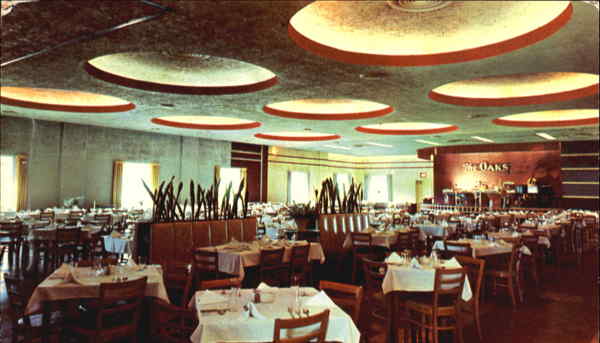
The Oaks Nite Club opened in 1930. Upstairs: dining and dancing. Downstairs: slot machines and a roulette wheel. A prominent chef from Minneapolis was hired, and the business was a great success for a time. As the sign says above, it suffered through two serious fires and was rebuilt. Probably only the foundations survive from its brewery days.
The chef, a certain Walt Kelly, eventually bought the establishment and after its 1948 rebuild it had a dining room that could seat 600, an 84 foot long bar, and a stage big enough for a 16 piece orchestra. Notables of the time including Lawrence Welk, Sammy Kaye and the Three Stooges appeared there.
But of course times change. Kelly died in 1957. By then its popularity was slipping. Perhaps it was television, or maybe the rise of suburbia made this supper club in the middle of nowhere just seem like an illogical destination.
There were attempts to keep it going, new ownership, new strategies. It was a dinner theater for a while. Then a church. More recently it has been a machine shop.
Ah, but the topic of this post is supposed to be the caves.
A news article at the time of the 1946 fire mentions that the stock of "rare old wines and liquors" were stored in the old brewery caves and so survived the blaze.
Walt Kelly's son in an interview said that the stories of gangsters fleeing the G-men through tunnels leading out to the nearby creek were just that, stories. But he did confirm that there are, or at least a few years ago, were, narrow passageways underneath from the days when beer was stored there.
One of the later owners of the establishment was the colorfully named Carl Gegenfurtner, who said the following in a 1960 newspaper article.
"I'd like to get down and explore these underground caves, the old brewery caves under The Oaks. But so far I've been too busy upstairs. We're all working hard hoping to have our big opening with all the fancy new equipment running full blast around April 15th."
And one final crumb of information on the caves. With due respect to Kelly Jr., who would be in a position to know things, it appears that the caves actually did extend quite some distance towards the creek. A short news story in 1956, with a very grainy photo, shows a truck on the shoulder of the existing road, its rear wheel sunk deep into a cave in from the underlying brewery cave!
Yep, right about here.
Very little of the old night club decor survives. These groovy 1960's era lights are just about all you can see from the outside.
Odd little additions and brick structures. About what you'd expect in a building that has been so many things over its long life....
Last week I mentioned that the Potosi Brewery was putting out a "Cave Ale" as more or less a homage to the old ways of brewing. Not that the cave was actually involved in the process.
Well, another brewery did it one better.
In 2015 the Schell's Brewery in New Ulm, Minnesota announced that they would be producing a "Cave Lager" actually aged in the 1860's brewery caves under their plant. It is a dark lager, in keeping with the prevalent style of that era.
The August Schell Brewery goes back quite a ways by Midwest standards. It was founded in 1860, two years after Minnesota became a state. Schell set up his brewery outside of New Ulm but, supposedly due to his generosity to the Native Americans, it was unscathed when New Ulm was besieged during the Sioux Uprising (alt title, The Dakota War) of 1862. Remarkably the brewery is still family owned, the second largest of such still remaining in the U.S.
I remember it falling on some difficult times in the 1970's...their signature "Deer Beer" was not highly esteemed.
But in the happier times that are our current Better Beer Renaissance Schells has done well. It is a respected local business that turns out good product. And they have been innovative in recent times.
One of their experiments has been ageing beer in the original Civil War era caves.
It was a bit of an experiment and is not currently under production. So I can't give it my personal taste test but others have pronounced it delicious.
A few pictures of the caves.
An article that came out around the time of Cave Lager's introduction mentions that these are only remnant caves, two in number, each 8 feet tall and going 20 to 30 feet into the hill. There were more extensive caves but they were filled in so as to improve the structural stability of the brewery overhead.
This makes sense and was probably a fairly common practice. I wonder if that explains the little dead end cave at the Bloomer Brewery?