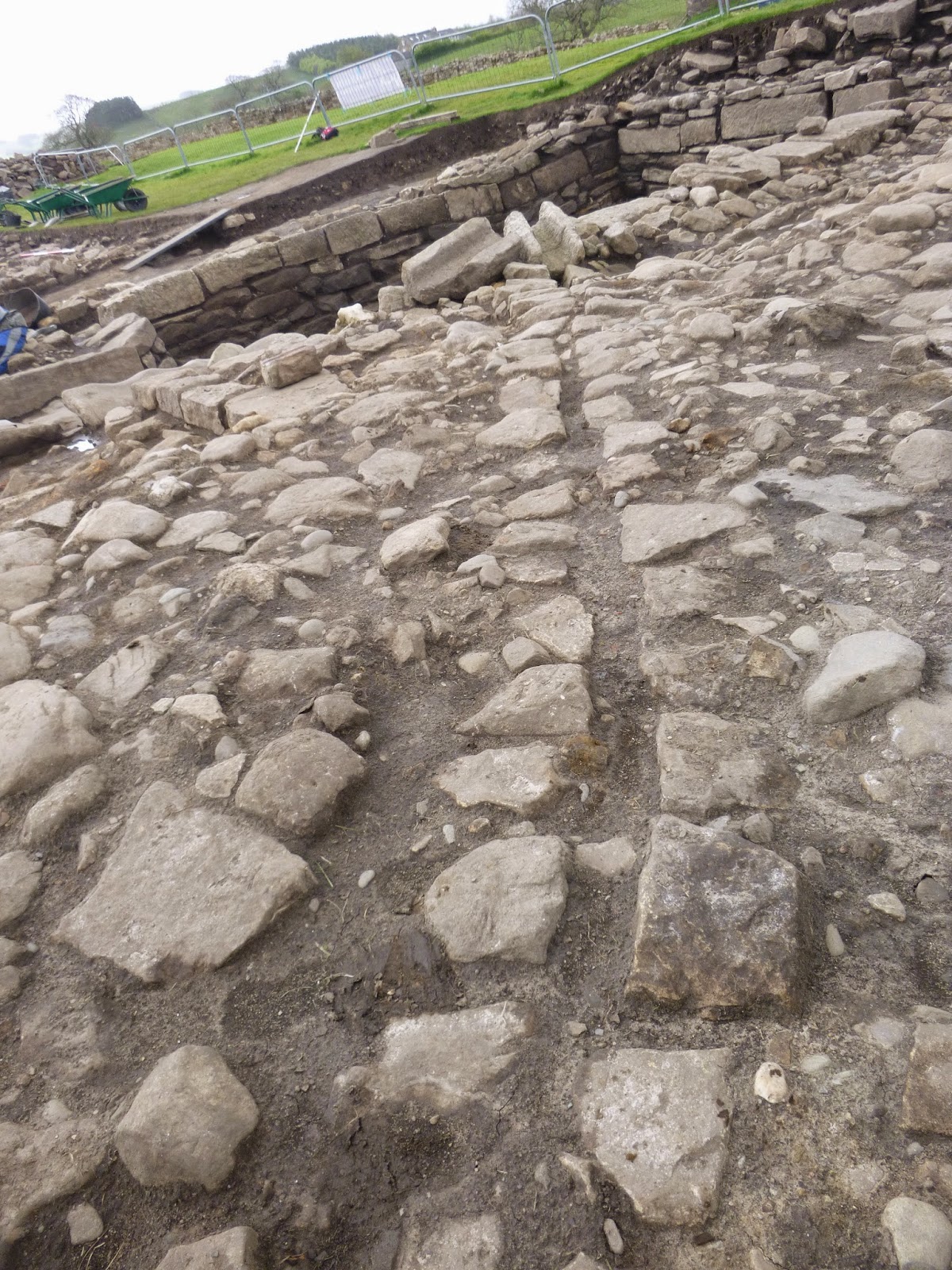
To some extent the feature we are excavating this week is "in the way". It needs to come out so that the ongoing excavations can link the street system of the fort with the headquarters building that is right next to our trench. But there are reasons to consider it a potentially interesting spot. Clearly it is late, even post Roman, but later inhabitants were very eclectic in their choice of building materials, and one could reasonably hope that bits and bobs of carved stone, inscriptions, statues etc could be incorporated into the later structure. Headquarters buildings tend to have a lot of that sort of thing.
So here is the area with the turf nicely peeled off on day One.
Quite the jumble pile, with that enigmatic drain from a much earlier road heading right into it.
About half way in there was an organized layer, something that was probably a floor surface from late Roman, or more likely, Dark Age occupation. I will jump ahead to the end of today and show the "floor" surface. One assumes it was quite a bit less wonky back in the day.
There was not a lot found today, most likely because the post Roman culture did not have much in the way of durable artifacts. What pottery you find may well be legacy pots and dishes kept from the old days, as new manufacture was rare to absent post Roman times. Or perhaps things like this bit of mortaria (grinding bowl) were simply part of the neighborhood trash that just sat around forever.
The Dark Ages were a time when things were reduced to a minimal level. You needed weapons, and needed them to be sharp. So here is a whetstone.
Bling was also an essential, and a nice ornamental broach was found nearby in the previous session.
When something interesting turns up elsewhere on the site it is sometimes brought around for others to see. This rather clever knife turned up today but I do not have the time period or context to pass along.
Various other interesting things are turning up elsewhere on the site, a nifty ring came up yesterday. This LINK to the official Vindolanda facebook page has a good image of it.
Tomorrow the struture we uncovered will be photographed for future study. Then it will most likely be cleared away to show what lies beneath. And who knows what that will be!
Wandering unsupervised in various real and imaginary places. Detritus reflects my interests in robotics, travel, history and the odder aspects of the world around me.
Tuesday, May 12, 2015
Monday, May 11, 2015
Vindolanda 2015 Day One
And so another excavating season begins.
There have been a few interesting changes since my last time on site. A huge water tank was uncovered at the end of last season and fully explored over the last few weeks. Its exact function of course is subject to interpretation, but basically it was a water supply for men and horses in the later stages of Vindolanda, when there may have been a detachment of the Roman mobile field army housed there on an intermittent basis. Various religious purposes could also be considered, there seems to have been a structure purpose built around it. Later of course it was just filled in with trash in the era when Things Fell Apart.
My pal Pete standing in front of the water tank.
Running away from the tank, or perhaps running to it, is this drain.
It leads to the area I was working today, which is basically a big berm of rubble. Probably a
building collapsed here. Other than rocks, not much in it thus far. A few bits of pottery, a couple of small pieces of worked stone. A burned (dog?) tooth. We have hopes for tomorrow when we will take it down a bit. Here is the side cut of the berm showing what appears to be a layer of flat stones. Could be floor surface or roof tiles....
I always love to find the little odd bits on the site, the kind of things that usually go unnoticed. Here is a bit of "mudstone" from last years excavations. It is soft, flakey stuff and when you leave it out in the elements over a winter it turns into this peculiar, but rather attractive lump.
Kind of reminds me of an agate encrusted baked potatoe!
There have been a few interesting changes since my last time on site. A huge water tank was uncovered at the end of last season and fully explored over the last few weeks. Its exact function of course is subject to interpretation, but basically it was a water supply for men and horses in the later stages of Vindolanda, when there may have been a detachment of the Roman mobile field army housed there on an intermittent basis. Various religious purposes could also be considered, there seems to have been a structure purpose built around it. Later of course it was just filled in with trash in the era when Things Fell Apart.
My pal Pete standing in front of the water tank.
Running away from the tank, or perhaps running to it, is this drain.
It leads to the area I was working today, which is basically a big berm of rubble. Probably a
building collapsed here. Other than rocks, not much in it thus far. A few bits of pottery, a couple of small pieces of worked stone. A burned (dog?) tooth. We have hopes for tomorrow when we will take it down a bit. Here is the side cut of the berm showing what appears to be a layer of flat stones. Could be floor surface or roof tiles....
I always love to find the little odd bits on the site, the kind of things that usually go unnoticed. Here is a bit of "mudstone" from last years excavations. It is soft, flakey stuff and when you leave it out in the elements over a winter it turns into this peculiar, but rather attractive lump.
Kind of reminds me of an agate encrusted baked potatoe!
Sunday, May 10, 2015
Refugee Flight
We had an odd experience leaving Rome. A day or two earlier we had been at the Roman site of Ostia (very impressive, I will write about it on other days). The site is near the main airport of Rome and I remarked to my wife that I was surprised at how few airplanes were going over head. Not a complaint mind you, I rather enjoyed the quiet. We had also seen an odd plume of black smoke and wondered what it might be.
Well, as it happens the main terminal for international flights had suffered a big fire. Cause unknown but I have heard suggestions of arson in response to staff cutbacks.
So when we were ready to leave Rome there was some uncertainty as to which terminal to go to. Following the information on the internet we went to terminal 3. It was back in partial operation but had a very odd feel to it. Out front were lots of police. There were pallets full of water bottles that were being handed out. Folks in hazmat suits walked here and there. It was creepy. We were directed to a shuttle bus that was to take us to a temporary terminal. People were a little edgy, running to the bus, trying to get in at the last minute. The police helped a few more get on with their baggage. Coupled with the smell of burning in the air my wife and I arrived at the same idea: this is what it must be like to flee a city that is about to fall to an advancing enemy. Paris, 1940. Saigon in 1974. The rush, the uncertainty...
Then we got off the shuttle and went to our gate. And saw this:
Yes it could be a starved refugee on the run, but the cloying smell of affluence and parfume in the air says we had arrived at an undamaged part of the airport.
Long hours of travel by air and train ensued, finally landing me here:
Glorious Northumbria, where I will be again a volunteer excavator at the Roman site of Vindolanda. The road you see above is about 2000 years old and leads straight to the site
I had a bracing stroll up from the train station, through sheep fields and past moldering, mossy walls.
And speaking of moldering and mossy, here is the 2015 photo from "Jet Lag Drinks Night" a long standing tradition for the night before digging begins. A good crew and a good turnout.
Time for a few hours of sleep.
Well, as it happens the main terminal for international flights had suffered a big fire. Cause unknown but I have heard suggestions of arson in response to staff cutbacks.
So when we were ready to leave Rome there was some uncertainty as to which terminal to go to. Following the information on the internet we went to terminal 3. It was back in partial operation but had a very odd feel to it. Out front were lots of police. There were pallets full of water bottles that were being handed out. Folks in hazmat suits walked here and there. It was creepy. We were directed to a shuttle bus that was to take us to a temporary terminal. People were a little edgy, running to the bus, trying to get in at the last minute. The police helped a few more get on with their baggage. Coupled with the smell of burning in the air my wife and I arrived at the same idea: this is what it must be like to flee a city that is about to fall to an advancing enemy. Paris, 1940. Saigon in 1974. The rush, the uncertainty...
Then we got off the shuttle and went to our gate. And saw this:
Yes it could be a starved refugee on the run, but the cloying smell of affluence and parfume in the air says we had arrived at an undamaged part of the airport.
Long hours of travel by air and train ensued, finally landing me here:
Glorious Northumbria, where I will be again a volunteer excavator at the Roman site of Vindolanda. The road you see above is about 2000 years old and leads straight to the site
I had a bracing stroll up from the train station, through sheep fields and past moldering, mossy walls.
And speaking of moldering and mossy, here is the 2015 photo from "Jet Lag Drinks Night" a long standing tradition for the night before digging begins. A good crew and a good turnout.
Time for a few hours of sleep.
Saturday, May 9, 2015
Areviderci Roma!
Oh, it has been fun.
I probably overdid it some with the walking on pavement in eighty degree heat. And the binge archeology hunting. Maybe even with the rich food and vino. Sitting at the keyboard at civilized hours back home, but what my pal Sunny calls "Stupid O'Clock" local time. The fever and chills might be a minor bug or some heat stroke. But I am thinking Rome Withdrawal.
Only one known total cure, coming back some day. But the worst of the symptoms can be eased by heading up now to Vindolanda for my annual two weeks of digging at the Roman fort site there. This year at least I have a head start on the first find of the season.
Rome has so much history it is falling out of the hillsides and competing with empty bottles and gelato spoons as litter. Walking past an ancient ruin that does not warrant a plaque and scarely a mention in my trusty guide book to all things old and Roman I picked up a shard and held it for a moment.
Sure, Italy is a little lax about enforcing some laws. All of the ones relating to traffic for instance. But they take their antiquities laws more seriously. The five second rule applies here. Toss it back into the great rubbish pile of Roman history.
Thursday, May 7, 2015
The Sieges of Rome and Minas Tirith
J.R.R. Tolkien was always a bit touchy about speculation on the origins and meanings of his work. But sometimes you can see clear "templates" for his stories. And I think the great man based some of the battle scenes in the Lord of the Rings on the Siege of Rome in the Gothic Wars, as related by Procopius.
For those who do not know the tale, Procopius was the secretary of Belisarius, one of the greatest generals in history. Under the direction of his Emperor, Justinian, Belisarius attempted nothing less than the reconquest of the western provinces of the Roman Empire...generations after they had fallen to the barbarian hordes. And using remarkable acumen and bravery he actually succeeded in large measure.
Tolkien of course was brought to the big screen by Peter Jackson. I think it makes an interesting exercise to compare the words of Procopius, which likely inspired Tolkien, with the images of Peter Jackson, who interpreted the LOTR visually. Then to walk the actual Aurelian walls that Belisarius defended as the Orcs, um I mean the Goths, raged against them.
Belisarius managed to take Rome from the Goths without a fight. He had successfully besieged Naples and as he marched on Rome appeared unbeatable.
Belisarius set about immediately to repair the fortifications of the City. On one occasion he ventured forth to examine an outlying fortification and was surprised by a large body of enemy soldiers who has appeared on his side of the river. Much the same thing happened to Faramir in The Return of the King.
Having escaped narrowly with his life he readied himself for the assault, which was not long in coming. Now most writers dismiss the abilities of "barbarians" in siege warfare. But the Gothic king had a good theoretical grasp of it, so his preparations included:
Belasarius was undaunted. As the army of Goths - at times they had him outnumbered 30-1 - came close he picked up a bow and with a remarkably long shot felled one of the Goth chieftains. This scene was pretty much duplicated entirely in LOTR where Helm's Deep is falling under attack.
When the siege towers were close enough Belasarius gave the order for his men to fire, but only at the oxen pulling the towers. The poor things went down like pin cushions and the siege towers stalled.
The Siege of Rome was then started in earnest. There were mass assaults on the walls and cavalry charges out the gates in response. The Goths tried treachery and diplomacy and the simple slow mathematics of starvation.
Nothing worked, so in the end they slunk away.
So, did Tolkien really have this in mind when he wrote the relevant chapters to LOTR? Lets look at the similarities.
Tolkien's great human heroes were the Numenoreans. They left their fallen home land and came to a new world. They build a great Empire that eventually was split into two halves. One half fell to barbaric forces but the other fought on alone. A great hero came forth to unify the two long sundered kindred. I mean really, other than Aragorn filling both roles of Belisarius and Justinian, and for the latter figures ultimately failing in their quest, it is pretty direct cribbing.
By the way, Rome's Aurelian Walls - built in haste as civil war and barbarism set the Empire aflame - are still standing strong and tall. Here is a section, one of the southern gates actually, in 2015.
The Porta San Paolo. It withstood the first assault of Goths in the 6th Century, then was treasonously opened to them in a second round of siege. It continued to guard the Eternal City....with various levels of success thoughout the long centuries.
In an age of nuclear weapons and stealthy terrorism it has likely seen its final assault. In 1944 the German army changed their mind about evacuating Rome and marched against a brave but outnumbered force of Italians. The park behind the gates now recalls their brave but futile stand.
For those who do not know the tale, Procopius was the secretary of Belisarius, one of the greatest generals in history. Under the direction of his Emperor, Justinian, Belisarius attempted nothing less than the reconquest of the western provinces of the Roman Empire...generations after they had fallen to the barbarian hordes. And using remarkable acumen and bravery he actually succeeded in large measure.
Tolkien of course was brought to the big screen by Peter Jackson. I think it makes an interesting exercise to compare the words of Procopius, which likely inspired Tolkien, with the images of Peter Jackson, who interpreted the LOTR visually. Then to walk the actual Aurelian walls that Belisarius defended as the Orcs, um I mean the Goths, raged against them.
Belisarius managed to take Rome from the Goths without a fight. He had successfully besieged Naples and as he marched on Rome appeared unbeatable.
And it so happened on that day that at the very same time when Belisarius and the emperor's army were entering Rome through the gate which they call the Asinarian Gate, the Goths were withdrawing from the city through another gate which bears the name Flaminian; and Rome became subject to the Romans again after a space of sixty years, on the ninth day of the last month, which is called "December" by the Romans, in the eleventh year of the reign of the Emperor Justinian.
Belisarius set about immediately to repair the fortifications of the City. On one occasion he ventured forth to examine an outlying fortification and was surprised by a large body of enemy soldiers who has appeared on his side of the river. Much the same thing happened to Faramir in The Return of the King.
Belisarius, who had not as yet learned what had happened to the garrison, was bringing up a thousand horsemen to the bridge over the river, in order to look over the ground and decide where it would be best for his forces to make camp. But when they had come rather close, they met the enemy already across the river, and not at all willingly they engaged with some of them. And the battle was carried on by horsemen on both sides. Then Belisarius, though he was safe before, would no longer keep the general's post, but began to fight in the front ranks like a soldier; and consequently the cause of the Romans was thrown into great danger, for the whole decision of the war rested with him.
Having escaped narrowly with his life he readied himself for the assault, which was not long in coming. Now most writers dismiss the abilities of "barbarians" in siege warfare. But the Gothic king had a good theoretical grasp of it, so his preparations included:
And when Vittigis heard this, he began in great earnest to plan an assault upon the wall, and the preparations he made for the attempt upon the fortifications were as follows. He constructed wooden towers equal in height to the enemy's wall, and he discovered its true measure by making many calculations based upon the courses of stone. And wheels were attached to the floor of these towers under each corner, which were intended, as they turned, to move the towers to any point the attacking army might wish at a given time, and the towers were drawn by oxen yoked together. After this he made ready a great number of ladders, that would reach as far as the parapet, and four engines which are called rams.
Belasarius was undaunted. As the army of Goths - at times they had him outnumbered 30-1 - came close he picked up a bow and with a remarkably long shot felled one of the Goth chieftains. This scene was pretty much duplicated entirely in LOTR where Helm's Deep is falling under attack.
But Belisarius, seeing the ranks of the enemy as they advanced with the engines, began to laugh, and commanded the soldiers to remain quiet and under no circumstances to begin fighting until he himself should give the signal. Now the reason why he laughed he did not reveal at the moment, but later it became known. The Romans, however, supposing him to be hiding his real feelings by a jest, abused him and called him shameless, and were indignant that he did not try to check the enemy as they came forward. But when the Goths came near the moat, the general first of all stretched his bow and with a lucky aim hit in the neck and killed one of the men in armour who were leading the army on. And he fell on his back mortally wounded, while the whole Roman army raised an extraordinary shout such as was never heard before, thinking that they had received an excellent omen.
When the siege towers were close enough Belasarius gave the order for his men to fire, but only at the oxen pulling the towers. The poor things went down like pin cushions and the siege towers stalled.
The Siege of Rome was then started in earnest. There were mass assaults on the walls and cavalry charges out the gates in response. The Goths tried treachery and diplomacy and the simple slow mathematics of starvation.
Nothing worked, so in the end they slunk away.
So, did Tolkien really have this in mind when he wrote the relevant chapters to LOTR? Lets look at the similarities.
Tolkien's great human heroes were the Numenoreans. They left their fallen home land and came to a new world. They build a great Empire that eventually was split into two halves. One half fell to barbaric forces but the other fought on alone. A great hero came forth to unify the two long sundered kindred. I mean really, other than Aragorn filling both roles of Belisarius and Justinian, and for the latter figures ultimately failing in their quest, it is pretty direct cribbing.
By the way, Rome's Aurelian Walls - built in haste as civil war and barbarism set the Empire aflame - are still standing strong and tall. Here is a section, one of the southern gates actually, in 2015.
![]() |
| If the army of Sauron had to first get past the Vespas and the Rome city buses they might be a seriously depleted and demoralized force by the time they got to the gate! |
The Porta San Paolo. It withstood the first assault of Goths in the 6th Century, then was treasonously opened to them in a second round of siege. It continued to guard the Eternal City....with various levels of success thoughout the long centuries.
In an age of nuclear weapons and stealthy terrorism it has likely seen its final assault. In 1944 the German army changed their mind about evacuating Rome and marched against a brave but outnumbered force of Italians. The park behind the gates now recalls their brave but futile stand.
Wednesday, May 6, 2015
The Column of Phocas
Although it is quite the jumble of mixed up stones, the Roman Forum really has the whole range of antiquity if you know where to look. The oldest stuff is deep down, a series of Iron Age huts way below the Roman layers. People have been living here for thousands of years. And the latest bit of what we would call the world of antiquity? Here it is:
This is the Column of Phocas. Like a lot of areas of the Forum it was partly fenced off, but if you were up close you would see an inscription that translates to:
TO THE MOST EXCELLENT, GRACIOUS AND MERCIFUL PRINCE
OUR LORD EMPEROR PHOCAS
CROWNED FOR ETERNITY BY GOD, CONQUEROR,
EVER AUGUSTUS
SMARAGUDUS, FORMER SUPERINTENDENT OF THE IMPERIAL PALACE,
LIKEWISE PATRICIAN
AND EXARCH OF ITALY
IN DEVOTION TO HIS GRACE
IN ACKNOWLEDGMENT OF THE NUMBERLESS BLESSINGS OF HIS MERCY
AND OF THE PEACE SECURED FOR ITALY
AND THE PRESERVATION OF LIBERTY
PLACED ATOP THIS LOFTY COLUMN
THIS STATUE OF HIS MAJESTY
TO THE EVERLASTING GLORY OF THE SAME
GLEAMING WITH THE RADIANCE OF GOLD AND DEDICATED IT
ON THE FIRST DAY OF THE MONTH OF AUGUST IN THE ELEVENTH INDICATION
IN THE FIFTH YEAR AFTER THE CONSULSHIP OF HIS MERCY
Quite the glowing dedication but reality was a little different.
Phocas was Byzantine Emperor between 602 and 610 AD. This was the tail end of Byzantine rule in Rome, and the "Peace Secured" (PRO Q(U)IETE) during his reign was actually a time of constant strife and warfare. Phocas himself was far from gracious and merciful, he gained power by assasinating then Emperor Maurice and five of Maurice's sons. And as to the "ever Augustus" part, Phocas was the subject of many plots which succeeded in killing him two years after this column was dedicated in 608 AD.
As a monument this looks pretty nice. But that too is a fraud. The base of the column is recycled from early use supporting a statue of Diocletian. And the column proper is from some unknown building of 2nd century date. Smaragudus did not even go to the effort to assemble this bit of architectural salvage, that was done in the 4th century for a monument of unclear purpose. He just re-cut the inscription and popped a nice statue up on top. And even that probably only was up there a short time.
With this amount of praise being heaped up for a rather brutal thug of an Emperor there was certainly some politics going on. Smaragudus was saying thanks for being given the job of administering Italy after a long exile. And Phocas was buying a little favor from the Pope at this time, it being the same year he donated the Parthenon for use as a church. As this saved one of antiquities great structures from the general trashing of Rome Phocas deserves a bit of thanks from we later citizens and visitors.
The column of Phocas never toppled and in fact was a prominent landmark in the days when the Forum was buried under tons of later trash and dirt. The inscription on the pyramidal base was totally buried. An exceedingly saucy Englishwoman, Elizabeth Duchess of Devonshire is sometimes given credit for the discovery of the inscription. In 1816-1817 she conducted what must have been highly scientific excavations with a crew of manacled convicts. In a poetic swoon Byron wrote in 1817 of "Thou nameless column with a buried base". But in fact the inscription seems to have been found earlier, circa 1813 and without English eccentrics being involved.
Lessons from history here? None that are edifying I fear. If you want to be remembered in a more favorable light than you deserve, kiss up to the Powers (spiritual in this case) that Be. And if you want to be remembered a long time, get in the last word!
Madison on the Tiber?
If you are either from Wisconsin or are a bit of a political junkie, you may recall that about two years ago there were massive protests at the state capitol. The issue generally was regarding the political power of public employee unions, and the teachers unions were the most active and vociferous opponants of the new laws. They felt that they would end up doing more work for less pay and benefits.
Today as I was walking over a still in use bridge built during the day of Julius Caesar, I looked upstream and saw this:
Quite the parade of marching, singing Italians. Later we learned that they were teachers unhappy about new laws regarding financing and administration of public schools. They were protesting reforms that they felt would cause them to do more work for less pay. Due to the one day teacher's strike there were no classes today.
Now, I will not comment on the validity of their cause. And regards the opposing viewpoints back home in the Badger State I will only say that people I respect hold strong opinions on either side.
But, scampering up to the tail end of the Demo today I think I have found one thing, one solitary thing, that Italians do with efficiency.....
Several paddy wagons following up at the end of the marchers!
Today as I was walking over a still in use bridge built during the day of Julius Caesar, I looked upstream and saw this:
Quite the parade of marching, singing Italians. Later we learned that they were teachers unhappy about new laws regarding financing and administration of public schools. They were protesting reforms that they felt would cause them to do more work for less pay. Due to the one day teacher's strike there were no classes today.
Now, I will not comment on the validity of their cause. And regards the opposing viewpoints back home in the Badger State I will only say that people I respect hold strong opinions on either side.
But, scampering up to the tail end of the Demo today I think I have found one thing, one solitary thing, that Italians do with efficiency.....
Several paddy wagons following up at the end of the marchers!
Subscribe to:
Posts (Atom)