Unlikely Places posts fall into two categories. Things I'm not supposed to post on Social Media and things that are too odd to be worth explaining. Take your pick.

Unlikely Places posts fall into two categories. Things I'm not supposed to post on Social Media and things that are too odd to be worth explaining. Take your pick.
My place up north is near the Namekagon River. A nice stream I've canoed it on numerous occasions and have helped with fish surveys there twice. It is quite scenic, and is named after a Native American chief who lived in the area and supposedly had a stash of silver nuggets that was never found after his death.
But it is not exceptional - I actually waded across it last deer hunting season - so I was surprised recently to learn that a ship was named after it during World War Two.
The USS Namekagon was (see below, maybe still is!) a smallish tanker of the Patapsco class. Only 1850 tons empty and a bit over 4000 fully loaded they were built for the US Navy to shuttle gasoline between various island outposts. They were mostly named after small rivers and were commissioned late enough in the war that they did not see any real action. The Namekagon for instance had just finished her shakedown cruise and arrived at Pearl Harbor when the war ended.
This class of ships is unusual in that many were built about as far from salt water as you can get in North America....on a backwater of the Minnesota River. Specifically at Savage Minnesota, at the barge terminal known as Port Cargill. In an age where we seem to have difficulty getting things done competently we look back and marvel at the fact that a bunch of barge mechanics built a class of 23 ocean going ships. Here is the Namekagon as it made its way down the Mississippi River after its launching.
.jpg)
After the end of the war she spent 18 months shuttling fuel to the far flung islands of the Pacific. Then in 1947 she underwent a refit before heading to her new base in Kodiak Alaska hauling passengers and freight to stations in the Arctic and down the West Coast. After a few more years operating out of Pearl Harbor again she went into reserve in 1957.
In 1962 she was transferred to the Royal New Zealand Navy and given the name HMNS Endeavour. Now she headed to the Antarctic delivering fuel to bases there until 1971.
That same year she was leased to the Republic of China's navy and renamed again, as the ROCS Lung Chuan. The Taiwanese eventually purchased her outright and kept her going until she was decommissioned again in 2005. Her final disposition is said to be "unknown", so there is a slim chance that the Namekagon is still out there as an aged tramp steamer! The first ship in the class, the USS Patapsco was converted to a fishing trawler is said to still be afloat and in use.
My visit to Calvary Cemetery on the west side of Milwaukee was impromptu. I had a bit of extra time, the traffic was not too bad, and there was a delightful sort of mist in the air. Just right for taking tombstone photos. I did no research. I could tell from driving past it on other occasions that it was the proper age. And within about a minute of entry I could tell it was a Catholic establishment. There are just some styles you almost always see in such places. Like this:

Here's another kind you see in Catholic cemeteries so frequently that it is almost diagnostic. A cross tacked on the top of a conventional "tree".


I don't get over to Milwaukee all that often but happen to be here on, well an errand I'll go into on another occasion. I made a point to drive over early because there is a very interesting cemetery that I'd seen several times zipping past on I-94.
I figured it would be good hunting, its the oldest Catholic cemetery in the city, and the ethnic groups who seemed fondest of tree shaped tombstones - Germans and Czechs - are abundant here. I was not disappointed.
But I'll save most of these for another installment. With only time for a quick update I'll just show you one example.


We have his name.

Every FIRST Robotics season is an educational experience. Obviously for the students, and this being a largely rookie team a great deal was learned. But even we grizzled veterans keep on learning. Sometimes the easy way, sometimes that other way.
I got a number of things wrong. This is rarely due to pure stupidity on my part, mostly it comes from a misread of the omens and portents. For instance, when the team decided early in the fall that a Week One event - i.e. the shortest possible build time - was a good idea I said sure, why not. I failed to factor in a resurgent strain of Covid that hobbled our early build season. Time lost in the early stages of build, when you are designing in CAD and doing rapid, effective prototyping, can never be made up. On the tail end of build season we had to give up on one key mechanism that would have made us more competitive.
I also misjudged the level of competition at this early event. Usually if you show up ready to play with a solid machine and kids who know how to drive it you will do rather well. This time we saw most of the other teams turning up with more complex machines than ours, and they mostly had them mastered. I think the difference is that there are many more "out of the box" solutions now than in years past. If you don't mind buying your engineering answers - and this is rather Real World - you can get a really nice machine running faster than if you were inventing the wheel. Or more accurately inventing something that has clever wheels in the correct places.
Additionally this year's game was quite similar to the last pre-pandemic one. It is felt that FIRST HQ wanted teams who missed out on 2020 entirely to be able to take the effort they had put in on that similar game and carry it forward. They did.
Other things I had a hand in were mixed results. We promoted a number of 8th graders who showed promise. Mixing cultures is always tricky, but overall this worked out well. We were settling in to a new home. It had pros and cons, but by the end of build season we were starting to get the place figured out. There will continue to be storage and access issues, but the stumbling blocks we encountered can be understood and hopefully addressed.
Clear victories? I'll claim a few. I got the team a cordless rivet gun. Man is that nice. Although our robot was not a wonder of modern tech it sure was solid. The quality of construction overall ended up being quite good. Hence the actual Perfection of the pit crew. There was simply not that much that could be broken.
We also did well with some grants. One very nice one was predicated in part on our being a team that welcomes diversity. We earned that one, going from our usual one or two girls on the team in our early years up to 8/25, with several stepping up to leadership roles. We are also starting to find funding for various capital expenses. When the school does not have things that can be reliably available to us we simply get and maintain our own. This is the path forward to more sophisticated engineering, and of course the need to acquire, set up, maintain and cherish our own tools and machines is highly educational.
So we ended the season with a sub .500 record but a crew of kids who appear to enjoy robots, working and each other. A good foundation to build on.

Ah, the Science Fair Volcano. Bit of a cliché that. But I'd never made one. Well the stars all seemed to be in alignment. We had the grandkids for a few days while their parents traveled. We had a gallon of vinegar. And, thanks to FIRST Robotics, we had big box of baking soda.
That last bit might seem a bit of a leap, but in FIRST you are expected to take safety very seriously. You are supposed to have a "battery acid spill kit" at the competition. Protective gloves, baking soda to sprinkle on the acid, a trash can to put it in. Since everyone at the event has the same set up I image the extremely unlikely event of an acid spill in the pit area would quickly become a blizzard of white powder being thrown about. Especially as our team a few years ago thought a four pound box was necessary. (We've since downgraded to a more rational size so this was now surplus).


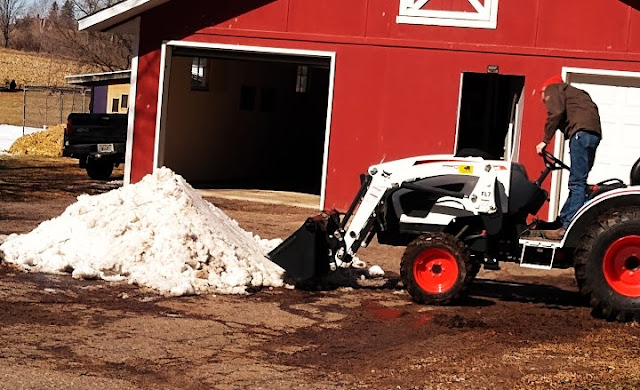


After the eruptions were finished the Sno-Cano and the pseudo lava were pushed away with the tractor. Leaving this interesting remnant for the neighbors to wonder about.

A bit of decaying taxidermy I spotted in a garage recently. I'd be worried if this thing swam up and bit me. And it looks quite capable of doing so.

