Wednesday, May 16, 2018

Brew from Scratch Project - Chapter One

I started home brewing in 1983.  I was living in South Dakota at the time and the beer options were few and not good.  "Old Dog's Head" was my home brew brand.  As is usually the case there were successes and failures but I always enjoyed the process.

Later I moved to Wisconsin.  And in parallel with that we began to enjoy a renaissance of small breweries that turn out magnificent ales and lagers.  I can interrupt my evening walk with a stop at a brewery right down the hill from me.  


But I am still interested in the brewing process and have decided to try a "total from scratch" process.  Grow the hops.  Grow and malt the barley.  I don't think I will carry a bucket of water up from the river but you never know.  The springs that fed the F.X. Schmidmeyer brewery are nearby and still running clear.  With some diligent boiling to deal with any microbes it might serve.


So over the next months you may have to endure a few updates.


First you have to grow stuff.


As part of an extensive back yard remodel I did have to consider pulling out the old fence.  But this section at least will be left up until fall.  I have for years been growing Cascade hops on it.  A few days before I took this picture I was squinting at the ground wondering where the hops sprouts were.  In about 72 hours they had grown a foot.


Hops are a good "crop" for a mediocre agriculturist to undertake.  Essentially a weed, it is probably hard to not get a bountiful crop after the vines have been established a few years.  And these have been growing every spring since I was last actively home brewing some 15 years ago.


Of course you need more than hops.  The absolute base ingredient of beer - well, other than wheat beer and such - is barley.  Again, very easy to grow, its essentially grass.  I bought a small bag with the following label.


I admit I had not known the Latin name for barley.  Back in my Roman archaeology days I have excavated around the periphery of a granary or "horreum".  So barley evidently is "common grain".   Maybe the granary was full of this.

I don't have a place to plant it but one of my sons has an acreage and is letting me till up a patch for the barley.  No doubt he'll accept payment in liquid form this fall.


Stay tuned.  

This is the first post in the Scratch Brew Project but the last post of this week.  Complicated travels and such.  Back with what I hope is interesting stuff on Monday. 

Monday, May 14, 2018

Postage Due

My world is by and large a happy place.  Robots zip about, sometimes with parts falling off.  My grandson has dubbed me "Naughty Grandpa", surely the highest honor to which a man could ever aspire.  I have the time, inclination and sturdy health to gallivant about the world, enjoying a tasty pint at the end of each adventuresome day.

But of course there are always a few darker notes.  It's just the way of things.

I've made only passing allusions to difficulties attendant to my parent's declining state. It is not a happy tale and one of the villains of the story is a voracious individual, in my opinion one of those social parasites who wears the mantle of Crusader for Rights while siphoning off the assets so painfully scraped together by elderly people who have no idea what the purpose or consequences are of the actions undertaken.   

The latest bit of unwelcome mail is more of the same.  Long winded, vaguely threatening, short deadline for me to consider whether to sign something.  And to add insult to, well, more insult, there was no return envelope for me to mail the form back.  I'm a tolerant person but when you leech away an obscene sum of money, I figure you can afford to pay fifty cents in return postage.

Well what's a guy to do.  The form has been screened for legal booby traps and tests clean, so it shall be signed and sent back.  I considered returning it postage due but decided instead to dig into the drawer of old but still legal postage stamps.  Lets see, got any combination that expresses my indignation at victimizing old people, making younger people people jump through endless hoops, and getting bloated and wealthy on the skimmed life savings of the Greatest Generation?


* To be clear, while I am griping specifically about the indignity of having to provide my own postage on a business correspondence, my comments are otherwise of a general nature.  My dealings with the financial service and legal industries as they relate to generational matters has been uniformly unpleasant.  Of the large cast of characters encountered along the way most - but not all - are competent.  And some - but not many - are of upstanding character.  They all get paid.

Friday, May 11, 2018

Middle School Robotics Spring of 2018 - Wrap Up.

My goal for this class was to give the middle school kids a taste of what it is like to build a FIRST level robotics project.  I'm prepared to call this a success.  Oh, there were some things that did not click.  The idea of building a robot with sensors and encoders, then having kids program for autonomous function was just a bit too much. We did have a FIRST drive frame and got a couple of kids tinkering with the real basics....drive ahead at such percent power for so many seconds....but the nature of software development is that it is hard to teach and given the logistics of an after school program and this age group, probably too much to shoot for.

To that end the idea of having a larger class on Tuesday doing mechanical and a smaller one on Thursday doing software was discarded almost from the start.  With software often stalled or at a point where perhaps one kid at a time could be taught the other kids on Thursday helped with the mechanical stuff.  And enjoyed it.  If I do this again it will be two medium sized groups and we'll blend hardware and software as we go along.

But there were plenty of things learned that were direct analogs of FIRST.

Last minute pit crew work.  As we drove out to show off the robot's functions it was noted that the left rear drive motor was not working.   With some supervision they had this swapped out in under ten minutes.


They also learned, I think, a bit about improvisation.  When the drive software continued to be difficult with regards to firing the dispensing mechanisms we simply swapped on a second control system, the obsolete one that we had used for test purposes.  With one student driving the robot and the other operating the pivot, solenoid and servo gate they attained reasonable operational competence in short order.

As the Tuesday group tidied up at the end of the day I asked them to come up with five ways that a project of this sort could encounter difficulties.  Their answers:

-Wire/connection issues
-Mechanical (motor) failure
-software issues
-User (student) error

I added Instructor error.  When the base level of skill is low it is inevitable that the project will be more directed by the teachers, and there were a few things I got wrong.

I'll finish with a few more photos and a couple short video clips.  I never know how well the latter turn out.   We expect to see several of these middle schoolers on the FIRST team in the near future, and while their technical skills are still rudimentary it is to be hoped that they have "learned how to learn" and will be formidable roboteers a few years down the road.

Carton dispenser loaded and ready.


Taking robot for a walk.  OK, basically just looking for classes to interrupt by driving in the door and handing out chocolate milk.  Which we then took back again!


Wednesday, May 9, 2018

Travel Prep Belgium

1. Language 

Belgium is a polyglot nation.  They speak - more or less - Dutch in the north and west, French in the south and east, and German in a small border enclave.  The Belgians have had a hard time welding these disparate communities into a cohesive nation.  In fact for a while they had no functioning Federal government at all, the various parts of Belgium just ran their own affairs.  Obviously most people speak more than one language.  I suspect that English is the most common second language, it being a useful and neutral back up option.  The close connection between Flanders and Great Britain likely makes this even more true where I will be.

But to be a courteous visitor I always attempt to have some ability to communicate in the local parlance.  I can stumble along in German which in turn is not too far from Dutch.  Its a shame I learned proper school German.  The "Pladdeuch" dialect that my dad grew up speaking is closer to Dutch, as the ancestral Wolters came from fairly near the German/Dutch border.

You Tube contains all matter of conversational German videos.  I have been chatting away for a while now.  Hopefully the problem I ran into in Italy will be less of an issue this trip.  Rome was so darned noisy that my over 60 ears had a hard time picking up subtle linguistic cues. (In truth I have a few issues even with spousal directives in English).  Rural Belgium should be better.  And I believe the crew I am working with will have all sorts of languages at their disposal.

2. Logistics 

Wonders of the internet.  Planes, trains and so forth are all arranged.  With google earth I have mapped out the hamlet I'll be staying in.  One restaurant, two bars, a grocery store, three ATMs.  There is a bus that goes into Ypres which at 5 miles away is just a bit past convenient strolling distance.  I'll be traveling alone this year which in some ways makes things easier.  I sometimes worry too much about travel companions and whether they are having a good enough time.  This will be sleep, dig, eat/drink, repeat.  Oh, and historic walkies on the in between weekend.

3. Eat/Drink

See above.  I have been doing my best to work up my tolerance to Belgian beer.  It is very tasty stuff but more alcoholic than the English ales I usually am quaffing on spring excavations.  I've also studied local menus a bit.  If you want to eat ox tongue great, but you should not order it by accident!
4.Boots 

I'd planned on taking Wellies.  The Ypres salient was notorious for deep, vile mud and Wellies were standard British equipment there.  That seems appropriate, as this style of boot really was popularized by The Duke of Wellington, or Arthur Wellesly as he was called when he defeated Napolean at Waterloo a ways north in Flanders.

I even got a new pair, these super light weight ones that would have packed so nicely.


Alas, the site requires steel toed safety boots.  A pair was acquired.  As the Shoe Outlet was having a buy one, second pair half off sale I just had to also get some lightweight "weekend walkers" to bring along as my other pair of foot gear.  So now I have two sets of new boots and a rather short time to break them in.  Twice a day walks now, once with each pair.  Up hills, down hills and if there is mud, straight on through.

5. Other prep

Well, what else can be done to prepare?  I'm heading off to get down into the trenches, to stand in places last occupied by humble soldiers.  They probably grumbled about the endless digging.  They likely thought their commanders were arbitrary and inconsistent.  But they were loyal soldiers, doing their duty without mutiny.

So, yes, I have been redoing the back yard and gardens per instructions by the High Command.

Monday, May 7, 2018

Time Capsule - The Shingle

As various extended family households begin to be "tidied up" there are boxes opened, trash and treasures revealed.  Time Capsule will be an occasional glimpse into these.  I'm not sure who might find them interesting but you could say that about most real time capsules dug up years later....

----------------------------------------------------------------------------


Today's artifact sits on a shelf in my living room.  But long ago it hung outside my father's medical office.


How long ago?  That's actually difficult to pin down.  He went to medical school during World War II on an accelerated program designed to turn out more military doctors.  He served in post war Germany and was still there during the Berlin Air Lift of '48 - '49.  He then returned to the States and did another year or two of training during which time he met a student nurse.  They married and some time in the early 1950's he started up a little practice in Minneapolis.  He "hung out a shingle" as the saying goes.  

And as you examine the sign more closely you can see that "shingle" is not far off the mark.  It is a simple board on which you can still see the saw cut marks.


The humble materials not withstanding this does seem to have been made by a professional.  I am always fascinated by little details and have studied this closely.  It looks to me as if the board was first painted black.  Then a thin coat of gold was placed over that layer or perhaps just over the lettering with a bit extra around the edges.  I think a thin layer of glue was then applied carefully and the sign coated with black grit....very much like what is on the shingles on your roof!  The white stuff peeking out here and there is probably the glue.

Below you can see all the layers, with the base black paint coming through in spots where the gold has worn off in the last 65 years.


The concept of "hanging out your shingle" is now just a familiar, archaic phrase.  But as you can see it was once literally true.  As an idiom it appears to go back at least as far as the 1830's and once applied more to lawyers than to doctors.  In each instance it carried on an older, European tradition of commercial signage, driven in part by prohibitions against doctors and lawyers advertising in earlier eras of our history.  With the proliferation of annoying ads (medical and legal being equally bad imho) this age seems to me as golden as the lettering on my dad's old sign.

Friday, May 4, 2018

Middle School Robotics Spring of 2018 - Chapter Four

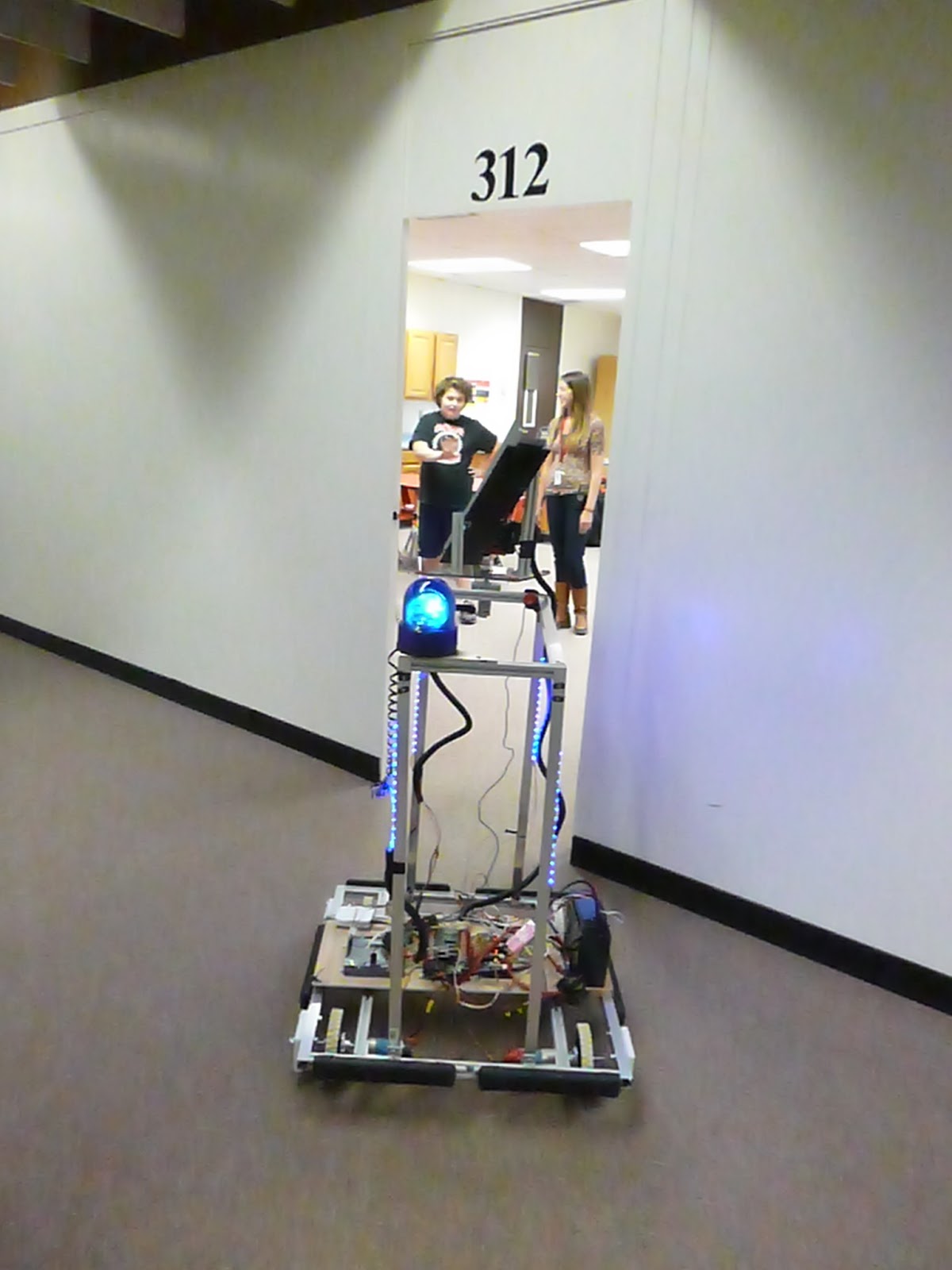
Robot with more Bling Lights.  Stringing up LED strips proved to be one of the more popular tasks.


Milk carton delivery sub system.  The red part is a servo holder left over from a prior FIRST robot.  It secures a large "quarter scale" servo.  This opens and closes a gate made of polycarb.  The mechanism above it is two car door locks.  These are actually little solenoids that push plastic holders in and out when the speed controller switches polarity.  This keeps the weight of the cartons next in line from pushing down on the gate, and also makes sure we don't deliver all six at once.  All parts have been tested and work, although we still have a minor alignment issue with one of the solenoids.


In these last pictures the robot is mechanically complete, although still having software issues.

Notice that the yellow flasher has been changed out for blue.  I had an extra dome and it fits the color scheme better.  Nice view of the mounted dispensing mechanism.

  .


Here's where the two solenoid plungers hold the second and third cartons in the tier in place so we only drop one at a time when the servo gate opens.

Those familiar with FIRST robotics know that all team members hate working on bumpers.  Just....hate 'em. Here I just had them stick on some of these padded strips.  We got a big box full of them from one of our sponsors when we did our benefit auction.


Although the dispensing mechanism won't come on line yet we do have drive capability.  Here "Big Blue" goes for a little cruise to visit other classes.  It was driving a bit sluggish.....only after we got back to the barn did I notice that one drive motor was disconnected.  Time for some more cable ties.


Wednesday, May 2, 2018

Time Capsule - Frank Quilici

As various extended family households begin to be "tidied up" there are boxes opened, trash and treasures revealed.  Time Capsule will be an occasional glimpse into these.  I'm not sure who might find them interesting but you could say that about most real time capsules dug up years later....

----------------------------------------------------------------------------

A undated picture from about 1965 or '66.


What I remember:

That's me in the Cub Scout uniform sitting next to a Minnesota Twins ball player named Frank Quilici.  He came over to our house after a fundraiser for the local Boys Club.  I recall that he gave a speech about how he grew up in a really tough neighborhood called "The Bucket of Blood".  That's the kind of detail that one remembers a half century later!  The picture also shows my older and younger brothers and the rear end of our dog White Tip.

What I can figure out

Quilici had a long career with the Twins.  He was a player, then a coach, then the manager for a while.  He even did radio play by play for a few years after that.  As to when this was taken it is a bit of a puzzler.  I am guessing '65 or '66 based on my size as compared to other dated pictures.  But Quilici was only called up in July of 1965 and then was sent down to the minors for all of '66.  I guess it could have been in the off season following the Twins appearance in the 1965 World Series.  It would be just like the notoriously cheap owner of the Twins, Calvin Griffith, to send a guy out on PR visits knowing he was not going to make the team again.  Or perhaps it was taken in '67 when Quilici made it back to the Twins.  I was always a skinny little kid.

What has changed, what has not

White Tip is long gone.  She had a good life and passed away when I was off at college. Frank Quilici is still around although I understand he has had some health issues.  His interviews seem more colored by the good times he had playing with great guys like Harmon Killebrew rather than by the frankly shoddy treatment he appears to have gotten from the organization.  My two brothers are also still alive and kicking.  I have about the same amount of hair.  They.....not so much.