Friday, November 11, 2011

St. Remy de Provence-hunting for Roman ruins

When Glanum fell on hard times during the late 3rd century many of the inhabitants seem to have just moved up the road a bit.  About a mile away at a road junction was some kind of settlement.  I have seen it described as a villa, a road stop or simply "an agglomeration".  Which basically means nobody knows for sure and there have not been any serious excavations. 

In part this would seem to be due to a general lesser interest level in late Roman activity in Gaul.  And of course there is an intact medieval town sitting on top of whatever Roman remains may exist at St. Remy.

The most notable medieval resident of the place was Nostradamus, who in 1503 was born here:
Oh, you can almost see young "Nosty" dreamily staring out the window, concocting those treasure hunting stories that have caused so much mischief ever since!

According to my trusty copy of The Roman Remains of Southern France there are two sites in the central portion of St. Remy where artifacts from Glanum are on display.  The first, the Musee des Alpilles seems to be a general purpose museum with some archeology stuff.  It is in the Hotel de Montdragon, Place Fevrier if you have time for a visit.  Across the square is the Depot Archeologique, housed in the delightfully named Hotel de Sade.

Yet another brief aside.  In this context "Hotel" meant not an inn with lodging, but the often ornate "in town" houses of wealthy aristocrats.  And yes, the Hotel de Sade was owned by that family if only by a bunch of distant relatives.  It now houses a cafe which looks quite nice thank you.

The Depot was supposedly open for hourly tours, but showed no evidence of this being the case.  Undeterred I squeezed past some obstacles down a narrow alley to peek at the Roman remains in its courtyard:

Traces of red tile from the heating system for the baths.

A mix of walls, old and older.  Note the large arch on the right side.

Peeking through the bars.

Now I started wandering about adjacent streets looking for late Roman work that was not in the guidebook.
Neat stonework below and slap-dash work above.  Probably built on a Roman foundation.
I found this rather haunting.  With stones always being robbed out and reused it can be hard to tell ancient from recycled, but this looks very much like an older, Roman archway that at some point in time was half walled up.  Perhaps the post Roman neighborhood was getting a little rough?  Then it got walled off completely, sealing out whatever unpleasantness lurked in the dark alleys of that age.

And another cut down archway.  What was going on here?  It recalls the arch seen behind the Hotel de Sade, but the larger arch has been chopped into by a smaller arch, a modern door and two windows on different levels of the building!

Wednesday, November 9, 2011

Glanum, Les Antiques

"Les Antiques" is the local name for two substantial Roman structures at the lower end of Glanum. 

photo credit:Marc Ryckaert


 These are respectively a mausoleum and a triumphal arch.  The arch is at the point where the road from Glanum and the main east-west road from Italy crossed.  The mausoleum is all that remains from the Glanum cemetery.

The arch is looking less triumphant than its original incarnation.  Go to Orange if you want to see a really first rate arch.  But the arch and the mausoleum both have some nice stone carving.
"Les Antiques" is a site that was never lost, mention of it can be found throughout the Middle Ages, and it was once the sort of spot travelers on the Grand Tour would stop at.  But it has an odd feel to it.  For one thing the stonework does not represent any specific event.  It appears to be just generic Roman soldiers lording it over generic barbarians.  So it is the equivalent of Roman stock footage.

The site also has a detached feel to it.  It is separated from Glanum proper by a busy modern road, and in fact it is next door to the car park for the site.  The archway gapes wide, but beyond it there is no sign of the road that once went through it....just a ravine that one assumes is the result of significant post Roman erosion.

The site has additionally suffered over the years from looting, as it was yet another of the places where Nostradamus cryptically hinted at buried treasure.  Nostradamus lived just up the road in St. Remy, and knew the site well.

Another undoubted visitor to the site regrettably must have been unimpressed with it.  Just across the road, in a medieval building partially made of robbed out stones from Glanum, Vincent Van Gogh spent the most troubled, but also the most artistically productive year of his life there.  Here is a listing of the paintings he did while confined at the Saint-Paul-de-Mausole asylum.  The place was of course named for the mausoleum shown above.

But did Van Gogh bother to do a single canvas depicting any Roman relics?  No he did not.  And the worlds of art and of archeology are the poorer for it.

Tips to visit.  "Les Antiques" are just sitting by the side of the road.  Supposedly you pay to park but there was nobody collecting money.  It is an easy walk, but with narrow road shoulders, from St. Remy about a mile away.  The Saint-Paul-de-Mausole asylum is also open to visitors.  There is an admission fee.  You can see some interesting depictions of scenes as Van Gogh saw them and compare to the current day.  There is also a Roman quarry near the site.  In the center is an isolated pillar 23 meters high.  It is felt that Roman stone cutters left a section au natural to show how much stone they had excavated over the years.

Monday, November 7, 2011

Glanum

Glanum is often described as being the best preserved Gallo-Roman site.  That's kind of true, but I think it is more accurate to say that it is one of the few Gallo-Roman sites that could be properly excavated, as it was more or less abandoned in the 3rd century AD.

It has a long history, even for this rather ancient part of the world.  First settled in the 6th century BC it seems to have grown up where a road through the mountain pass happened to be near a reliable spring.  It started out as a strictly Gallic site, then it was influenced by Greeks from Marsailles, and finally the Romans took it over.  A remarkable number of elaborate public buildings sprang up, they in fact seem far out of proportion to the residential base.  Finally in the late 3rd century things fell apart.  The empire was being buffeted by civil war, economic collapse and barbarian incursions.  Basic maintenance of the drainage system broke down and a flood obliterated much of the site.  The residents moved, some up the road to the site of modern day St. Remy, others lived on site in much reduced circumstances.

The site is about a mile south of St. Remy.  The best way to visit is to enter through the visitor center at the north end, then walk clear through the site to the higher south end.  Then turn back and study more carefully. This allows you to see the site more or less as it evolved over time.

Among some very early residential structures at the top of the site is this puzzling structure.  Initially thought to be hypocaust heating, the clay tiles are felt to be involved in smoking wine as a preserving tactic.

The sacred spring.  Now inhabited by gold fish.

Looking up towards the top of the site.
Like most Gallo-Roman sites Glanum had its inspiration in a local water deity.  In this case, Glan.  Here is a nifty altar dedicated to Glan, the Glanicae (sort of Glan's heavenly back up band) and Fortuna Redux.  It was dedicated by a soldier of the XXI Legion on safe return from a journey.  VSLM, dude.

An impressive drain system under the main road.  Pretty much essential if you decide to build in a ravine.

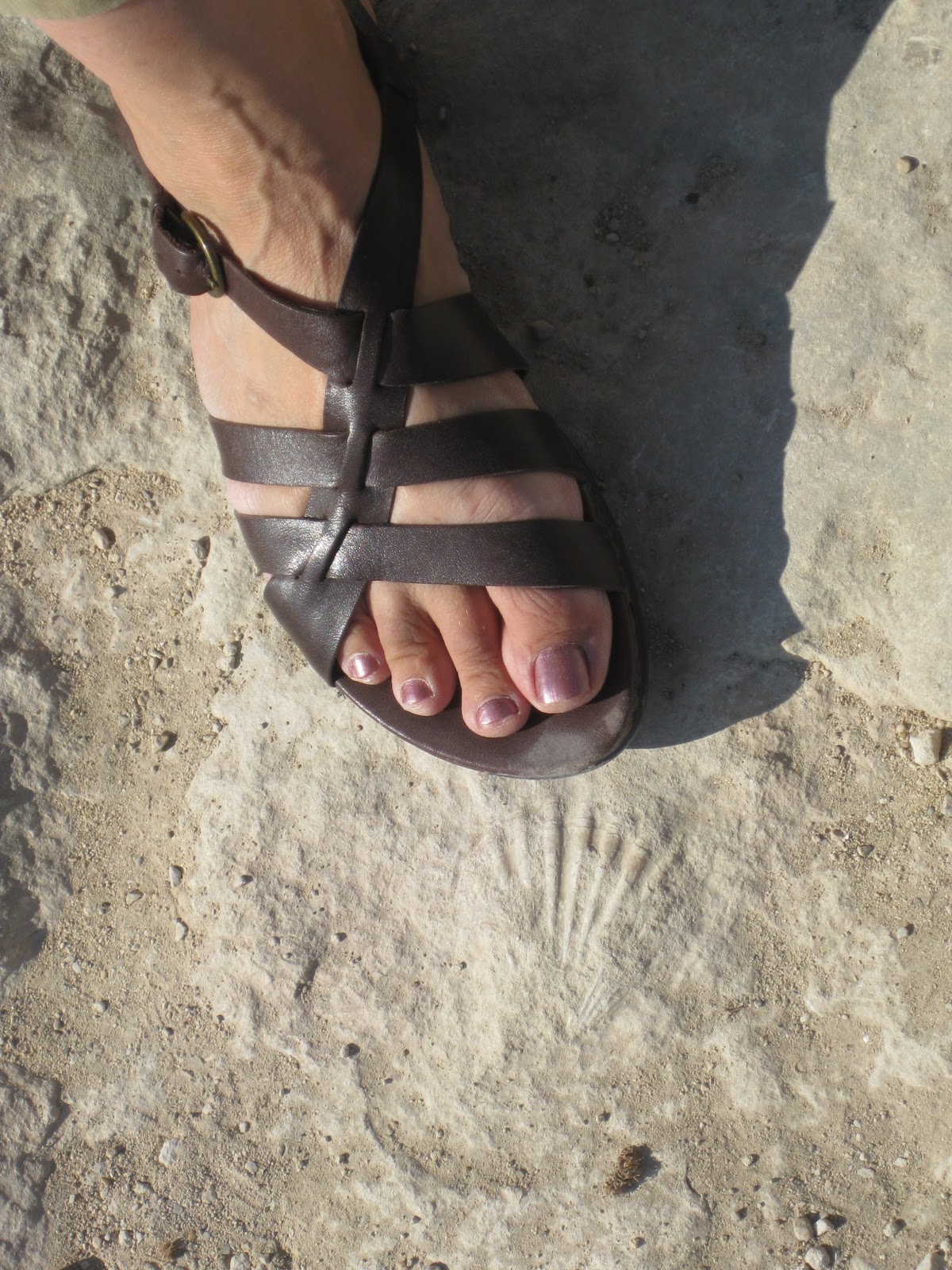
Everything is made from limestone, quarried nearby.  Nice fossils to be seen.  I wonder what the Romans thought of them?
One of the "Gemini Temples" two structures felt to be dedicated to Lucius and Gaius, the adopted sons of Augustus.  The columns did not survive antiquity, and have been restored.
Looking down the site, Gemini Temples with the open Forum plaza behind.

An ornate water spout from the public baths.  It reminded me of a similar feature in Bath, England.  The water in this case did not fill the actual bath but rather a fountain in the exercise area of the baths.

Glanum was an interesting site, but had an odd feel to it.  The religious and public buildings outnumbered and physically dominated the actual housing.  It would have been interesting to be there when excavations were in progress, as I believe is still the case most summer seasons.

Friday, November 4, 2011

Mysteries of France-Super Hero division

From my wandering observations:
A rather un-super looking fellow.  As best I can figure out this is an old fashioned poster that directs you to a web site.  It seems to be political cartoons.

A sign outside a clinic.  I'm sorry, but if you want people to feel good about getting immunizations a picture of you wearing a "weasel-squeezer" spandex suit while holding a six foot tall harpoon of a syringe is not going to do that.  I also note that there is no logo or emblem on the chest.  GenericMan.
Udders, but massive biceps and a lantern jaw on this cow.  Say, there's no added hormones in this beef, are there?

More of a Super Villain I guess.  Pripiat is a big mysterious swamp in Russia.  Maybe he comes from there?

Thursday, November 3, 2011

Obelisk Extra Credit

My posting on Obelisks and Empire was already running long and wandering a bit, so here are a few bits of obelisk trivia that did not fit in well.

Burial Legends

The obelisk at Vienne served the typical purpose, marking the finishing line at the Circus, or Hippodrome.  Somehow in the superstitious middle ages the rumor got around that Pontius Pilate was buried there!  A search was undertaken, but it is not clear from the records if this involved digging underneath it or actually disassembling the multiple stones that make up this non-monolithic structure!


On the subject of possible burials and obelisks, there was a longstanding rumor that the ashes of Julius Caesar were housed in a metal ball atop the Vaticano obelisk.  This had been brought to Rome by Caligula  in AD 37 and placed in the Vatican Circus.  The obelisk was moved in 1586 and the ball examined.  It held  nothing but dust.  This is the only obelisk in Rome that has never fallen.   

Did the legend of Julius Caesar being buried atop an obelisk influence the design of the Washington Monument?  Two Fathers of their respective Countries.....

Moving the Darned Things

The Romans transported the obelisks from Egypt using specially built "obelisk ships".  Two large cargo ships held the obelisk tied between them and submerged.  A third ship was secured in the lead position as guide ship and for additional rowing power.  Must have been hard rowing...Obelisk Ships

A somewhat similar method was used to bring the so-called "Cleopatra's Needle" to London.  A special iron cylinder some 92 feet long and 16 feet in diameter was constructed.  Dubbed "Cleopatra" this was a sort of floating dock that would be towed all the way to England.  While under tow in October of 1877 a storm came up.  Despite the efforts of the crew, five of whom drowned in attempts to save the "Cleopatra", the floating dock broke loose and was feared lost.  Remarkably it stayed afloat and was salvaged four days later.

When Cleopatra's Needle was erected in London a time capsule was placed under it.  Among other things it holds photographs of what were felt to be the 12 most beautiful women in England.

The obelisks in New York, London and sometimes Paris are all referred to as Cleopatra's Needle.  Even though the best evidence is that they are at least a thousand years older than Cleopatra.

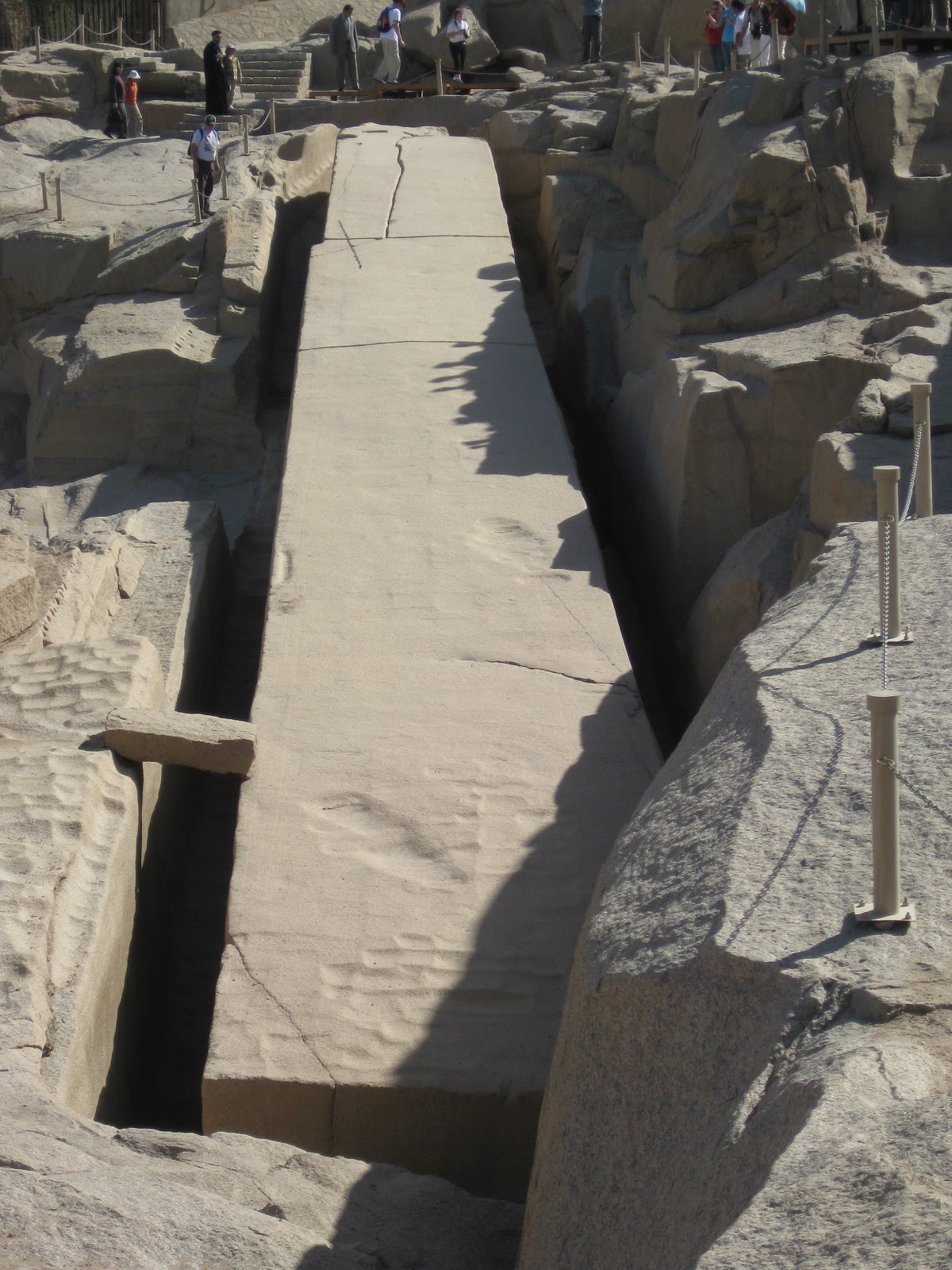
The biggest Egyptian obelisk of all is still lying in its quarry at Aswan.  The Unfinished Obelisk was half way done when it was found to have cracks that would doom any attempt to raise it.  I saw this on a trip three years ago. It does not appear to be going anywhere.
Egyptian stone workers by the way did not have the benefit of any useful metal tools.  They tediously pounded away at the hard rock with even harder rock, round balls of volcanic basalt.  I am guessing that the unimaginable man-hours that went to waste when the above obelisk was written off caused howled curses that slightly disturbed even the pickled sleep of the pharoahs.

A snoozing dog near the foot of the unfinished obelisk.  An interesting contrast in priorities. 

Wednesday, November 2, 2011

Say....that's a nice obelisk over there.....

As mentioned recently a common feature of most Roman Circuses was an obelisk.  In addition to the Arles specimen here is another Gallo-Roman site, Vienne south of Lyon.
And a link showing what is known about the Circus there.  Vienne

As a finish line marker an obelisk is certainly effective, but they are awfully difficult to move about, and the same objective could likely have been attained with perhaps 0.1% of the effort by just having some sort of flag pole do the job.  So, what's the deal with the obelisks?

It all goes back to Augustus.  Even casual students of Roman history will recall that he had a falling out with Mark Anthony who fled to Egypt and to the embrace of Cleopatra.  This was problematic in both a practical and a symbolic sense.  Cleo years earlier had a fling with Julius Caesar that produced a son and possible rival to Augustus.  Augustus you may remember was adopted postumously by Caesar, who was his great uncle.  A more direct heir with a royal mother could be a problem.

So in addition to the usual brutality of conquest in the ancient world there were some personal issues at stake.

So fine, after conquering Egypt Augustus felt like taking home some tangible trophy.  Oh, he could pick something small and portable, as Egypt is just chock a block with good statuary.  But no, he chooses this:

photo credit:http://www.flickr.com/photos/76204898@N00

24 meters tall without the later base.  Yes, Augustus found the most phallic public symbol in the newly conquered province and lopped it off, effectively saying that he had emasculated the opposition.  He also had the potential dynastic rival quietly dispatched .

Am I being a little overly dramatic?  Perhaps being a little Freudian 18 centuries early?  Lets look at some other official imagery of Roman conquest, the series of Judea Capta coins minted to crow about putting down a pesky rebellion in a part of the world that has been in ferment ever since...

Here we have a dejected maiden representing Judea, and a soldier demonstrating, uh, well, The Glory of Rome.

Too subtle?  Here is another version:

This mold maker had a economical sense of design, he just made the tree trunk into the phallic element.  Nice addition of the coconuts by the way.  Judea does not look happy. Anyway, you catch the drift, and more to the point so did anyone who had a notion to cross swords with the legions.

Augustus actually hauled back two obelisks, one for the spina of the Circus Maximus and the other as a sundial in the Campus Martius.  Later emperors all wanted to emulate Augustus, so the pilfering went on for centuries.  All told there are eight ancient Egyptian obelisks in Rome, about as many as in Egypt proper, and there are also a number of Roman copies of same.  More on this here.

Genuine ancient Egyptian obelisks were not all that numerous.  There are only 29 or 30 of them, it depends on how you count unfinished specimens.  Other sites around the Empire generally had to settle for copies.  The final tally of where the authentic Egyptian ones ended up appears to be: 

Still in Egypt-9 although it is felt that several more sank on transport down the Nile.
Italy-11, with 8 in Rome.  Most set up at the Circuses, others at temples.
Isreal-1, Herod the Great set one up in his Circus
Turkey-1, set up in the Constantinople Circus by Theodosius the Great
There are several smaller ones in museums, three in the UK, one on temporary loan in Poland.


And then there are the three "neo-Imperial" obelisks, set up to echo the greatness of Rome and Augustus.

Modern Imperialism is a little bit nicer.  In ancient times the script was something like this:

"We are Rome.  We just thrashed you soundly.  We are taking that obelisk".

The modern, civilized script ran:

"We are your very powerful friend.  We could thrash you soundly any time we felt like it.  It would make us happy if you offered us an obelisk.  You would like to do that, wouldn't you?"

It probably helped that the Ottoman officials in charge of things in the 1800s were famously susceptable to private financial incentives.

The British were first.  In 1819 the local Ottoman governor offered an obelisk to England in recognition of Nelson's victory at the Battle of the Nile.  There it sat as nobody could figure out how to move the darned thing. 

Meanwhile the French, not happy with being reminded about Lord Nelson, talked the Ottomans into gifting not just one but two obelisks in 1829.  It took four years to move one to Paris, with an effort so draining that the engineer in charge refused to touch the second one. 

Having perhaps learned a few things from the French effort, the British moved "their" obelisk in 1877, but not without much effort and some loss of life.

Finally those late comers to the world scene, the Americans got interested.  Considering New York to be a world class city the equal of London and Paris, a new record for obelisk acquistion was set...from polite wheedling, through baksheesh, to dedication in Central Park in only three years. 

As it happens, obelisks do not fare all that well when moved.  The London specimen was damaged by German bombing in World War One.  The Paris example has suffered several indignities including being covered with a giant pink condom by protesters and being climbed by daredevil tightrope walker Alain "Spider Man" Robert.  And the New York obelisk is being eroded by urban pollution so badly that the Egyptian goverment-before being distracted by the revolution-was saying they wanted it back if we were not going to take better care of it!

Tuesday, November 1, 2011

Regarding The Vindo Landa Rush, Carpenters and Sooners

This, as seen on a sestertius, is a carpentum.  It was a two wheeled covered wagon usually pulled by mules.  Incidentally, our word for cart is a simple contraction of carpentum, and since they were made of wood our word for carpenter descends from this source.  Perhaps from the intermediate step of a maker of carpentums; no doubt with a common source of "carpe" or to grasp as for instance, a tool. 

Anyway....
This is an image of the Oklahoma Land Rush, actually one of several events where previously off limits land was opened up for settlers at a designated time.  Wagons, looking much the same but with four wheels by now, lined up at the border and at the designated time folks rode hell for leather to stake claims on the best locations.

Sometimes they got there and found the prime sites already occupied by folks who snuck in illegally and early.  This has entered American lore, and these industrious cheaters are recalled as "Sooners".  This is also the name of the University of Oklahoma's football team.  One would imagine endless offsides penalties, but they actually have been very successful over the years.

So, what is the end destination for the above linguistic wanderings?  Clearly I am not riding all out to stake a physical claim someplace.

The point is this.  At exactly noon Greenwich Mean Time, November first, the on line registration for the 2012 Vindolanda excavation season goes live.  This "virtual" Vindo Landa Rush gets more intense every year.  For the 2011 season 75% of the 600 spots vanished in the first 12 hours.  This included pretty much all of the more desirable slots in June, July and August.  Certainly a far cry from my first season...I recall signing up in January of 2008 to go digging in May of that year!

Hopefully all goes well.  (Rumor has it that a computer glitch did allow a few "Sooners" for the 2010 season!).  I know that a few feelings were bruised and plans altered last time around when folks had some unavoidable delay at getting to their keyboards.

So wish me luck, I will be aiming for my usual two weeks in early May, a time when Northumberland is green and perfect, when the curlews are making a racket, and when mysteries await the trowel.

(scheduling this to post at precisely noon GMT!)