Bill, my prized taxidermy squirrel was created at a shop called Dreaming Badger. It is a little out of my usual route but the other day I was passing by with a few minutes to spare.
They have a lot of bears.
As to why it was effectively a Bull Market for Bears the owner indicated that several of these had become without homes due to spousal refusal to have them about. In one instance there was a divorce involved.
And there was other stuff too.
I found the raccoon to be a little alarming. I am sure it was supposed to look as if it was poking its head out of a hole in a tree trunk. But the actual effect looked more like a hideous raccoon-fungus hybrid.
Finally, speaking as one who has been closer than you should get to a live moose, here is what a stuffed one looks like close up.
Yes, I do like me some taxidermy. Maybe the existing bear skin rug - a ridiculous bargain at an antique shop - needs an upgrade.
Wandering unsupervised in various real and imaginary places. Detritus reflects my interests in robotics, travel, history and the odder aspects of the world around me.
Monday, July 7, 2014
Friday, July 4, 2014
A Road Trip to Darwin's Playground
A new Affiliate Member of the family is one smart cookie. We recently went down to be there for her PhD defense. Just to show support you know. I would not actually leap up and punch any members of the examining committee for asking mean questions. My wife might have but none were forthcoming.
On the drive down we saw this interesting vehicle pulled into a gas station.
We made sure to leave before they did. It is not a trailer you would want to be following at highway speeds, just in case the back door jolted open.
The Defense was held in the building where she has had her office for the last couple of years.
It is pretty impressive....most of the areas require a key card to enter, and on the top floor is some kind of biology research unit for NASA. Maybe that helps explain the interesting statue collection out front:
The collection is titled "Darwin's Playground" and is the work of a Chicago artist called Tony Tasset. They seem to have originally been called "The Blobs" which does do them justice. They require occasional scrubbing and have needed some holes drilled to drain off water, otherwise they accumulate various molds and algae that are a little too concrete a representation of Life.
One grad student claimed that they were inspired by the shape of ribosomes. I think it more likely that they are just weird creations designed to frighten new undergrad researchers into cleaning their Petrie dishes diligently. "You know, the last time the lab got that grubby things got a little out of hand...."
A whimsical side light to a day filled with proud accomplishment. I am now demoted to being maybe the 5th or 6th smartest person in the family and that is excluding Bruce the Dog on the technicality of his not being an actual person.
On the drive down we saw this interesting vehicle pulled into a gas station.
We made sure to leave before they did. It is not a trailer you would want to be following at highway speeds, just in case the back door jolted open.
The Defense was held in the building where she has had her office for the last couple of years.
It is pretty impressive....most of the areas require a key card to enter, and on the top floor is some kind of biology research unit for NASA. Maybe that helps explain the interesting statue collection out front:
The collection is titled "Darwin's Playground" and is the work of a Chicago artist called Tony Tasset. They seem to have originally been called "The Blobs" which does do them justice. They require occasional scrubbing and have needed some holes drilled to drain off water, otherwise they accumulate various molds and algae that are a little too concrete a representation of Life.
One grad student claimed that they were inspired by the shape of ribosomes. I think it more likely that they are just weird creations designed to frighten new undergrad researchers into cleaning their Petrie dishes diligently. "You know, the last time the lab got that grubby things got a little out of hand...."
A whimsical side light to a day filled with proud accomplishment. I am now demoted to being maybe the 5th or 6th smartest person in the family and that is excluding Bruce the Dog on the technicality of his not being an actual person.
Wednesday, July 2, 2014
York - The Roman Dead
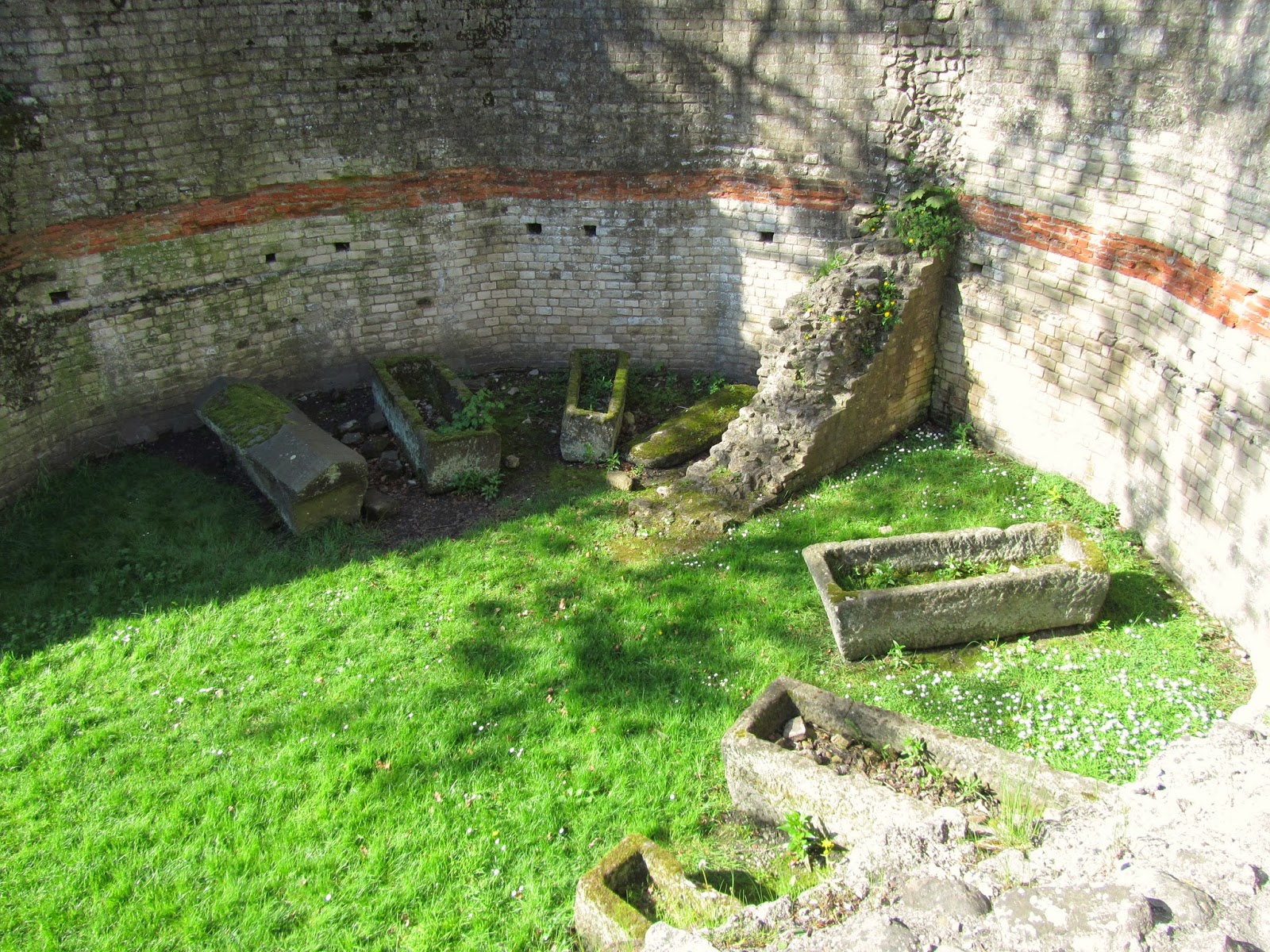
In my recent post on Roman Remains in York I gave you a teasing glance at the inside of the Multangular Tower, once one of the main bastions in the defenses of "Eborucum". There you saw a bunch of sarcophagi scattered about.
Lets get this straight from the outset, the Romans did not bury their dead inside their cities or forts. This was forbidden by the oldest of their laws and seems to have been a universal dictate. The rare exceptions can safely be assumed to be murder victims such as the body found at Vindolanda a few years back. So, absent skulduggery*, no dead Romans inside of settled areas. So what gives?
Just this. When York was expanding in the 19th century the area outside the old town was being heavily built up. This is where the numerous Roman cemeteries actually were. People kept finding sarcophagi. And giving them to the local Museum. Some of these were marvelous, finely decorated artifacts. Most were of the "gee thanks, another sarcophagus" plain variety. Some of the former were put on display in the Museum or held there in storage. Most of the latter were left scattered around the Multangular Tower and the adjacent St. Leonard's Hospital.
But apparently in 2011 a decision was made to spread the sarcophagi around a bit. Oh, we still have some by the Tower:
And in the Museum Gardens:
And a very nice assemblage including three from a disused storage tunnel under the museum. This bunch has been set up on a former bowling lawn in a pattern felt to be reminiscent of an actual Roman burial site:
There is something fascinating about sarcophagi. For one thing they are an interesting cultural bridge across a very long stretch of time. The Romans borrowed the concept from the Egyptians. And since it was the form of burial in vogue in the Late Empire it got adopted by the early Christian church and carried on into the Middle Ages.
The grouping above has some especially nice specimens.
This one was for Julia Victorina and her 4 year old son Constantius. It was provided by her husband Septimus Lupianus a veteran centurion of the VI Legion.
A sarcophagus for Aurelius Super, Centurion of the VI Legion. Provided by his wife. This one was found near the previous example in a burial ground near Castle Yard. It is speculated that there was a burial club for Centurions and their families. Note the two part lid. Several of the sarcophagi had these and with lines too straight to be mere breaks. I doubt they would follow our custom of keeping the top part open for viewing at a funeral, but it makes an interesting parallel to modern coffin design.
A rather nice specimen. The inscription says it was supposed to house a woman named Aelia Severa. But when it was found it had a male skeleton inside it suggesting reuse. This is not the original lid, they borrowed one off another sarcophagus in their collection. The letters DM appear on both top and bottom. This stands for Dis Manibus. It translates to "for the Manes". In Roman theology the spirits of the dead would become Lares if they had been good, or Manes if they had a mixed record. Bad men became malign spirits called Larvae or Lemures. Interesting thought number 1: we have adopted these last two names for somewhat unlovable creatures that live in dark places.** Interesting thought number 2: in the Roman schema it appears you expressed hope for the equivalent of the Christian purgatory rather than heaven! Perhaps in a society where dead Emperors were often deified it was considered presumptuous to aim for the top spot?
A nice example of the "two part lid".
On a lot of sarcophagi you saw these sets of holes. Sometimes one, sometimes one on each side. They were used to anchor metal brackets that held the lids on tight. A lot of these sarcophagi were actually above ground, and one would not want grave goods pilfered. Or your loved one tossed out to make room for a clandestine burial.
I like sarcophagi. They are the sort of ancient artifact that we can still relate to. Their functionality has endured, and has perhaps even influenced the design of our modern day coffins. They seem to have survived from antiquity in substantial numbers, they are just so darn sturdy. No doubt quite a few of them around the former Roman Empire are doing duty as a planter, as seen above, or as an animal watering trough in some rustic locale.
-------------------------
* I had always assumed that the term "skulduggery" had something to do with digging up skulls. Not so at all. It is a derivation of a fairly modern Scottish word skuldudrie that means adultery. Who knew?
**This per the late and somewhat opinionated Christian writer Augustine of Hippo. There are a lot of variations on this general scheme from other writers.
Lets get this straight from the outset, the Romans did not bury their dead inside their cities or forts. This was forbidden by the oldest of their laws and seems to have been a universal dictate. The rare exceptions can safely be assumed to be murder victims such as the body found at Vindolanda a few years back. So, absent skulduggery*, no dead Romans inside of settled areas. So what gives?
Just this. When York was expanding in the 19th century the area outside the old town was being heavily built up. This is where the numerous Roman cemeteries actually were. People kept finding sarcophagi. And giving them to the local Museum. Some of these were marvelous, finely decorated artifacts. Most were of the "gee thanks, another sarcophagus" plain variety. Some of the former were put on display in the Museum or held there in storage. Most of the latter were left scattered around the Multangular Tower and the adjacent St. Leonard's Hospital.
But apparently in 2011 a decision was made to spread the sarcophagi around a bit. Oh, we still have some by the Tower:
And in the Museum Gardens:
And a very nice assemblage including three from a disused storage tunnel under the museum. This bunch has been set up on a former bowling lawn in a pattern felt to be reminiscent of an actual Roman burial site:
There is something fascinating about sarcophagi. For one thing they are an interesting cultural bridge across a very long stretch of time. The Romans borrowed the concept from the Egyptians. And since it was the form of burial in vogue in the Late Empire it got adopted by the early Christian church and carried on into the Middle Ages.
The grouping above has some especially nice specimens.
This one was for Julia Victorina and her 4 year old son Constantius. It was provided by her husband Septimus Lupianus a veteran centurion of the VI Legion.
A sarcophagus for Aurelius Super, Centurion of the VI Legion. Provided by his wife. This one was found near the previous example in a burial ground near Castle Yard. It is speculated that there was a burial club for Centurions and their families. Note the two part lid. Several of the sarcophagi had these and with lines too straight to be mere breaks. I doubt they would follow our custom of keeping the top part open for viewing at a funeral, but it makes an interesting parallel to modern coffin design.
A rather nice specimen. The inscription says it was supposed to house a woman named Aelia Severa. But when it was found it had a male skeleton inside it suggesting reuse. This is not the original lid, they borrowed one off another sarcophagus in their collection. The letters DM appear on both top and bottom. This stands for Dis Manibus. It translates to "for the Manes". In Roman theology the spirits of the dead would become Lares if they had been good, or Manes if they had a mixed record. Bad men became malign spirits called Larvae or Lemures. Interesting thought number 1: we have adopted these last two names for somewhat unlovable creatures that live in dark places.** Interesting thought number 2: in the Roman schema it appears you expressed hope for the equivalent of the Christian purgatory rather than heaven! Perhaps in a society where dead Emperors were often deified it was considered presumptuous to aim for the top spot?
A nice example of the "two part lid".
On a lot of sarcophagi you saw these sets of holes. Sometimes one, sometimes one on each side. They were used to anchor metal brackets that held the lids on tight. A lot of these sarcophagi were actually above ground, and one would not want grave goods pilfered. Or your loved one tossed out to make room for a clandestine burial.
I like sarcophagi. They are the sort of ancient artifact that we can still relate to. Their functionality has endured, and has perhaps even influenced the design of our modern day coffins. They seem to have survived from antiquity in substantial numbers, they are just so darn sturdy. No doubt quite a few of them around the former Roman Empire are doing duty as a planter, as seen above, or as an animal watering trough in some rustic locale.
-------------------------
* I had always assumed that the term "skulduggery" had something to do with digging up skulls. Not so at all. It is a derivation of a fairly modern Scottish word skuldudrie that means adultery. Who knew?
**This per the late and somewhat opinionated Christian writer Augustine of Hippo. There are a lot of variations on this general scheme from other writers.
Monday, June 30, 2014
Roman York - Cows and Conservation
Akin to many early English and Continental cities York inherited a very sturdy city wall around its central core. These walls were of vital importance during the restless late Roman and Dark Ages, and continued to be of defensive value well into early modern times.
But when urban life started to get busier in the late 1700s, many cities decided that a course of walls with limited access points was in fact a negative, a drag on modernization and prosperity. So many fine Roman and medieval monuments were smashed down unceremoniously.
In the case of York the walls were of course in disarray. The fortifications of the great Roman fortress had deteriorated dramatically by the time the Vikings showed up. And as to what happened in between, the time of the Anglo-Saxons was almost entirely unknown. Of course medieval building on top of the earlier stuff, then a long gentle decay had caused the walls of York to be a mish-mash of stonework and crumbling ruins.
So it was not surprising that the city fathers applied in 1800 for an Act of Parliament to knock the walls out entirely. What was surprising was the degree of emphatic resistance on the part of far sighted preservationists. Their efforts were not entirely successful, some 300 yards were torn out anyway, but the coherent sense of York as an ancient place is largely intact today, with a fine display of restored walls upon which one can walk and enjoy the city view. Tourism dollars and pounds have certainly far exceeded any short term gain that could have come from wholesale demolition.
Also, a spirit of inquisitiveness was established. People actually thought about what they were seeing in front of them.
By 1839 York was starting to wake up in earnest. That was the year that the railroads came. By some accounts that was also the year that a tunnel was to be dug through the course of the city walls near the old St. Leonard's Hospital. (I have also seen 1842 quoted, and it seems more likely).
The purpose of this tunnel is obscure in the on line sources I have encountered, but my tour guide in York last April gave this version.
At this point in time keeping livestock in the city was common. A farmer had a shed near the earthen berm that was what the city wall had become. He wanted to make a tunnel so that his cows could exit the city to grazing land without having to traipse through the streets. Workmen were employed.
But they came across the foundation of a stone tower. Rather than bash on they stopped, and local antiquarians were called in. The structure was of ambiguous age, but was felt to be from the mysterious interval between Roman and Viking eras. It has been dubbed "The Anglian Tower" for this reason. In fact it sits on Roman foundations and probably was a late Empire structure refurbished by the Angles.
I got a couple of photos of the site, and consider it good fun to try and correlate the images with the history. I can't promise perfect clarity. Neither the morning sunlight nor the Light of History are ideal in this spot.
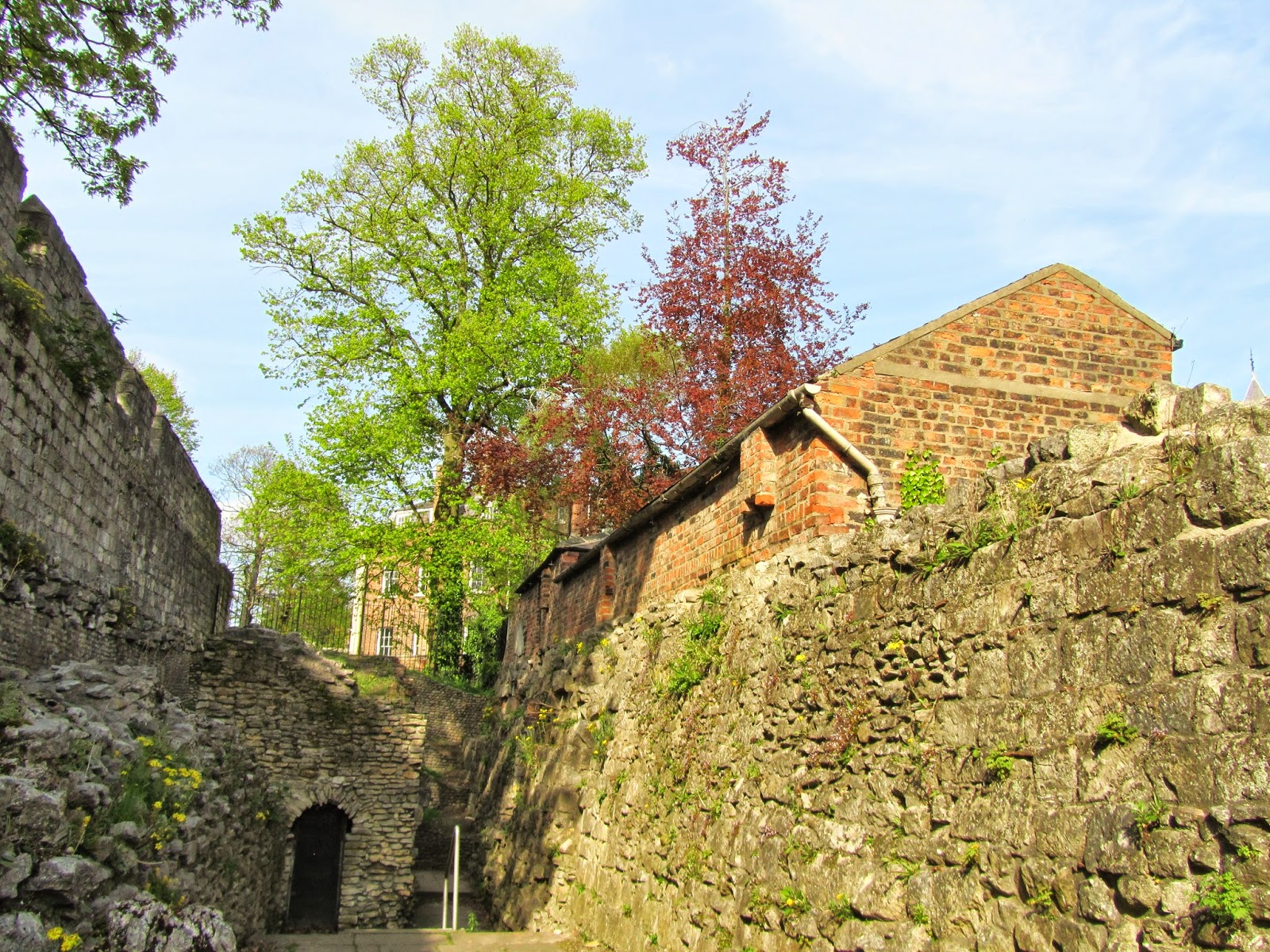
Brick cow shed on the right. Medievial city wall on the left. The stubby structure in the middle is the Anglian Tower. Recall that in the early 1800s ground level would have hidden the tower entirely.
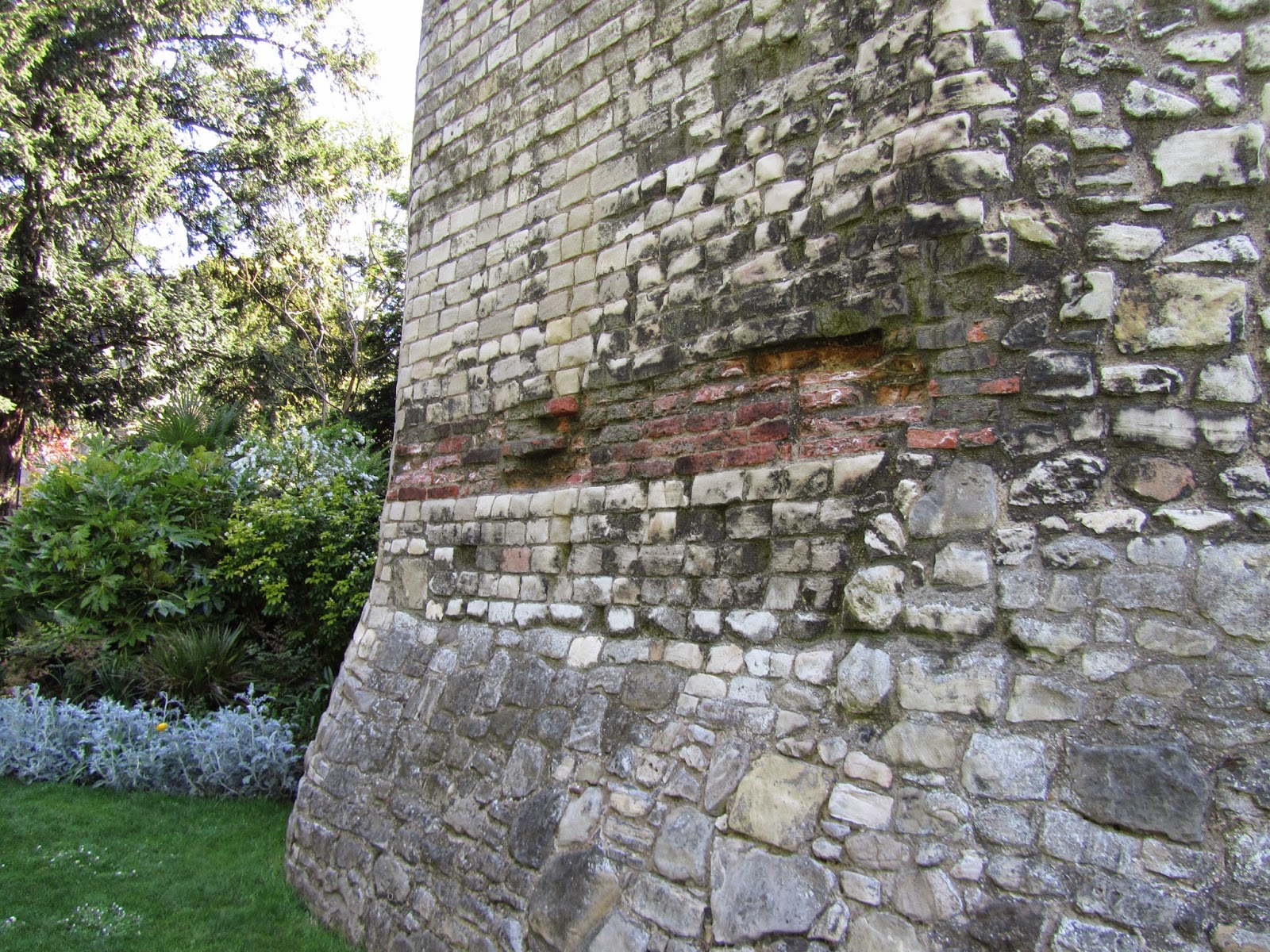
Close up of the Anglian Tower. The lower levels were excavated in 1970. Many confusing and confounding wall structures of variable dates were exposed. A plaque on the site mentions that one of the excavators, a certain Jeffery Radley, was killed in an accident on the site that summer.
Just to the right of the Tower, set into the brick wall of what looks like the lower level of the "cow shed" we see this:
I am assuming that this was the proposed exit for the bovines. The archway is of indeterminate age and seems to be slopped together from brick and stone. It looks to be about one cow width in size.
As per my earlier mea culpa, details on this site are hard to come by. Some sources indicate the tunnel was a more ambitious venture, not just an impractical way to get to the pasture. Some sources date the excavations on this site to 1969 instead of 1970. And as to the dating and use for the Anglian Tower, well just don't go there. Go Here I guess.
But it is a fine, quiet little spot. Almost nobody goes there. I think most with an interest in the Roman Remains never get past the more famous Multangular Tower which is to be found a short distance away. I think that has been sufficiently written about and photographed so will leave you with only one image and one thought...
Ummmm...the Romans didn't really bury people under their defensive tower, did they? Well of course not. On that topic, lets talk. Next posting.
But when urban life started to get busier in the late 1700s, many cities decided that a course of walls with limited access points was in fact a negative, a drag on modernization and prosperity. So many fine Roman and medieval monuments were smashed down unceremoniously.
In the case of York the walls were of course in disarray. The fortifications of the great Roman fortress had deteriorated dramatically by the time the Vikings showed up. And as to what happened in between, the time of the Anglo-Saxons was almost entirely unknown. Of course medieval building on top of the earlier stuff, then a long gentle decay had caused the walls of York to be a mish-mash of stonework and crumbling ruins.
So it was not surprising that the city fathers applied in 1800 for an Act of Parliament to knock the walls out entirely. What was surprising was the degree of emphatic resistance on the part of far sighted preservationists. Their efforts were not entirely successful, some 300 yards were torn out anyway, but the coherent sense of York as an ancient place is largely intact today, with a fine display of restored walls upon which one can walk and enjoy the city view. Tourism dollars and pounds have certainly far exceeded any short term gain that could have come from wholesale demolition.
Also, a spirit of inquisitiveness was established. People actually thought about what they were seeing in front of them.
By 1839 York was starting to wake up in earnest. That was the year that the railroads came. By some accounts that was also the year that a tunnel was to be dug through the course of the city walls near the old St. Leonard's Hospital. (I have also seen 1842 quoted, and it seems more likely).
The purpose of this tunnel is obscure in the on line sources I have encountered, but my tour guide in York last April gave this version.
At this point in time keeping livestock in the city was common. A farmer had a shed near the earthen berm that was what the city wall had become. He wanted to make a tunnel so that his cows could exit the city to grazing land without having to traipse through the streets. Workmen were employed.
But they came across the foundation of a stone tower. Rather than bash on they stopped, and local antiquarians were called in. The structure was of ambiguous age, but was felt to be from the mysterious interval between Roman and Viking eras. It has been dubbed "The Anglian Tower" for this reason. In fact it sits on Roman foundations and probably was a late Empire structure refurbished by the Angles.
I got a couple of photos of the site, and consider it good fun to try and correlate the images with the history. I can't promise perfect clarity. Neither the morning sunlight nor the Light of History are ideal in this spot.
Brick cow shed on the right. Medievial city wall on the left. The stubby structure in the middle is the Anglian Tower. Recall that in the early 1800s ground level would have hidden the tower entirely.
Close up of the Anglian Tower. The lower levels were excavated in 1970. Many confusing and confounding wall structures of variable dates were exposed. A plaque on the site mentions that one of the excavators, a certain Jeffery Radley, was killed in an accident on the site that summer.
Just to the right of the Tower, set into the brick wall of what looks like the lower level of the "cow shed" we see this:
I am assuming that this was the proposed exit for the bovines. The archway is of indeterminate age and seems to be slopped together from brick and stone. It looks to be about one cow width in size.
As per my earlier mea culpa, details on this site are hard to come by. Some sources indicate the tunnel was a more ambitious venture, not just an impractical way to get to the pasture. Some sources date the excavations on this site to 1969 instead of 1970. And as to the dating and use for the Anglian Tower, well just don't go there. Go Here I guess.
But it is a fine, quiet little spot. Almost nobody goes there. I think most with an interest in the Roman Remains never get past the more famous Multangular Tower which is to be found a short distance away. I think that has been sufficiently written about and photographed so will leave you with only one image and one thought...
Ummmm...the Romans didn't really bury people under their defensive tower, did they? Well of course not. On that topic, lets talk. Next posting.
Friday, June 27, 2014
Forgotten Brewery Caves - Mystery and Danger Part Two !
After our visit to the bi-level cave Dodge and I drove over to another small town. It helps our hunting that each and every small burg had to have its own brewery in the 1850s and 60s.
What I knew about this site was that a small, walled off section of brewery cave existed in a building that had once been a saloon. And that the brewery was nearby. Walking along the road in what I figured was the right place for the brewery I found this foundation:
After a while you just sort of know where you will find things. And, about 10 feet away from this, fronting out onto the road, there was this:
At first glance you think: storm sewer. But there is absolutely no reason for such a thing to be in this location. The hill above has no structures of note on it. The cement work on top of the tunnel mouth looks quite new, but when you peek inside a little ways...
That is old stone work. Dodge stuck his hand up above the loose fill and could feel a cold draft. Clearly this was connected to something. Earlier when looking for the brewery foundation he had found a broken shovel and figured this was a Sign. Carefully he moved a little of the loose dirt.
A brick archway, very typical for a beer storage vault. He even stuck his head and flashlight a little further in, but not for long. Brewery caves carved from good old St. Peter sandstone are, literally, rock solid. This space was mostly filled with loose dirt and had a crumbly, insubstantial feel to it. Trust me, no matter how fascinating you find brewery caves you do not want to go into something that looks like this.
Theories? The hillside did not have a proper, solid rock face to it. I think this was a brick storage vault. It looks, from the inside view and from a depression in the hillside, as if it has collapsed. I do not think this connects with the small section of better quality cave in the building 100 yards away. Maybe that was dug as a replacement. I also don't understand the cement. Is it older than it looks? It was used by the Romans you know. Or was there some reason to reinforce this structure at a much later date. A few brewery caves were pressed into service during the Cold War as Civil Defense shelters.
I would take my chances on whatever fox hole I could dig quickly in my own back yard.
Lets be smart in all matters of Exploration.
----------
Addendum. I should really read all my references before writing. I actually have an explanation for the odd newer cement overlying the brick vault. It turns out that the road there was a "new" one, built in 1920. It went smack through the old brewery leaving only the little section of foundation that I encountered. It obviously also cut into the brewery cave/vault and has mostly collapsed it. There must have been enough water drainage from the remnant that an outlet was constructed. My advice is the same if not stronger now. Stay Out.
What I knew about this site was that a small, walled off section of brewery cave existed in a building that had once been a saloon. And that the brewery was nearby. Walking along the road in what I figured was the right place for the brewery I found this foundation:
After a while you just sort of know where you will find things. And, about 10 feet away from this, fronting out onto the road, there was this:
At first glance you think: storm sewer. But there is absolutely no reason for such a thing to be in this location. The hill above has no structures of note on it. The cement work on top of the tunnel mouth looks quite new, but when you peek inside a little ways...
That is old stone work. Dodge stuck his hand up above the loose fill and could feel a cold draft. Clearly this was connected to something. Earlier when looking for the brewery foundation he had found a broken shovel and figured this was a Sign. Carefully he moved a little of the loose dirt.
A brick archway, very typical for a beer storage vault. He even stuck his head and flashlight a little further in, but not for long. Brewery caves carved from good old St. Peter sandstone are, literally, rock solid. This space was mostly filled with loose dirt and had a crumbly, insubstantial feel to it. Trust me, no matter how fascinating you find brewery caves you do not want to go into something that looks like this.
Theories? The hillside did not have a proper, solid rock face to it. I think this was a brick storage vault. It looks, from the inside view and from a depression in the hillside, as if it has collapsed. I do not think this connects with the small section of better quality cave in the building 100 yards away. Maybe that was dug as a replacement. I also don't understand the cement. Is it older than it looks? It was used by the Romans you know. Or was there some reason to reinforce this structure at a much later date. A few brewery caves were pressed into service during the Cold War as Civil Defense shelters.
I would take my chances on whatever fox hole I could dig quickly in my own back yard.
Lets be smart in all matters of Exploration.
----------
Addendum. I should really read all my references before writing. I actually have an explanation for the odd newer cement overlying the brick vault. It turns out that the road there was a "new" one, built in 1920. It went smack through the old brewery leaving only the little section of foundation that I encountered. It obviously also cut into the brewery cave/vault and has mostly collapsed it. There must have been enough water drainage from the remnant that an outlet was constructed. My advice is the same if not stronger now. Stay Out.
Wednesday, June 25, 2014
Forgotten Brewery Caves - Mystery and Danger Part One !
Well, a little of each.
Today some small town brewery caves that I explored with one of my Mole Buddies, Dodge. I am afraid I shall have to invoke the "no locations" rule for reasons that will become evident. These caves appear to be on public land and there is nothing stopping the careless from getting themselves into trouble...
Our first cave is a curiosity. It is a two level cave. Some of the really big breweries had multi-level caves of necessity. They just had an awful lot of beer to store. A few smaller establishments seemed to favor a design where three caves would be dug in parallel, with the central one being a bit higher up. My theory is that the central cave would be filled with ice, and since cold air goes down cross channels would keep the beer in the laterals cold. It would avoid the awkwardness of manhandling two distinct and difficult classes of objects - kegs and block ice - in the same cramped space.
But my theory did not apply to our first caves. They were up on a cliff face. The lower entrance was sealed, but a second one about 8 feet higher up and 10 feet over was accessible. This gave us entry to a very small cave. Too small for beer storage really. It had some odd features;
A partial brick wall that only went half way across the space. No use I could see.
This does not show it well, but at the back of the cave was a place where some crude stonework had been broken into, exposing a shaft going down to a lower level cave. And when you looked up:
A vent in the roof with a large ceramic pipe hanging rather precariously. The pipe looks to be original equipment, why would anybody replace it after the brewery went out of business in the 1880s? The site of the vent can still be seen in a dimple further up the hillside, but the channel is choked with roots and dirt that have washed in over the years.
Dodge volunteered to chimney climb down the shaft into the lower cave. Taking a picture upwards you can see the vent pipe.
The lower cave was clearly where the beer was stored. A nice space with some attractive limestone coloration. Also some unfortunate graffiti and a lot of beer bottles.
Dodge shinnied back up the connecting passage with a little difficulty, it is about a six foot drop and a 10 foot climb. I was sorely tempted to go down myself, so I did a little quick math on his age and mine.
"Hey, do you see yourself doing that kind of climb 32 years from now?"
"Nope."
So I decided to stay up top. Thanks for the photos and the advice, Dodge.
The mystery here is what the upper cave was for. Somebody went to some trouble to excavate a space that really had no storage usefulness. My thoughts are that these caves were probably natural ones that were expanded. The lower one was closer to the brewery and was enlarged and squared off for storage. The connecting passage was probably natural, it shows signs of being expanded here and there but was not heavily tooled. The upper cave may have been dug, or more likely expanded, simply to allow access for putting in that vent pipe.
Beer needs to be cold. Looking at that passage between upper and lower caves I can tell you for sure, kegs did not traverse it. Nor did workers with any regularity. Nope, air flow and nothing more.
Our adventures for the day were not done, but that can wait until next time.
Happily enjoying a beer with my intact ankles propped up.....
Today some small town brewery caves that I explored with one of my Mole Buddies, Dodge. I am afraid I shall have to invoke the "no locations" rule for reasons that will become evident. These caves appear to be on public land and there is nothing stopping the careless from getting themselves into trouble...
Our first cave is a curiosity. It is a two level cave. Some of the really big breweries had multi-level caves of necessity. They just had an awful lot of beer to store. A few smaller establishments seemed to favor a design where three caves would be dug in parallel, with the central one being a bit higher up. My theory is that the central cave would be filled with ice, and since cold air goes down cross channels would keep the beer in the laterals cold. It would avoid the awkwardness of manhandling two distinct and difficult classes of objects - kegs and block ice - in the same cramped space.
But my theory did not apply to our first caves. They were up on a cliff face. The lower entrance was sealed, but a second one about 8 feet higher up and 10 feet over was accessible. This gave us entry to a very small cave. Too small for beer storage really. It had some odd features;
A partial brick wall that only went half way across the space. No use I could see.
This does not show it well, but at the back of the cave was a place where some crude stonework had been broken into, exposing a shaft going down to a lower level cave. And when you looked up:
A vent in the roof with a large ceramic pipe hanging rather precariously. The pipe looks to be original equipment, why would anybody replace it after the brewery went out of business in the 1880s? The site of the vent can still be seen in a dimple further up the hillside, but the channel is choked with roots and dirt that have washed in over the years.
Dodge volunteered to chimney climb down the shaft into the lower cave. Taking a picture upwards you can see the vent pipe.
The lower cave was clearly where the beer was stored. A nice space with some attractive limestone coloration. Also some unfortunate graffiti and a lot of beer bottles.
Dodge shinnied back up the connecting passage with a little difficulty, it is about a six foot drop and a 10 foot climb. I was sorely tempted to go down myself, so I did a little quick math on his age and mine.
"Hey, do you see yourself doing that kind of climb 32 years from now?"
"Nope."
So I decided to stay up top. Thanks for the photos and the advice, Dodge.
The mystery here is what the upper cave was for. Somebody went to some trouble to excavate a space that really had no storage usefulness. My thoughts are that these caves were probably natural ones that were expanded. The lower one was closer to the brewery and was enlarged and squared off for storage. The connecting passage was probably natural, it shows signs of being expanded here and there but was not heavily tooled. The upper cave may have been dug, or more likely expanded, simply to allow access for putting in that vent pipe.
Beer needs to be cold. Looking at that passage between upper and lower caves I can tell you for sure, kegs did not traverse it. Nor did workers with any regularity. Nope, air flow and nothing more.
Our adventures for the day were not done, but that can wait until next time.
Happily enjoying a beer with my intact ankles propped up.....
Monday, June 23, 2014
The Dog ate my Homework. Also my Vicodin.
There are probably a lot of nurse's stations that feature a little shrine like this:
The nurses have to field a lot of requests for early refills on controlled substances. Many are legitimate. People who are on a regimen of pain control meds do after all sometimes develop acute conditions such as kidney stones and broken arms. A few of the reasons given take a little more consideration. Here are a few that were offered up:
The first one gets points for honesty. The second one, well, perhaps for creativity.
Hmmm. The writing on the second note might be hard to make out, but the comment was "I was shaking so bad, my pills all fell down the drain". This might be realistic for a Parkinson's patient. There are of course other reasons for people calling for early med refills to be shaking.
Ah, the Classics. Dogs seem to enjoy prescription drugs. And the top one made me smile. I can assure you there is nothing more buoyant than a bottle full of pills. Assuming it was sealed. Now, if you were taking the pills while out boating I guess that may have something to do with the subsequent sinking...
All kidding aside health care professionals have a difficult job to do here. People in pain need to be helped. But at the same time the unfortunate tendency of the healthcare system to toss habit forming drugs around too freely needs to be controlled.
The nurses have to field a lot of requests for early refills on controlled substances. Many are legitimate. People who are on a regimen of pain control meds do after all sometimes develop acute conditions such as kidney stones and broken arms. A few of the reasons given take a little more consideration. Here are a few that were offered up:
Hmmm. The writing on the second note might be hard to make out, but the comment was "I was shaking so bad, my pills all fell down the drain". This might be realistic for a Parkinson's patient. There are of course other reasons for people calling for early med refills to be shaking.
Ah, the Classics. Dogs seem to enjoy prescription drugs. And the top one made me smile. I can assure you there is nothing more buoyant than a bottle full of pills. Assuming it was sealed. Now, if you were taking the pills while out boating I guess that may have something to do with the subsequent sinking...
All kidding aside health care professionals have a difficult job to do here. People in pain need to be helped. But at the same time the unfortunate tendency of the healthcare system to toss habit forming drugs around too freely needs to be controlled.
Subscribe to:
Posts (Atom)