Showing posts with label The Tired Continent. Show all posts

Friday, November 21, 2025

Regimental Steins Part Three - Corporal Dolland of the 167th

Another regimental stein that my father acquired in post WW II Germany and brought home.  They are among the many things we found when cleaning up my parent's junk filled house.....


As you can see, this one does not have the cannon on its top, but it is also from an artillery unit.  That unfortunate absence aside, there is a lot going on with this specimen.

It has a name across the bottom.  Or rather a rank and a last name.  

Gef. Dolland.  At least I think that's a D.

Gef. stands for Gefreiter, or Corporal.  Near as I can tell this is a more esteemed rank in the German army than in other armies of the time period.

The dates of initial service are 1905 to 1907.  Given his higher rank and the fact that the Great War broke out only seven years after he did his mandatory two years of service, its likely this fellow ended up back in uniform in 1914.  When the initial rush of August stalled every man with any experience or leadership potential was called up.....

You can see the larger print motto that runs across the top of the stein.  It translates to:  "He who has served faithfully deserves a full glass dedicated to him".

This one has lots details.  Across the lower part of the pewter lid run three mottos in capital letters.

SIEG ODER TODT - VICTORY OR DEATH 

GOTT MIT UNS - GOD IS WITH US

DONNER HEGEL MORD & BLITZ - THUNDER HAIL DEATH AND LIGHTNING.


There are a series of scenes on this stein.  The paint is raised, so I think they are hand painted.  I won't show them all, but here's an example:


A guy with his sweetie sitting on a sofa.  The legend reads, approximately: 

"And so was the (military) service most beautiful."

You can just see the next scene below, or rather I suppose the one that preceded this.  It's a soldier returning to his home after his two years are up.  This one says:

"Open up mother, your son is home and wants a drink"

I feel like I should add an exclamation mark there, but one does not appear on the original.

The unit designation is a little easier to figure out on this one.  Helpfully it has the Regimental number - 167 - displayed.  The scribbly lines near the bottom of the stein give more detail.  

"As a reminder of your service with the (?) company Oberle Regt 167 Kassel.  The word Oberle is cryptic, it probably alludes to where the regiment was recruited, which was in the upper (ober in German) region of Alsace.  Students of history will no doubt recall that this part of the world got traded back and forth between Germany and France.  If we assume this soldier was 18 years old in 1905, then he'd have been born circa 1888.  Alsace had only been a part of Germany for 17 years at that point.  As far as I can tell his regiment served with distinction, but troops from this area were somewhat suspect with respect to desertion over to the French side of the trenches!

As a time capsule this item is impressive.  You get a sense of what life as a recruit was like.  Or at least you get an idealized version of it.  Here, take a look at one final image....


Remarkably these steins had a list of names, the guys you served with.  The list varies in length, anywhere from a handful or as many as a hundred.  This panel feels smooth, so perhaps a stencil was used.  I would not envy anyone who had to hand paint this!

It was apparently a list of the guys from your area that you served with.  Everyone went in as a conscript at the same time.  They came out at the same time.  They went back to their homes and got on with their lives.

Seven years later most of these men would have been called back into service.  How many survived?  I have seen stats that say roughly 15% of German servicemen were killed during the war.  I'd assume that being a somewhat older guy called up near the start of things would make your odds a bit worse.  And of course you had the very many who whose lives were changed by wounds or just the trauma of combat. 

A bit less fun than the jokey stuff shown on this stein, where mom is ready to pour you a drink, where a sobbing young lady is told "Girl stop crying, the recruits are coming", and where a group of nattily clad soldiers clink their beverages and say:


"The Reservists are living High"

The 167th Regiment was part of the 22nd Division.  They actually spent most of the war on the Eastern front.

After 1918 Alsace reverted to French rule...other than the years 1940 - 1944. 

Corporal Dolland, if he survived the First World War, was in for some changes.  I wonder if mementos of German service were something you had to keep on the back shelf....

Wednesday, November 19, 2025

Regimental Steins Part Two - Reservist Christman

Photographing a one liter beer stein is not easy!  I've rather shortchanged the cool top on this.


Of the two regimental steins my father brought back from Germany circa 1951, this is the one with all the "stuff".  There's a lot to look at, but as we'll see it is a bit more pedestrian than the next one we'll visit.

Presumably that's Reservist Christman depicted in the central image.  It is almost certainly not "him" in an artistic sense, just a generic young artillery man.  These were created with a combination of stencils and paint.  One way to sort it out is by touch.  The base image of the soldier is smooth, so probably stencil.  But the buttons on his uniform and the gilded stuff on his hat is raised, so added by hand!

There is never a first name on these things but the markings indicate he did his active service time as a recruit/conscript between 1898 and 1900.  The spidery, hand applied script indicates he was in the 3rd Company of "foot artillery"* of an artillery regiment based in Mainz.  Unhelpfully I can't be sure of the regiment, but it is probably the 117th, aka The 3rd Grand Ducal Hessian, aka the Grand Duchess regiment.  I am at least sure of Mainz, which narrows it down to three options, and there is a 3 among all the scribbles and abbreviations.


On one side we have this serious image and saying.  It translates to, more or less:

"It is the Artilleryman's job to make a powerful argument"

Around the top is another serious saying:

"Canonen donner ist unser Grufs"**

Cannon thunder is our Greeting.

But this stein is not all cannon thunder and bluster.  It does not photograph well but when you hold the empty stein up to a bright enough light you can see that there is the image of a man and a woman sitting in a tavern stamped into the base in what is known as a Lithophane.  One of the many ways to tell a real from a repro regimental stein is the content of the lithophane.  This one is typical.  Nudes are all fakes.

On the other side is something along the lines of: "Today the last shot was fired because I must go home".  Certainly the kind of sentiment that one would expect at the end of military service.  Being launched homeward by the cannon and waved off by your kamerades seems to fit.


So, what ever happened to Reservist Christman?  Absent a first name we shall never know.  But if he did his main military service on the dates listed here 1898-1900 he would have gone out of the most active reserve status by 1905.  He would have then spent 10 or 11 years in a second line sort of organization called the Landwehr.  So by 1914 he'd have been getting a bit old for soldiering.  Maybe mid 30s.  He'd still be a member of the lowest level of reserve, called the Landsturm, but by the time they got down to calling up those fellows he'd be pushing 40.  Let's hope he was not marched off to the last years of The Great War at that age.  Of course specialized skills were always in higher demand, and he was after all, an artilleryman....


* Foot artillery would be attached to an infantry division.  The guns would in general still be moved by horses.  Horse artillery was much less common, but cavalry divisions did have a few light field pieces they'd haul around with them.

** Among the oddities here is that the "f" depicted is a double s.  So, Gruss, or Greeting.


Monday, November 17, 2025

Regimental Steins - Part One

My dad picked up some antique beer steins when he served in Germany right after the war.  They even appear in the detailed inventory of things he shipped back home.  I find them fascinating.  There's really not an equivalent in our culture.

In Germany during the late 19th and early 20th centuries, almost all men did a period of required military service, then went into the Reserves.  After that they still got together for drills on a regular basis.  It would be other guys from your community, and there were definite social aspects to the experience.  Evidently, near every major training base, there were special military shops where you could order a custom beer stein to commemorate all this.  Specific to branch of service, regiment, even the names of the guys in your company.  They vary a bit in level of seriousness.  As we'll see, they will have the dates of the man's active service as a roughly 18 year old Recruit.  So these were a sort of keep sake of your "Army Days" and something you'd get out when the other guys from your company got together for drinks.  Presumably Old Stories were told over these.

I have two examples.  Each is worth close study and will get its own post.  Here's a couple of teaser pics.....


Although fascinating artifacts these things do not have particularly high value on the antiques market.  They made a lot of these.  And there are many more repros attempting to fool buyers.  For these two the provenance is rock solid, some staff sergeant did a complete inventory of all Lt. Wolter's stuff that was being shipped home in 1948.  These are listed.

Wednesday, February 12, 2020

Time Capsule - Button Box Part Three

A non button item from the button box.  This is at first glance rather jarring to the eye.  We are accustomed to having medals display the national colors of the nation issuing them.  This is a definite and intentional exception.  Take a closer look.


The front does not help much.  It's a thematic mish mash.  An angel with shield and sword, the latter now lowered.  A radiate crown suggesting the Statue of Liberty.  Bare feet striding across a curved surface that could be the face of the earth.  I'm seeing elements of Joan of Arc, The Angels of Mons, maybe the Arch Angel Micheal.


Here's the reverse, and the start of our explanation.  All the Allied Powers in World War One.  


At the end of The Great War there was a sense of unity.  So it was decided that a medal commemorating service would be issued to all Allied soldiers with the ribbon representing a blending of all the national flags, and the back listing the Allied Nations.  It's a nice touch to include Montenegro and Brazil, whose contributions were minor, and Russia who had dropped out and to some extent even switched sides.  In fact, this medal was, in the US version at least, issued not only to soldiers who fought in World War One but also in the post war Allied interventions in the Russian Civil War!

The front images had similar themes but were a bit different for the various nations.  Here's a rather racy version representing Belgium, taken from this compilation.


The subject of these Great War commemorative medals is actually complicated, as one would expect with so many war weary nations all doing this at once.  There seem to be official and semi official versions, and the supposedly uniform size and theme requirements were not always adhered to.  Some of these are quite rare and worth a bit, but an example from a major combatant nation, separated from the history of the soldier, and lacking the various "battle honor" clips you sometimes see is not much more than a historical curio.

One final thought.  Notice the image on the back of the medal.  It is an axe and a bundle of sticks.  This is the classic "fasces" a symbol indicating that a group of people, or group of nations were stronger united together than standing alone.  When this medal was issued in 1919 a wounded Italian veteran named Benito Mussolini had already founded the Revolutionary Fascist Party with this as its emblem.  In the years that followed Fascism would spread and of the nations listed on this medal only sensibly neutral Portugal would be spared the horrors of a Second World War.

Wednesday, August 14, 2019

Time Capsule - Such Complicated Treason

My "Time Capsule" posts are random by design.  They describe odd historic artifacts that I find, mostly in neglected cupboards and closets.  Often they are whimsical family mementos.  But once in a while something darker shows up.

At first glance this appears innocuous.  It is a little coin, made of aluminum.  Obviously it is French.  The axe and sheaves of wheat are a little peculiar, the former being disturbingly close to the symbol of Fascist Italy, which resembled an axe in a bundle of sticks.


And here's the flip side.  The date is ominous.  1944.  The inscription reads "Work, Family, Fatherland".


These days the study of history is not what it once was, but most people know that France was conquered by Germany in 1940, and was only liberated by the Allies in the latter half of 1944.

This coin was issued by the Vichy government....collaborators with the Nazis.


But the issue is as advertised a complicated one.  Although France was a deeply divided nation that had factions across the board from communists to  extreme right wing types, there was never any love for Germany.  What there was in the summer of 1940 was -arguably - simply no choice.  France had been defeated so quickly and so completely that accepting whatever terms were available was perceived as the only alternative to a nation destroyed entirely.  And of course England - also never popular - was felt to have skedaddled at Dunkirk, leaving the French behind.  They then went on to attack and destroy French naval assets abroad with much loss of life.  A resigned Gallic shrug and getting along with the government they had did not seem so bad in this light.  They'd had bad governments many times before.

But it would not have worked without one man.  Philippe Petain, Marshal of France and the most respected public figure of the day.  He'd been called in at the 11th hour to form a government as the panzers approached Paris.  It was his gravitas that made the deal with Hitler seem like a regrettable necessity.  Because he had saved France before.  More than once actually.

Petain was already near retirement when he began the war commanding a single brigade.  He fought with distinction when France was saved by the Miracle on the Marne in 1914.  Promoted, he commanded the army that held fast at Verdun in 1916, defeating the great German assault at such a high cost.  He later commanded the entire French Army in 1917 when half the divisions on the Western Front mutinied and refused to go over the top for yet another round of futile slaughter.  Always a soldier's commander he was fair, compassionate and able to correct many injustices while holding the ring leaders accountable.  Of the 600 plus death sentences handed down, all but 26 were commuted.

Only Petain could have brokered the deal that kept half of France unoccupied and nominally free.  But of course it ended badly.  At first the French and Germans had an uncomfortable coexistance.  The movie Casablanca set in Vichy controlled North Africa gave a fair sense of this.  But as the war turned against Germany all semblance of independence was stamped out.  Southern France was occupied, Nazi laws were brutally enforced, and neighbor turned against neighbor on matters of real or imagined collaboration.

Petain was In Switzerland at the end of the war, but come to France voluntarily....but what to do with him?  Imagine some alternate history America where George Washington lived long enough to see England triumphant in the War of 1812.  Imagine further that he was given a choice.  "Be your King's Viceroy in our reclaimed American colonies.  If you refuse we shall burn all your cities to ash and execute the traitorous American soldiers in our custody".

It was necessary to put Petain on trial and to find him guilty.  He was sentenced to death but in an echo of his stern but humane actions of 1917 the sentence was commuted.  He died in prison in 1951, aged 95.

His sometime protege Charles de Gaulle said of him that his life was: "successively banal, then glorious, then deplorable, but never mediocre"


Monday, July 30, 2018

Time Capsule - Binoculars and a Story

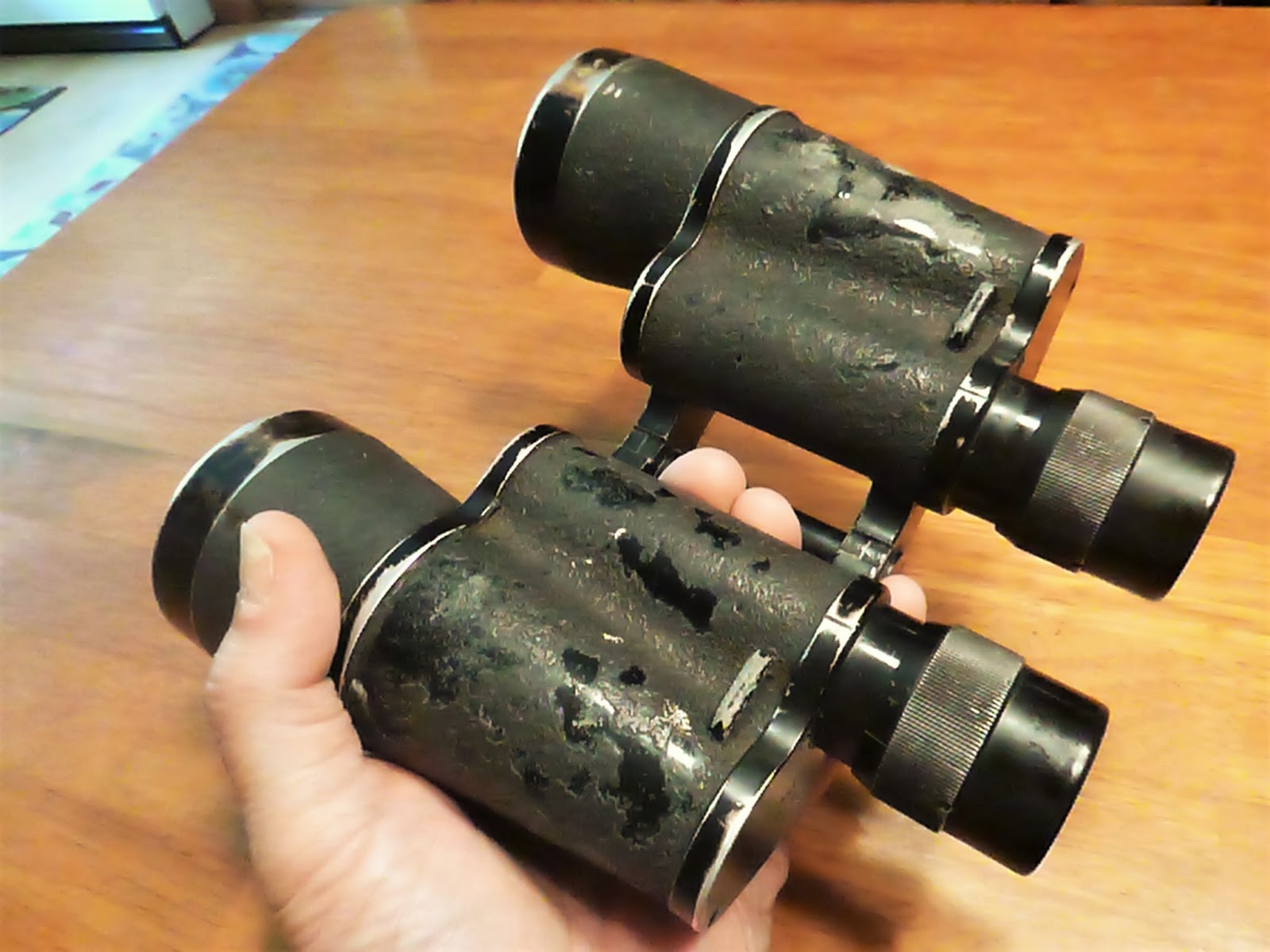
My 95 year old father in law is sharp of mind but his eyesight is not good.  When we were out to visit him in June he offered me a pair of binoculars.  "I can't see a thing with 'em any more".  He did not know much about them, but thought they had been made by Zeiss, a famous German optical company.  He got them at a car wreck on the Indiana turnpike, I assume back in his days as a reserve sheriff's deputy.  

Let's have a look and see if any more of their story can be puzzled out.

The binoculars have seen a bit of use and wear, but are actually in good working order. Clearly this was a quality built bit of equipment.


The internet is really quite helpful on this kind of question, so these markings on the binoculars proper, helped a lot.  "Dienstglas" translates literally to "Service Glass" meaning a shatter resistant, high quality lens for military use.  The numbers relate to the magnification factor.  The designation blc was the code for the Carl Zeiss factory in Jena.  Zeiss then and now were among the world's leaders in optical lenses. 


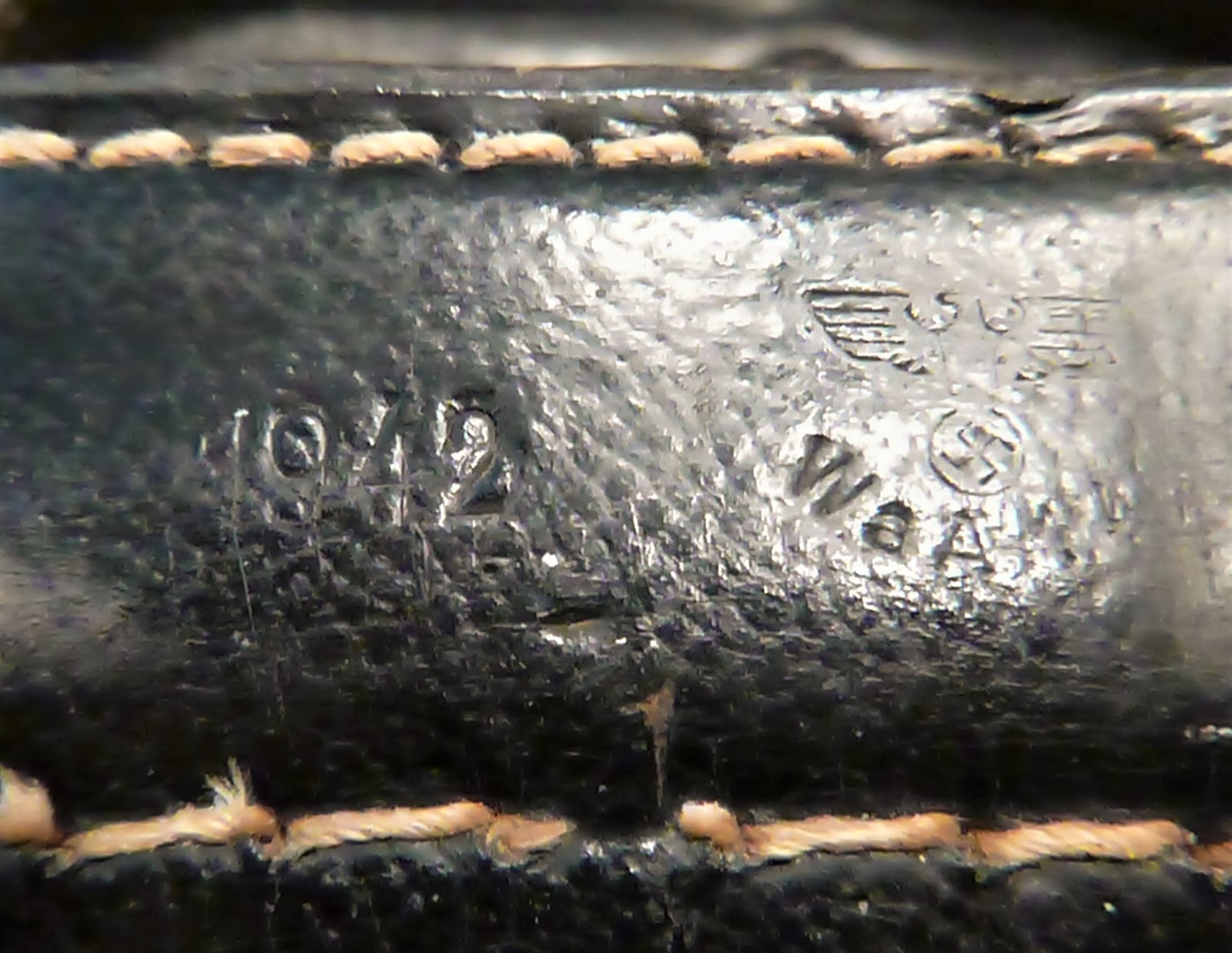
Although the above strongly suggests military binoculars the confirmation was actually on the leather case.


Note the date, 1942.  The Eagle and swastika logo has beneath it another code. Unfortunately part of it is worn off as that is where the clasp rests.  WaA stands for "WaffenAmt".  This was the organization responsible for weapons procurement.  Stamps of this sort were placed on items during their manufacture.  They indicated that the item had been made to correct specifications.  Very tentatively I think the numbers that follow "might" be 14, which would mean the case was made at the Curt Vogel leather works factory in Cottbus.


To make things just a little more confusing the metal clasp has another code on it.  This looks to be frn42.  frn indicated the Federn-Draht und Metallwarenfabrik in Havel.  

What is probably going on here is an assembly of parts from various suppliers.

So, we have a pair of German military binoculars made in 1942.  But how did they get to Indiana?  One must assume that an American serviceman acquired them overseas and brought them back.  This is a good example of how provenance - the documented history of an item - is everything.  Were these taken from a captured officer on D-Day? Or bought at a flea market twenty years later?  The glasses and case show signs of considerable use.  But was it with the Afrika Korps or on the outskirts of Stalingrad?  Or was this a brand new pair when some farm boy from Indiana grabbed them out of a warehouse, then faithfully took them duck hunting for many seasons?

Don't know.  

As a side note German binoculars are a pretty common thing to find be it on ebay or perhaps at a modern day flea market.  They were the sort of thing that was avidly sought after and the US military's restrictions on taking home items such as firearms did not impede the spiriting off of this kind of souvenir.

Monday, June 18, 2018

Belgium in Review

A wrap up of my Belgian adventures.....how well did my pre-trip preparations work out?  And what kind of place is it anyway?

In general my preparations worked well.  Lots of walks and garden work in the weeks prior made the physical labor manageable.  I take curious pride in being an efficient mover of dirt.  The first week home I actually had more aches and pains than during my two weeks of digging.

Belgian beer?  As it turns out this was not much of a pub crowd.  And the two local establishments were not always open anyway.  But there were several evening get togethers for curry, barbecue or whatever.  The Uni students brought some watery low cost beer.  Those of us with foresight and funds brought better stuff.  As usual the company and the beer act in concert and the evenings were delightful.  Odd...what with John Denver sing alongs by our guitar playing Austrian explosives expert....but delightful.


The default language on site was as I suspected English.  Belgium can't agree on much of anything and with Dutch, French and German all being official English has become the default.  In second place was Dutch, or rather the Flemish variant of it.  I was able to pick up a bit while digging.  The security guy at Brussels airport was impressed.  He had also heard of the dig on the news and we had a nice chat.

I must with reluctance dispense some negative points to Brussels airport.  The train going to and from the place has a regular team of annoying beggars.  They come around and listlessly hand out grubby pieces of paper saying that they are poor, work with children and would like some money.  They come back later to collect the scraps and put out a hand.  They seem used to being ignored and just move on to their next location, leaving the lingering smell of a three pack a day smoker in their wake.  The airport also has some very suspicious "helpful" individuals who will for instance be right there if the ATM is being difficult, offering to direct you to one that they know works........

But in general the inhabitants of the rural area I stayed in were much the same as country folks the world over.  Polite if primarily absorbed in their own lives.  One of the Belgian archaeologists I worked with told me that Belgians are Europe's most passionate home bodies.  They are said to be "born with a brick in their stomachs".  The contrast of immaculate homes and gardens and very sleepy public spaces would seem to back this up.

Having spent a decade excavating a bit earlier in May and a ways further north - up at Hadrian's Wall - I packed more warm clothes and fewer T shirts than needed.  We had blazing hot weather and I usually slugged down an entire 2 liter bottle of water.  

After the first week I did have my logistics worked out.  There were nice showers on site so I got cleaned up prior to returning to the diggers hovel.  There was also a comical little washing machine so the bag of laundry detergent I carried along was a good call.  The convenience store down the block was pricey but they were open early and made a good lunch time sandwich.  I never found coffee beyond the highly potent stuff available in small quantities on site, but it was just sufficient to avoid withdrawal symptoms.

I was able to manage Belgian trains and buses, and timed things such that I left the excavation having consumed the last of my provisions and wearing my last items of clean clothes.  About half the garments I brought with went into the trash or into a clothing for charity collection bin that I found.

I had numerous conversations with the eclectic bunch of excavators on site, often on the subject of where they should go to visit the "real" America.  So many Europeans confine themselves to New York, LA, Florida and even, God help 'em, Vegas.  I suggested they rent a car and hit the small roads in summer time.

So some of my critique of Belgium is unfair by my own standards.  Brussels for instance is an unlovely place as seen by the train, and no city is fairly judged by its airport.  That being said among my last images of Belgium were this series of ads, all of them showing emaciated, unhappy young people.  


Not the real Belgium, just as LA, NYC and Vegas are not the real America.


Wednesday, June 21, 2017

The Finance Police on the Case!

I guess its not exactly a secret that Italians are, shall we say, less than diligent in paying their taxes.  People who actually understand the intricacies of the VAT tax estimate that in 2014 Italians "evaded" 27.5% of what they should have paid. That makes for a not insignificant 36.9 billion Euros.  And that is just for VAT, one of the many taxes that Italy has on the books. The actual, total scope of tax evasion?  Who knows. Lots is a fair statement.  And it takes a toll, our trips to Italy have been made a bit less enjoyable by trash in the streets and archaeological sites closed because the government is chronically underfunded.

I was a bit taken aback to find out that the Tax Police actually have squad cars!


But I was really surprised to find out that they in addition have an "air force" of 100 planes and helicopters and a "navy" of 600 vessels.

If that seems a bit over the top for the purpose of persuading people to take paying taxes seriously I suppose it is only fair to mention that this branch of what are called "militarized police" also have responsibility for many other functions including preventing drug trafficking.

Wikipedia of course has so  Much More.  The Guardia works to track down illegal art sales.  They fight credit card fraud.  They run mountain rescue stations.  They even have nominal duties to prevent illegal immigration.  I wonder if their ships and that of the Italian Navy ever fire shots across the bow as the latter is currently tasked with rounding up ramshackle refugee vessels off the coast of Libya and towing them back to Italy.


Here's the current commander of the Guardia Finanza.  Although the Italians are not notably proficient at either military or police matters they do have the best damn uniforms.

Monday, March 2, 2015

Tourism in the Bandit Infested Hills

I both admire and envy my more adventuresome friends.  They travel, seemingly without fear, to Laos and Tunisia and Antarctica.  They trek across the Sinai on camels.  They join the Peace Corps and live in Central American hamlets.

I am speaking generally of people ten to twenty years younger than I, those who came of age in an era of cheap airline tickets and social tolerance of delayed adulthood.  The folks I am envying here did most of their globetrotting either before or in place of raising children.

I now have the available time and resources to travel where I will, but there are more risks than there used to be.  It once was that you were safe so long as you did not venture out on an ill advised jaunt into bandit infested hill country.  Now the bandits have come down from the hills and live among us.

I have walked through too many places where terrorists attacks have occurred.  The Olympic complex in Munich, the London Underground, the Valley of the Kings in Egypt.  I regularly pass through the Amsterdam airport where the infamous "underwear bomber" was helped onto a US bound plane on some sort of humanitarian ticket.  I have driven past the Pentagon and have walked under the dome of the US capitol that escaped its intended targeting on 9/11.

No center of culture and urbanity is safe.  Paris the City of Lights.  New York, the self styled "Greatest City on Earth", Moscow with its atrocious subway bombings and Tokyo its sarin gas attack. For all the negative publicity that rural America gets, it is still a very, very safe place to live.

In a matter of weeks we will be heading for Italy.  It seems like a safe enough place to go, certainly Italy has done little to offend anyone of consequence in recent times.

But just a few hundred miles away, on the shores of Libya we now see the barbarians of Islamic State lining up Coptic Christians for mass slaughter.  And at the end of their latest atrocity one of the jihadists points a bloody knife north across the sea and proclaims that they will march on Rome.

You don't hear about that part of the message much in American news media.  Oh, in part it is wise to give these monsters as little attention as possible.  But a bigger part of it is the sheer embarrassment of our Current Administration.  Having started an optional war against Mohamar Khadaffi they "led from behind", dropping equal numbers of bombs and press releases.  Now we have another festering, chaotic pool of terrorism, and one with convenient access to Italy via a well intended policy in which refugee boats are actually helped ashore by the Italian Navy.

I usually avoid politics in my writings.  But part of the reticence to discuss the catastrophic implosion of Libya is that to do so would be an embarrassment to our Current President - who was gifted a Nobel Peace Prize for his anticipated diplomatic brilliance - and to our hopeful "President in Waiting", who was Secretary of State when the Libyan incursion was somehow, implausibly, deemed to be a safe and prudent action.

But these are the conditions that exist.  This is the world we live in.  The bandits are probably now in the Seven Hills of Rome.

You do what you can.  I get in and out of airports as quickly as possible.  I like to think I have good situational awareness.  Several times in Egypt I got a vague sense of danger.  Usually a close look around would show up a few of the Mubareck era Secret Police on the periphery of things.

I think we will steer clear of obvious danger zones, St. Peter's square for instance.

I always try when traveling to avoid an easy identification of my nationality, although when dealing with a threat like Islamic State their hatreds are so eclectic that passing myself off as being from Luxembourg may not suffice.

I don't think it is morbid to have one's "affairs in order" before going on a journey.  It is one less worry in life and when I travel I prefer to live for the moment.  Another glass of "vino della casa", another bit of ancient building peeking out from under modern trappings, another day of having no obligations other than enjoying ourselves.

I am sure I will climb up on the Aurelian Walls that surround the ancient parts of Rome.  They were built at a time when the Empire was crumbling at the edges and savages were expected to reach to the very heart of Western Civilization.  The Walls held then, and in fact for another century and a half the external enemies were kept out.


Like all enduring things of a past age they are thought provoking.  And could give you justifiable reasons for either optimism or pessimism.

At one point in their history they were an inconsequential barrier when an army, flush with victory and carrying the banner of a radical new religion just marched on through.  Constantine the Great with his newly professed Christianity prevailed against greater numbers and carried the day.

But at a later date and against even more lopsided odds the Byzantine general Belisarius strode these battlements.  He had prevailed against armies of Goths that should have matched him ten times over. But he had sturdy walls and strong resolve and the barbarians raged against them and broke.

Friday, October 25, 2013

Archaeological Chaos

When we were in France last spring we took a side trip to a sleepy little town in the western part of the country.  It was once a site of much industry, and in particular had a major manufacturer of buttons, beads and tile.

As my better half collects buttons it seemed a logical spot for an "off the beaten path" side trip. Especially since one of her fellow collectors tipped her off as to the location of an enormous dump...where you could go and dig up buttons all day long.

Evidently the place ran into financial difficulties in the 1970s, and when it closed they just hauled the inventory out back and dumped it.  Acres and acres of artifacts.  All of it naturally atop roughly 200 years of earlier dumpings....


I am normally cautious about tossing around big numbers, but imagine this stuff going down for many meters.  We are talking about millions of bits of tile.  This looks sort of boring but other sections were more varied.  And more what we came for.


My interest in collecting is sort of the magpie variety.  If something is shiny and catches my eye I like it.  There were a few other folks wandering around the dump site with bags and small hand tools. Some of them apparently were looking for very specific tile bits. Doing a bathroom remodel on the cheap I guess.

Pity the far distant archaeologists who have to make sense of this mess, or of similar industrial age mega sites.  Proper archaeology involves taking each "small find", marking its location precisely, then placing it into its own little bag for later study.

If you have an interest in buttons and such my better half blogs on such matters regularly.  Drop in and visit at NEXT DOOR LAURA.

If you happen to be in France and have an interest, there sure seem to be enough buttons, tiles and beads for all.  And if you turn up in the near future you may not need any tools.  We left ours hanging on a branch. It is hard enough to bring big old bags of tile as carry on luggage.  I did not want to explain these.


We also left you a few artifacts.

Yer Welcome.

Friday, June 14, 2013

Post Cards from World War I - Part Two

Also from the Tongeren Flea market, a couple of French examples:

Although undated you get the sense that this one was from early in the war.  The fellow looks very dashing and "sang froid" as he uses a sputtering bomb as "a new lighter". Indeed, I have seen another example dated 1915.  Here is the text:

The handwriting here is not too bad, albeit with the cramped word spacing common to post cards.

It is addressed to a Madam Parmentier who is staying at the home of M. Pouffier.  Why? The first lines read: "We are all in good health and well happy to be delivered of those dirty boch".   I hope you are the same."  Is this a family who became refugees?  Although the writer is presumably in the army he says little about that, only that "we have not had too much unpleasantness with the boche."

I think it may be a man named Louie writing to his sister in law, as he mentions his own two children. He also says that poor Reimi should get a long letter.

Here is another odd one...what a way to spell out Happy New Year.

And our text:

My French translator could not make much out of this one.  The cute couple on the front notwithstanding it seems to be a fellow wishing his brother a happy new year.  Perhaps that is best, how many sweet hearts would actually want to think of their loved one being surrounded by gigantic artillery shells.  Or is this perhaps a bit of phallic imagery?  It is possible to read too much into such things, but one imagines the target audience for this card was lonesome soldiers and their back home wives and sweethearts.  In that context we seem to have a coquettish smile on her face, a gently held bunch of flowers - could be dropped at any moment - and some serious looking cannons and ammo.

And recall that we are talking about lonesome French people here.

Wednesday, June 12, 2013

Postcards from World War One - Part I.

Note:  European Flea Markets are a treasure trove for history lovers.  I am not sure how general the trend is but I ran across much more material related to the Great War than to the Second one.  Probably it is a combination of things.  Much of the material from the 1930's and 40's is still sheltered within intact households.  And of course anything relating to the Nazi era is at the same time shunned and prized by the antiquities market.

There are some fascinating post cards from World War One.  I found lots of these at the Tongeren Flea Market.  Skipping over the majority which were of the comic genre - gas masks and latrines, rats in soup kettles - I picked up a few that had a personal feel to them.....

Translated loosely this says:  No Sugar Ration Card!  Since I can't give you sugar I will give you a sweet kiss!

You can't help but identify the sender of the card with the amorous soldier on the front, but in fact this is one of a series of patriotic themed cards.  I have seen them referred to as Romantic Gesture cards.

But who sent it?  And what did he have to say?  We have a few problems to overcome.

This was an era of extravagant penmanship and slang ridden conversation.  Coupled with some ink fading and I fear my interpretation of the above will be guesswork in places.

Even the date is obscure.  On the front of the card is a PFB logo.  This should indicate it was made by Paul Finkenrath of Berlin.  Unfortunately that company went out of business in 1910, and the reference to sugar rationing clearly makes this a war time issue.  The postmark is light in a key spot, but I think it is from 4-10-1917.  One assumes that the Finkenrath trademark was revived during the war years.

It is posted from Motorschule Russelsheim.  Russelsheim was a place where among other things, aircraft motors were made.  It later became the headquarters for Opel.  I have seen an oblique reference to pilot trainees being sent for a month of education at a Motorschule.  This would be after basic training but before flight school.  This makes me wonder if the writer of this card was a pilot trainee?  What I can make out of the message does have one odd phrase in it..."Im luften grussen".*  It means "the airiest of greetings". An unusual way to put things...was he making an oblique comment to sneak it past the censors?

I am assuming that the sender had the last name of Fothenberg or something close to that.  That name does not appear on the list of World War One aces, although my reading indicates that there were a surprisingly large number of pilots trained in World War I, and few attained memorable success.  Or was he a humble mechanic?  Did he attempt pilot training and wash out?  Did the Motorschule also train truck drivers?

Let us assume that Fraulein Kuchart was proud of him in any case.
-----------
* the weird letter that looks like a capitol B is now archaic.  It was the equivalent of "ss"
--------------
Addendum:  It has been suggested that above message actually alludes to training as a motorcyclist.  Less cool than a pilot I suppose, but still interesting.  I can't personally make the German word for motorcycle "Motorad" appear, but my feeble excuse still applies, it was an era of extravagant penmanship and lots of slang.

Monday, May 27, 2013

Verdun. Where 1916 can never end.

If you sometimes wonder how the world got into its current sad state I can point you to the very spot where things went so badly astray.  It is in a series of hills just east of the drab town of Verdun France.

The Great Powers - none of which rank as such any longer - blundered stupidly into the First World War.  Their diplomats had in utmost secrecy created an interlocking web of treaties and understandings that were nothing less than a Doomsday Machine for Western Civilization....one that put armies of millions to the march after an inept but implausibly successful terrorist act.

Brave men, those armies of 1914, "Lions led by Donkeys" as tragically belated wisdom had it.

But there were still rays of hope.  Nations were at war but civility in men remained in places. The Christmas Truce of 1914 where the guns went silent and soldiers from both sides sat down together showed a Europe that might have been and still could be.

But Verdun changed it all.  Having spent so dearly neither side could settle for less than a total victory, or for less than unstable, draconian "peace" terms.

Verdun was where France and Germany met in the longest, most intense, most concentrated battle of World War One, and perhaps in all of history.

The statistics are somehow both dry and appalling.  Both personal and surreal.

Nobody ever accurately tallied the butcher's bill.  But there is general agreement that there were half a million wounded.  And a quarter of a million dead.  Forty million artillery shells were fired into a small area.  I have seen various estimates...could there really have been 150 high explosive shells landing on every square meter of the battleground?  Could there really still be 12 million unexploded rounds sleeping beneath the now forested hills?

At the end of the battle Verdun looked like this:


And frankly many areas looked worse.  I picked an image with a few skeletal trees because other areas more closely resemble images of some other planet, of some of crater-scarred moonscape.

I have had a fascination with the place since reading Alistair Horne's superb The Price of Glory.  So when I had a chance I spent a few solemn hours walking on what Mr. Horne rightly describes as "one of the most haunted places on earth".

At the end of the war there was no effort to reclaim the land.  It was of no value for agriculture - the topsoil had been blasted off entirely.  And to remove the unexploded ordinance?  Impossible.  They are still finding it routinely just doing the most basic of forestry and road maintenance.  So it was left alone.

Walk with me a little while in the silent glades of Verdun, where it will always be 1916. With every step you tread upon the atomized remains of those long martyred Lions. Death is all around you.  Remember this.  Stray not far from the marked and monitored paths....

A turret in one of the great forts


Note the thickness of the armor in this observation cupola.  And that it was not enough.

Here are shell holes...almost a century later.


On the right is a park bench.  It is a place for contemplation.

concrete supports for trench walls.  Still standing in a zig-zag trench system.


It was spring time in Verdun when I was there.  But Alistair Horne was right...you hear no birds singing.  And apart from a few small beautiful flowers you get no sense whatsoever of new life.

Friday, May 24, 2013

Tree Shaped Tombstones - A Continental Specimen

In a cemetery in small town France,


It is similar to the "Rustic Cross" type seen in the states.

It had some nice flourishes and details.


Sometimes I wonder if these tool details are Masonic symbols.  But in this instance I figure them to be occupational references.  This was probably a wheel wright.