Showing posts with label Tavern Tales. Show all posts

Wednesday, July 15, 2026

My Get Rich Quick Product Idea

Ah, getting older.  Well, it does beat the alternative.  But you do have to attend to more "maintenance" as the birthday cake candles glow a bit brighter.  

As a retired MD I'm a bad patient.  But there are things I believe in strongly enough that I even talk myself into them.  Like colonoscopy.  Turns out I have a bit of  family history, my grandfather dying of it at just a few years older than I am now.  So, there's nothing for it....

The procedure is not so bad.  I just insist on the good meds.  Much as Fentanyl has caused suffering and tragedy when used illicitly, it - in concert with its good pal Versed - makes for a dreamy, detached state. 

Now the prep, that's just not fun.  But necessary.

Suffice to say that you have to drink some stuff that gives you very kinetic, ate a bad burrito in Mexico level diarrhea.  Don't plan anything on that prep day.

The prep meds usually come in small - but deadly as it happens - colored glass bottles.  Now, on to my make a million bucks idea.

I used to be a fair home brewer.  And I'm pretty sure you could concoct a beer flavored prep solution.  Great beer?  Oh, no way.  But better than the horrid sensation of glugging down what tastes like concentrated Dead Sea water?  I think so.

But you'd have to market it well.

I've tried asking AI to show me some example "brands".  In some cases it was unwilling.  I mean, the obvious is BUTT LITE.  But that stuff can hardly be considered beer.....  So, how about:


This is actually almost spot on for the little green bottles of Affliction.  They are perhaps half the size but just that color.   

I actually enjoy the occasional Heineken, and once had a very memorable tour of their flagship brewery in Amsterdam.  For a variety of technical reasons there were some parts of the tour we could not take that morning, and each time we were promised "Well, that will give you more time in the tap room".

Apologies for the satire Heineken, I actually  think highly of your product.

Now, there are a number of US beer brands, current and historic, that would not need any alteration at all to be good colonoscopy prep names.  If, and this is a gigantic if, their copyright lawyers looked the other way and whistled, I could see several names being quite compelling just as they are.

Schlitz, Blatz, any others you'd like to suggest?

But perhaps your tastes do not run to European or US beers.  I've enjoyed some Mexican lagers as well.  Modello and Dos Equis do not sound immediately promising, but what about:


Should of course have a crown on the label, and actual Corona comes in clear bottles.

I've always felt that the silly times we live in make satire darn near impossible.  So who knows, perhaps somebody has already tried this concept....

Monday, June 15, 2026

Food and Drink Reviews - Northumbria 2026

Well, at least the small part of Northumbria that I've gotten to know well.  These suggestions might come in handy for folks walking or otherwise visiting Hadrian's Wall.  No Star ratings or major negatives, just my observations.  Each of these places could make for a good experience.

Going from East to West.....

1. Carts Bog Inn.  This is way off the beaten path, down to the south of Haydon Bridge.  It's been an inn since the 1770's.  It got its start, and its name, because carts loaded with ore went down this lonely road...and got stuck in a low spot.  The drivers needed a place to collect themselves, perhaps waiting for the equivalent of a tow truck. I'd been wanting to visit the spot for years, and finally managed it in May.  It did not disappoint.


The place has retired greyhounds snoozing on cushions.  Lots of campy artwork, much of it also dog related.

Really good food.  I recommend the Bog Pie.  It's a concoction of steak and mushrooms, and it was so tasty it even made mushrooms edible.  I hate mushrooms.  Another of our party had lamb shank, also good.

Two minor caveats.  Only open a couple days a week, and a small place.  So call for reservations.

And the beer selection was so-so on our visit.  One tap seemed to be "out".  They probably do better most nights, it is after all said to be on the location of a brewery from the 1500s!

2. The Bowes Hotel.  My home away from home in the UK.  Convenient as a place to stay, as there are bus and rail connections right outside the door.  A brisk walk up to Vindolanda if someone shows you the sneaky path!*  But for food and drink purposes.....  I recommend the Cumbrian sausage with mash, and any of the curry dishes they rotate through.  The owner's wife is from Thailand, when she's in the kitchen dial your spice request down a notch!  For drink I favor Reiver, an ale made about 10 miles to the north.  


3. The Twice Brewed Inn.  Right on the Military Road and just down the hill from the Hadrian's Wall waling path.  So, great location.  When I started going there it was a humble, funky kind of place.  I like such places.  Now it has gone upscale.  They have their own brewery on site, whose wares I recommend.  They have fun stuff like night time stargazing.  The outdoor gazebo seating areas are nice on a warm day.  I have not had the food there in times recent, but its probably pretty good.  This place is big enough that reservations might not be essential, but are appreciated.   Located exactly in the middle of the Hadrian's Wall Path this spot will always be enjoyed by hungry/thirsty walkers.  

4. The Milecastle.  A long time favorite, this is one of the first places we visited when walking Hadrian's Wall Path.  It's a small place, so reservations needed.  Very good pies, which of course in the UK will not be apple and lemon meringue sort of stuff.**  Nope, steak, poacher's pie, kidney, that sort of thing.  The place is no doubt popular with my digger pals due to the proximity of Roman stuff which gives it its name.  Supposedly in business since the 1600's, although its not just Roman buildings that come and go.  They seem to have a mobile pizza operation that I saw set up this summer, but I did not have a chance to sample this new venture.

5. The Black Bull.  Moving just a bit further west and south to the delightfully named Haltwhistle there is a little pub on the back side of the main square.  It is what I call a Time Warp establishment.  By that I mean it looks and feels just like the pubs you see on Brit TV when they are depicting the 1950s.  The owner is ex military.  He can be a bit brusque, but switched gears immediately when he noted some "ink" on one of our excavators who was a former British Army sergeant.  I've never had food there, but they serve it intermittently.  But I very much enjoy the atmosphere and the ale.  I suggest Tim Taylor Landlord, although it makes me think of Tim the Tool Man from the old Home Improvements show.  He'd find a lot to "fix up" in this ancient building.


There are lots of other food and drink options as you go here and there in the Hadrian's Wall country.  Some appear and disappear, as is the rule in the hospitality industry.  

Of course your enjoyment of a place will depend on the pleasure of the company you are with...and how badly you need sustenance and perhaps to get in out of the rain.  The above list covers quite a few places along the "best" central portion of the Hadrian's Wall Path, but I have not included entire categories, such as tea rooms.

I don't much care for tea and tearooms, but such places will often have sandwiches and so forth.  Off the top of my head I can recall places at Chollerford and Greenhead, plus the in house establishments at the "attractions" of Vindolanda, the Roman Army Museum, Housesteads and Birdoswald.  There also appear to be various "Honesty Stands" along the walking path where a much needed can of soda could be acquired on the rare days when hot sun is overhead in Northumbria....

-------------------------------------

* The owner of The Bowes is happy to arrange pick up and drop off services for guests.

**In the UK "pie" is a rather generic category.  For desserts most everything is called a "pudding", although confusingly things like Yorkshire pudding are really what we'd call pop overs.  Sticky toffee pudding with custard is recommended highly.  I think all the above places could manage a good one.

Wednesday, May 6, 2026

UK Prep - 2026

I have a travel check list.  Several of them actually.  

I keep my archaeology stuff ready to go, albeit no longer permanently packed in my carry on travel bag.  Since starting at Vindolanda I've been attending way more robotics events and it comes in handy for those.

Of late my collection of hunting garb and digging garb has started to intermingle.  They are both designed for layers on, layers off, although the former has more camo patterns.  I may bring along something bright yellow for visibility.  Some days I am crossing roads in early morning fog, and camo is not ideal.  Maybe this?

I wear low top hiking boots about 90% of the time.  With modern "quality" it takes me a month or two of trying pairs on to select one.  Then a couple of months to break them in.  I usually get about three years out of a pair.  I try to wear them until they are kaput, then "bin them".  I have at least once discarded a pair in the UK, sparing me some packing space.  Alas, my last pair started losing stitch cohesion in February, so I'm breaking in a new pain of Keenes.  They seem to have negotiated with my feet to a tolerant mutual understanding.

When in the UK I do lift things.  Barrows full of dirt and rock for instance.  I try to get ready for this.  Walking is good.  Working on the hunting land is good.  Recently I had a long bus trip back from a robotics tournament and in the days after noticed my back was complaining.  I admonished the malingering lumbo sacral regions and spent a few days moving rocks in our back yard pond feature.  That actually made things better.  

I also lift the occasional pint at the end of a digging day.  Prep for that also requires foresight.  Proper English ale is not easy to find in Wisconsin.  For a while I could get Lazy Monk Brewing's Scottish Ale.  Being close to the Border this is good enough.  And of course comes in the pint denomination which Bacchus intended for Mankind. 


Alas, it is a seasonal product.  At a store in the next town over I can get Boddington's Pub Ale.  It's not UK good, but will suffice.  

We generally bring a few US type treats over.  Girl Scout Thin Mints.  Maybe I'll bring a small bag of Dot's Pretzel sticks.  The UK has a bewildering assortment of snacks, biscuits, puddings and such but nothing quite like either of those very American junk foods.

That's most of the necessary prep.  Bank a few tall tales.  Avoid any discussion of whose political class is worst.


Wednesday, April 29, 2026

A Few More Tales of the Bloomer Brewery

On my recent visit to the Bloomer Brewery building I heard a few stories of the place.  For some reason there are plenty of 'em.  Perhaps it makes sense.  This is the sort of small town where people remember things, and the physical survival of the place encourages that.  

It's early days were pretty much the usual tale of fires, ownership changes and so forth.  It's when Prohibition came along that things got interesting.

Jacob Breunig bought the brewery in 1915.  Four years later alcohol became illegal.  That did not seem to deter him, and the tales of Prohibition era moonshine are backed up by a raid by the "Revenuers" in 1928.  Bruenig sold the brewery to an A.L. Lipschulz of Saint Paul.  This was probably in 1934; the architectural drawings we saw last time are associated with the sale.  The new name "Bloomer Beverage Company" dates to this time.

After a few years he sold out to a man named Tankenoff.  Oddly the product line trended towards ales instead of lagers.  In this era their products were often named "Al's"after Mr. Lipschulz. 


Business was so-so.  This was not the sort of drink most rural Wisconsinites favored, and I've heard there was lingering resentment on the part of local authorities after the whole moonshining thing.  To be fair I've also heard that the Chippewa County sheriff of that era turned a blind eye to this sort of thing.


It was the US Army contract that kept the business going.  Shipping their ale, now rebranded as Buckingham Ale, to the UK was good business.  

After the war the brewery closed.  And the building was used for many things.  Storage, but that's boring.  How about a worm farm?


People like to fish in these parts.  Fish like worms.  Worms like a nice cool basement.  What could possibly go wrong?  Well, the place had rats.  Solution? Rat poison.  New problem?  Rats defecating on the worm beds left traces of poison that killed all the nightcrawlers.

OK, how about a fish farm?  The accounts I've heard vary a bit.  Sometimes the rats re-enter the story.  But the more detailed version is that they were trying to raise some sort of trout.  These are a finicky thing to aquaculture, and if someone forgets to turn on the circulating pump one day.......

At various times parts of the sprawling complex seem to have been vacant.  Our discussion at the bar turned to the issues of homelessness, and I was told that one time there was a guy living somewhere in the place.  He started a fire and died.  The fire department put out the smoldering fire and tossed his body rather unceremoniously onto a snow drift.

My revisit to look for the caves was prompted by a bar patron partly falling into a hole where one of the cave's vents finally washed down whatever it was filled with in the 1920's or so.  And as it happens, falling into things is a theme here.  One time when a guy renting out some space drove his truck in, a wheel sunk deeply into the ground.  They had found the original well from the brewery.

Delightfully it was excavated, cleaned up, and a new top put on it.  The above ground stonework in this picture is new, as of course is the sensible grate on the top.  The well goes down a long, long way.


The cheerful guy on the left has been associated with the building for a half century or more.  He still does maintenance, and had lots of tales of what state the place was in when he arrived on the scene in the early 1970's.  When the well was found they got a guy with climbing equipment to come over from the local creamery.  I guess tanks and chimneys there needed cleaning.  My bar pal put on the harness, lowered himself way down there and called to the people up top to take a look.  He'd gotten a box of iron pyrite - aka fools gold - and scattered it around.  Obviously there was brief but intense excitement.

I do hope he was wearing that green plaid shirt and hat, and that it was Saint Patrick's Day....


Friday, January 9, 2026

The Object in Hand - Haitian Beer!

Time for a bit of mid winter tidy up.  Boxes are being pulled out, rummaged through.  Some things are being kept, others tossed.  Never quite enough of the latter.  Sometimes you find things that just are askin' for a bit of research.  Behold:


Out of context this might be considered a bit sketchy.*  But context we indeed have.

When my Better Half was in college she spent a semester abroad.  Not in Paris or any such fun location, in Haiti! This was towards the tail end of the Duvallier dictatorship, Papa Doc and Baby Doc, but before it descended to its current state of anarchy.  

This beer coaster came back with her.  She recalls that the drinks available in 1978 were Coke, beer and rum.  All warm.  She never tried the beer, but has always been a fiend when it comes to using coasters for drinks.  So what's the story behind this, er, colorful item?

Prestige beer is, or perhaps was, a product of Brasserie Nationale d Haiti, or BRANA.  This was founded in 1973 by Michael Madsen.  Madsen was Haitian, from a Danish family of some prominence.  Prestige beer was first produced in 1976.  My wife was in Haiti a couple of years later.

BRANA's other lines of business historically were mostly soda.  Pepsi, 7Up, and more recently their own products King Cola and an energy drink called TORO.  

BRANA had some early investment from Heineken.  In 2011 Heineken effectively took over the company by buying up 95% of the stock.  So, how has that investment worked out?  Well, there's still a nice looking website but it does not seem to have been updated in years.  There's also a facebook page, similarly showing no recent posts.  So, how about Google Maps?  Well, its pointing me to a plant called, oddly, cocacola lachine canada.  It claims to still be in operation, and the satellite view shows trucks there.  I tried to get a street view, but no go.  I guess the conditions in Port au Prince are such that driving around with a Google car is not practical.  Someone did leave a review 3 months ago speaking highly of Prestige, so I assume it is still being made there.  

This is apparently a picture.


It is vanishingly unlikely that I'll ever sample a Prestige but if one comes my way I at least have the proper coaster.  And I'm sure it is, as it has been for fifty years or so, the best Haitian beer.  

That's a low bar considering it appears to be the only beer brewed there.

______________________________________________-

* Regards sketchy status.  In something current it might be considered offensive to show a black guy with exaggerated features and platform shoes.  But this was the 1970's.  All of us, black and white dressed badly.  My college room mate was from the South Side of Chicago.  Great guy, like me he became an ER doc.  Alas, gone too soon.  He had a big 'fro and shoes just like that.  The 1970's, ugh.


Friday, December 5, 2025

The Taverns of Old Chippewa Falls - Part Three. The Earliest? And some other Guys.

For those who live elsewhere, Wisconsin has a long established "tavern culture".  Not quite as integral as pub culture in England, but still very important.  So it's natural for a local historian to want to explore its origins.  And also, its much harder than you'd think.

Regards Chippewa Falls the two complicating factors are where exactly you draw the community lines, and the reality that every hotel, store, boarding house and for all I know, church, would offer you a taste of something on request.  So what constitutes a tavern?

My criteria are that an establishment must be called a "tavern" or "house", it must be in the current city limits, and it must be 1860 or earlier.  The Civil War and its aftermath completely transformed the community.  A big chunk of the population departed to join the Union Army, and when they returned its hard to call it the Pioneer era.

I've already covered some early taverns and their owners:

Moses Hebert, or "Old Moses".  He shows up in the 1870 census as Moses Aber.  But he is mentioned as being in the liquor business in the 1850's.

Peter Rosseau, who seems to have been the sort of unofficial Mayor of Frenchtown.  He was probably operating the Rosseau House in the 1840s.  And although the history of Frenchtown is fragmentary there would have been other establishments operating early.

Oh, and then there's the whole crazy Mother Fossler story.

Let's add a few more from the 1860 Census.  It gives a few names.  Not much more than names, but still something.

Ferdinand Tish.  Saloon.  Age 32, born Germany.  Value of property $200.

Peter Lamare.  Saloon. Age 27, born Germany.  Value of property $500.

Peter Lazo.  Saloon Keeper.  Age 60 and born in Canada, so evidently not the same guy listed above.

And then there's Tim Hurley, who was pouring drinks in 1849.

Hurley was one of a crew of guys who came up from Galena Illinois in 1848, shortly after Wisconsin became a state.  The lead mines were playing out a bit, and a wealthy merchant named Bloomer decided to round up a crew of river men and perhaps under employed miners, come upriver and try a new venture.  Going past Chippewa Falls they started to build a mill upstream at a location called Eagle Rapids.  How the nearby community of Bloomer got its name is a little...complicated.

Mr. Bloomer decided this was not for him, so after a short time he sold his interests to some locals and went home.  Hurley and some other guys lingered on, getting involved in the unpleasant lynching I've mentioned earlier.

Hurley's establishment was variously described as a tavern and a place where gambling went on.  It was not spoken of favorably.  That's just about all I can tell you regards Mr. Hurley.  He was said to have married, almost certainly a local Ojibway woman, and was still here for the 1850 census albeit being listed as a laborer.

Beyond that point he is lost to history, what with a common name and an era where very little of what was going on was written down at all.  I wonder if he, like others in that footloose time he decided to try his luck out in California when the Gold Rush got well and truly started....

Trying to pin down a location for Hurley's tavern is no easy task.  But I think I can put you close.  In a time before significant road travel everything faced onto the river.  The banks are altered somewhat since then, but that narrows it down.  It is also fair to assume that he would not be set up in the "company town" area right near the Falls.  So in this photo I'm standing approximately where the first tavern on this side of the river would have been.


On the left is the building where our robotics team got its start.  It is now an upscale "Market Place" where you can purchase interesting food and such.  The small building on the other side of the parking lot is The Ritz, a sort of benign descendent of the first drinking and gambling joint.  I have it on good authority that you can get a glass of refreshment and some quasi-legal "pull tabs" there.  And back behind, on the part of the block across the alley, you can see a single large tree.  This is not the sinister white pine on which the Native man was hung in 1849, but is in roughly the same location.  Also quite near the 1850's first cemetery of Chippewa Falls.  Happier vibes as seen on a sunny, early fall day.

Friday, November 21, 2025

Regimental Steins Part Three - Corporal Dolland of the 167th

Another regimental stein that my father acquired in post WW II Germany and brought home.  They are among the many things we found when cleaning up my parent's junk filled house.....


As you can see, this one does not have the cannon on its top, but it is also from an artillery unit.  That unfortunate absence aside, there is a lot going on with this specimen.

It has a name across the bottom.  Or rather a rank and a last name.  

Gef. Dolland.  At least I think that's a D.

Gef. stands for Gefreiter, or Corporal.  Near as I can tell this is a more esteemed rank in the German army than in other armies of the time period.

The dates of initial service are 1905 to 1907.  Given his higher rank and the fact that the Great War broke out only seven years after he did his mandatory two years of service, its likely this fellow ended up back in uniform in 1914.  When the initial rush of August stalled every man with any experience or leadership potential was called up.....

You can see the larger print motto that runs across the top of the stein.  It translates to:  "He who has served faithfully deserves a full glass dedicated to him".

This one has lots details.  Across the lower part of the pewter lid run three mottos in capital letters.

SIEG ODER TODT - VICTORY OR DEATH 

GOTT MIT UNS - GOD IS WITH US

DONNER HEGEL MORD & BLITZ - THUNDER HAIL DEATH AND LIGHTNING.


There are a series of scenes on this stein.  The paint is raised, so I think they are hand painted.  I won't show them all, but here's an example:


A guy with his sweetie sitting on a sofa.  The legend reads, approximately: 

"And so was the (military) service most beautiful."

You can just see the next scene below, or rather I suppose the one that preceded this.  It's a soldier returning to his home after his two years are up.  This one says:

"Open up mother, your son is home and wants a drink"

I feel like I should add an exclamation mark there, but one does not appear on the original.

The unit designation is a little easier to figure out on this one.  Helpfully it has the Regimental number - 167 - displayed.  The scribbly lines near the bottom of the stein give more detail.  

"As a reminder of your service with the (?) company Oberle Regt 167 Kassel.  The word Oberle is cryptic, it probably alludes to where the regiment was recruited, which was in the upper (ober in German) region of Alsace.  Students of history will no doubt recall that this part of the world got traded back and forth between Germany and France.  If we assume this soldier was 18 years old in 1905, then he'd have been born circa 1888.  Alsace had only been a part of Germany for 17 years at that point.  As far as I can tell his regiment served with distinction, but troops from this area were somewhat suspect with respect to desertion over to the French side of the trenches!

As a time capsule this item is impressive.  You get a sense of what life as a recruit was like.  Or at least you get an idealized version of it.  Here, take a look at one final image....


Remarkably these steins had a list of names, the guys you served with.  The list varies in length, anywhere from a handful or as many as a hundred.  This panel feels smooth, so perhaps a stencil was used.  I would not envy anyone who had to hand paint this!

It was apparently a list of the guys from your area that you served with.  Everyone went in as a conscript at the same time.  They came out at the same time.  They went back to their homes and got on with their lives.

Seven years later most of these men would have been called back into service.  How many survived?  I have seen stats that say roughly 15% of German servicemen were killed during the war.  I'd assume that being a somewhat older guy called up near the start of things would make your odds a bit worse.  And of course you had the very many who whose lives were changed by wounds or just the trauma of combat. 

A bit less fun than the jokey stuff shown on this stein, where mom is ready to pour you a drink, where a sobbing young lady is told "Girl stop crying, the recruits are coming", and where a group of nattily clad soldiers clink their beverages and say:


"The Reservists are living High"

The 167th Regiment was part of the 22nd Division.  They actually spent most of the war on the Eastern front.

After 1918 Alsace reverted to French rule...other than the years 1940 - 1944. 

Corporal Dolland, if he survived the First World War, was in for some changes.  I wonder if mementos of German service were something you had to keep on the back shelf....

Wednesday, November 19, 2025

Regimental Steins Part Two - Reservist Christman

Photographing a one liter beer stein is not easy!  I've rather shortchanged the cool top on this.


Of the two regimental steins my father brought back from Germany circa 1951, this is the one with all the "stuff".  There's a lot to look at, but as we'll see it is a bit more pedestrian than the next one we'll visit.

Presumably that's Reservist Christman depicted in the central image.  It is almost certainly not "him" in an artistic sense, just a generic young artillery man.  These were created with a combination of stencils and paint.  One way to sort it out is by touch.  The base image of the soldier is smooth, so probably stencil.  But the buttons on his uniform and the gilded stuff on his hat is raised, so added by hand!

There is never a first name on these things but the markings indicate he did his active service time as a recruit/conscript between 1898 and 1900.  The spidery, hand applied script indicates he was in the 3rd Company of "foot artillery"* of an artillery regiment based in Mainz.  Unhelpfully I can't be sure of the regiment, but it is probably the 117th, aka The 3rd Grand Ducal Hessian, aka the Grand Duchess regiment.  I am at least sure of Mainz, which narrows it down to three options, and there is a 3 among all the scribbles and abbreviations.


On one side we have this serious image and saying.  It translates to, more or less:

"It is the Artilleryman's job to make a powerful argument"

Around the top is another serious saying:

"Canonen donner ist unser Grufs"**

Cannon thunder is our Greeting.

But this stein is not all cannon thunder and bluster.  It does not photograph well but when you hold the empty stein up to a bright enough light you can see that there is the image of a man and a woman sitting in a tavern stamped into the base in what is known as a Lithophane.  One of the many ways to tell a real from a repro regimental stein is the content of the lithophane.  This one is typical.  Nudes are all fakes.

On the other side is something along the lines of: "Today the last shot was fired because I must go home".  Certainly the kind of sentiment that one would expect at the end of military service.  Being launched homeward by the cannon and waved off by your kamerades seems to fit.


So, what ever happened to Reservist Christman?  Absent a first name we shall never know.  But if he did his main military service on the dates listed here 1898-1900 he would have gone out of the most active reserve status by 1905.  He would have then spent 10 or 11 years in a second line sort of organization called the Landwehr.  So by 1914 he'd have been getting a bit old for soldiering.  Maybe mid 30s.  He'd still be a member of the lowest level of reserve, called the Landsturm, but by the time they got down to calling up those fellows he'd be pushing 40.  Let's hope he was not marched off to the last years of The Great War at that age.  Of course specialized skills were always in higher demand, and he was after all, an artilleryman....


* Foot artillery would be attached to an infantry division.  The guns would in general still be moved by horses.  Horse artillery was much less common, but cavalry divisions did have a few light field pieces they'd haul around with them.

** Among the oddities here is that the "f" depicted is a double s.  So, Gruss, or Greeting.


Monday, November 17, 2025

Regimental Steins - Part One

My dad picked up some antique beer steins when he served in Germany right after the war.  They even appear in the detailed inventory of things he shipped back home.  I find them fascinating.  There's really not an equivalent in our culture.

In Germany during the late 19th and early 20th centuries, almost all men did a period of required military service, then went into the Reserves.  After that they still got together for drills on a regular basis.  It would be other guys from your community, and there were definite social aspects to the experience.  Evidently, near every major training base, there were special military shops where you could order a custom beer stein to commemorate all this.  Specific to branch of service, regiment, even the names of the guys in your company.  They vary a bit in level of seriousness.  As we'll see, they will have the dates of the man's active service as a roughly 18 year old Recruit.  So these were a sort of keep sake of your "Army Days" and something you'd get out when the other guys from your company got together for drinks.  Presumably Old Stories were told over these.

I have two examples.  Each is worth close study and will get its own post.  Here's a couple of teaser pics.....


Although fascinating artifacts these things do not have particularly high value on the antiques market.  They made a lot of these.  And there are many more repros attempting to fool buyers.  For these two the provenance is rock solid, some staff sergeant did a complete inventory of all Lt. Wolter's stuff that was being shipped home in 1948.  These are listed.

Monday, May 5, 2025

Vindolanda 2025 - Day One

First day of digging is always preceded by "Jet Lag Drinks Hour".  This is, by admittedly imperfect recollections, the 15th year of this ritual.  One was done virtually during Covid.  A couple have been very informal.  But a nice crew turned out this time.


 Participants from the UK, the US, New Zealand, and the only person I've ever met from Yemen.  The topics involved all manner of things.  Tattoos, what it is like to administer emergency first aid while dressed like a pirate, that sort of thing.  Then the customary toast to Absent Friends and off to bed.


Stunning weather and new areas to open up.  The process of removing the green stuff is called "de-turfing".  If you loudly announce that its time to get the Sod Off you will get some strange looks...

I will be showing fewer pictures of small pretty things this year.  Policy on this has gotten a bit tighter  In fairness they are doing a much better job on the "official" side regards publicizing what is going on.  Oh, and so far I've found only a few small bits of pottery.

So expect more reportage on the odd aspects of life as a volunteer excavator.  Such as, on my morning walk in, these big patches of stuff that look exactly like our rhubarb....but evidently are some sort of nasty super weed that can grow right through asphalt!


Wednesday, February 26, 2025

The Taverns of Old Chippewa Falls, Part Two - Mother Fossler

Part one of our exploration of early Chippewa Falls taverns was fairly upbeat.  Peter Rosseau came to the area as an adventurous young man, became the leading figure of his little community of French Town, married, had a bunch of kids.  Yes, things were rough in the early days.  And French Town was fated to decline and vanish, but that was after his passing.

Our next story is, like Rosseau's, fragmentary.  And interesting.  But also less happy.  Pioneer life was hard.  Making a living running a bar/hotel (now it would be the hospitality industry!) has never been an easy path.  It certainly was not for "Mother Fossler".

In advance, apologies for the numerous spellings of her name.  That's just how it is with German names in the 19th century.  We have tough sledding ahead to make sense of this one folks, so lets dive in.... 

It's pretty certain that in the 1850's it would be hard to find a home, store or boarding house where you couldn't get a drink of whiskey!  But as to the first actual saloons, an interesting starting point is a sort of letter to the editor from 1913 that is simply signed AN OLD TIMER.*  In it he - probably not a she given the topic - has a lot to say on the topic of saloons.  In an article about Chippewa Falls that is mostly encouraging churches, businesses and construction of a nice public library he says:  "By the number and character of plague spots, it is growing better, for when I first knew it as a village of a few hundred inhabitants, there was but two saloons, Old Mother Fosslers and Mose Heberts...."

Hebert, or Old Moses, we've met before, but this was my first clue about an early saloon run by a woman.

She was then married to a man named Andrew, who appears on the muster list of the 1st Wisconsin Regiment as either Fosler or Foster.  His point of enlistment was Chippewa Falls, and it is known that Mrs. Fossler was one of the women of the community who sewed a flag for the home town company.  They carried it through entire conflict, and it was returned home tattered but proud in 1865.  

Andrew Fosler probably came back sooner, as he is recorded as being discharged due to disability in November of 1862.  But he now becomes peripheral to our main story.

Because curiously almost every subsequent reference to the Foslers I can find is centered on her.  For instance, in 1867 "Mother Fosler's" barn burned down, with arson suspected.  Mr. F. is not mentioned.

Best I can determine the Foslers moved to Chippewa Falls in 1855, making them very early settlers indeed.  They appear to have lived "at the foot of River Street", putting them well out of the orderly community centered around the saw mill and company store.  Indeed, it seems likely they lived just across the river from the dubious hamlet of French Town, and conveniently next to the ferry that went there.  This area was also called "Comstock Landing".  

But that seems to have been a bit later.  Thomas McBean, the go to source for history of the early town, had a few things to say in 1897.  He mentions that "Old Fosler" had lived in one of the boarding houses near the Falls called "Battle Row", which burned in 1857.  He then says that "..his relic still lives in the lower end of town."  Battle Row, by the way, is said to have gotten its name from the ongoing squabbles of its female inhabitants!

One very odd feature of this situation is that at some point after Andrew Fossler vanished from the scene he was replaced by a man often called John Fossler, but whose actual name was Klinsch.  Supposedly little was known about him other than that he came here from Luxembourg in 1855.  That's the same year as Mother Fossler. Did she remarry a fellow early settler after Andrew left her?  And when did the actual saloon get started?  Perhaps after the fire in '57 that made them relocate?  John seems to have been associated with it from an early date.  From his obituary comes this memorable passage...


This sure sounds like the pre-Civil war era, so I assume "Mother Fossler's" establishment was on south River Street.  Actually it is very close to my home, and I walk my dog past it almost every day.  The area has been much altered by flood control measures and road work, so there is realistically no prospect of pin pointing its location.

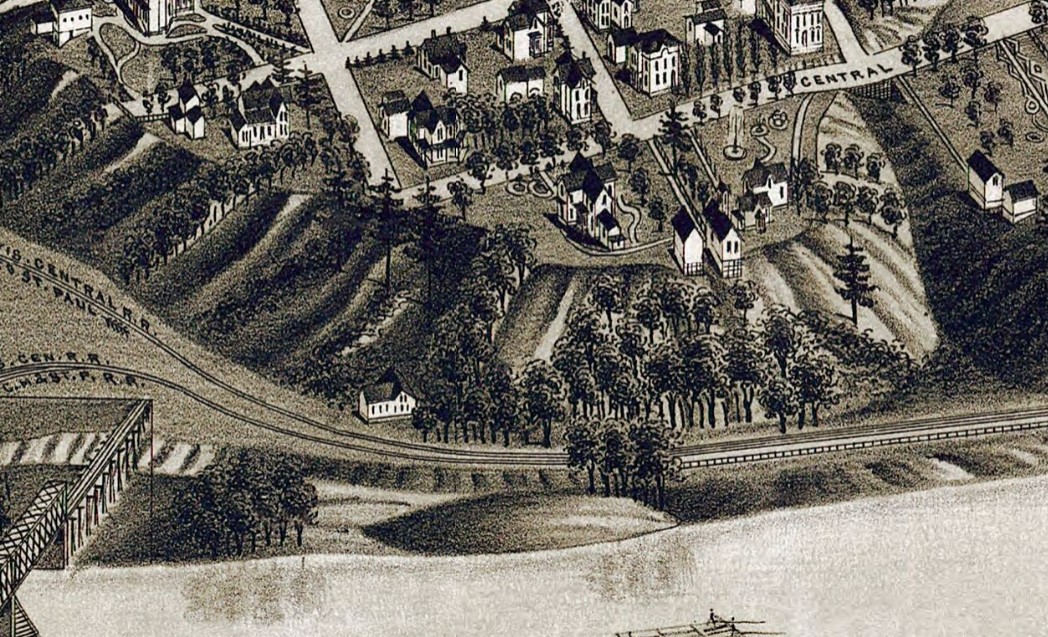
I think this is the spot, that lone building at the bottom of the hill.  This is from an 1886 Birdseye view.  It shows a two story structure all by itself.  River street no longer goes there due to a re-routing of the railroad tracks.  That outbuilding behind might be the "little shack" referred to above.  It was a sad and lonely place by the late 1880's.  Literally on the other side of the tracks, and not far from a swamp that was used as the city dump.  The flat spot on the river bank is where the ferry used to run.  It had been discontinued years earlier as bridges were built.


The same spot today....  Ironically the colorful stuff on the left is a mural depicting early Chippewa Falls history.  The high school kids who did this had no idea how historic this spot actually was.


So what to make of the two "Mr. Foslers"?  In the 1860 census we find Andrew, his wife (her name was Catherine by the way) and their son William living in Chippewa Falls.  Occupation, "keeps boarding house".  So that fits.  Husband and wife were from Baden, Germany.  I can't find a John Klinsch, or anything like that name, but to be fair the copies are hard to read, and I'm getting used to this crew being sneaky with names!

John "Fosler" dropped dead in the street in 1895.  He had been little noticed in the paper before that, other than being arrested for what sounds like public drunkenness.  My difficulty finding him in 1860 census suggests a bit of confusion on the part of the later writers, who might have mixed him up with Andrew Fosler.  I've had no luck so far in tracking down Andrew, who I suspect may have reverted to the alternate name Foster that sometimes is listed.  There is a fellow of that name and about the right age who lived in Menomonie, so maybe that's him.

Catherine Fosler got a brief bit of publicity in 1893, when it was reported that she was destitute and near death in her unheated shack.  Neighbors later denied this and the sheriff confirmed that she had been seen as usual, about town with her bucket of beer.  In one of these exchanges some rather harsh things were said:


Ouch.

Although I have yet to find an obit, Catherine Fosler apparently died in 1896.  Old Settlers usually got a bit more grace from the later citizens of Chippewa Falls, but her dubious marital status, her penchant for drinking, and general lack of success in the world were apparently held against her.  Well, as it says above, let her sufferings - of which she had quite a few, cover her faults.  Which were probably also numerous.
_____________________
* OLD TIMER may well have been Thomas McBean.  It's not as if there were that many people still alive at this point who had seen Chippewa Falls in the mid '50's, and McBean did like to write letters to the newpaper...


Friday, February 21, 2025

The Taverns of Old Chippewa Falls - Part One. French Town.

Wisconsin has a "Tavern Culture".  There's good and bad to this of course.  Some people get themselves in trouble with alcohol, and when we made the move from a shoe leather and horseshoes based transportation system you had the horrible issue of drunk drivers.  But those problems aside, its like the Pub Culture of England.  Its nice to have a local establishment where you can go, have a glass of beer, maybe something to eat, maybe watch a ball game.

Oddly, it is difficult to put taverns into their rightful place in local history.  They were on the fringe of respectability in the era of the Temperance Movement, and were mostly an all male domain.  The writers of newspaper columns and official histories darn well knew all the watering holes in town and had a plenty of stories, but its not as if they were going to put them down on paper for the whole world - their wives included - to see!

So as I try to bring the early days of Taverns in Chippewa Falls into focus I can say at the onset that this will be nothing more than a series of glimpses.  All historians are travelers from afar.  Not in distance but in time.  So think of me as a visitor strolling down the streets of a frontier community, peering into the windows of some fascinating buildings while trying to figure out what goes on in there!

Part One of this study has to begin in French Town.  In terms of anything other than a "company town" this was the original community here.  It is, or was, on the south side of the river.  As its name suggests this was an early French Canadian settlement, or more properly, French Canadian guys and their mostly Native American wives.  Nobody seems to know when it got started, and indeed, there have been fur trappers and such coming here since the 1700's.

But just about the earliest name and date I can put to the place happens to be part of our tipsy tale.

----------------------------------------------------------------------------------------------------------------------

Peter Rosseau was born in Canada in 1815.  He is said to have been in this part of the world early enough to help build the first mill in 1832.  The account suggests this was down stream a ways, but it's likely he was living in French Town in the 1830's, with the first sawmill here being built in 1837.  At what point does a house with a friendly owner, who'd put you up for the night and offer you a drink become a tavern/hotel?  The "Rosseau House" was certainly present in some form in the early 1850's, and I'd not rule out an earlier date.

Just about the first documentation I could find was an offhand reference to a rather unsavory murder.  A man named Wylie had a jealous streak.  When his wife walked by a saloon in French Town in 1857, something impolite was said.  The next day the man who had offended her was found with his head bashed in.  This sort of thing happened every few years in the French Town of the pre-Civil War era.  Wylie by the way was not charged, but decided it was prudent to skip town for parts unknown soon after this incident.

Another 1850's reference to French Town and Rosseau comes from a man who remembered the place when he came to the area in 1854.  "Peter Rosseau kept a boarding house there.  Rosseau was the king there and owned everything around."

The Rosseau House went for a bit of respectability later on.  An 1869 mention in the Chippewa Falls Democrat: "Peter Rosseau's well known hotel in French Town is now in full running order and ready to accommodate guests.  Bar and stable in connection with the house".

Curiously, this also appeared in 1869:


It's hard to make much of this.  Baumgarth was a dealer in Wines, Liquors, Cigars and Groceries over on the "respectable" side of the river.  He was also County Treasurer.  Mondelert must be a mis spelling of Mandelert, a common enough name in these parts to be a dead end.

I don't have any information on the origin of this photo, so all I can say is that some claim it is a picture of the Rosseau House.  Date unclear.


I've been a bit skeptical of this one in the past, but seeing the Harness Shop in the context of "Bar and Stable..." maybe its legit.   I could see that fancy overhang on the right side of the picture being a hotel/tavern.  My prior dismissal of a street light in an obscure back water of town is probably not valid.  I've found evidence of them being installed pretty early in more isolated spots.  The long, wide straight road.  Does it have a parallel on this 1874 illustration?


This image by the way is just about the only reliable plan of French Town.  There are three buildings big enough to be the Rosseau House.  I thought I had another one identified as a second known early tavern, but as it turns out, I was wrong...........

Peter Rosseau died in 1871.  Despite being one of the first settlers of our community he seems to have passed with little notice.  To be fair, newspapers of this time period are intermittently available and not very good.  I'm sure for his wake there was a serious bash at the Rosseau House.  Perhaps the apparent management changes in 1869 reflected poor health?  

At about the same time another man comes onto the saloon scene in French Town.  And despite turning up a generation later and only tending bar for a short while, we know a lot about Valentine Blum.  And no, you can't see his establishment on the 1874 view.

Valentine, or sometimes Valentin, Blum was born in Germany in 1844.  He moved to Wisconsin in 1860 and to Eau Claire in 1864.  His main work then became....river pilot!  He was the guy who steered big rafts of logs down the Chippewa River.  And evidently he was good at it.

In 1870 the census lists him as working at the mill in French Town.  And, starting in the spring of 1870, also running an establishment in French Town that combined saloon, restaurant, bowling alley and "lager beer fountain"!  

Sounds like a fun place.  I'd go there.  But it does not appear to have been a success.  It seems to have gone out of business in 1871.  In October of that year the owner, the fascinating E.R. Hantzsch, was advertising for a new tenant as the place had been "unoccupied for some time".  A month later it burned down.  These things happened often in places built out of and heated by, wood.  Maybe more often if there was insurance money involved.  Just sayin'.

After his year or so running a sort of 19th century entertainment center Blum went back to working in the saw mill.  1873 finds him sounding rather respectable, he was an election official in Eau Claire where he presumably lived.  But then there's that other matter.  Also in 1873 a batch of rowdy lumberjacks turned up in Chippewa Falls and "..got upon a right lively bender...".  The police who were sent in to quiet them down were met with fists, thrown objects and abuse.  They retreated for a time and things really got out of hand.  And it is reported that: "Valentine Blum, a resident of this place but now running the French Town mill was shot through the neck."  It was pointed out that he was "...taking no part in the affray", making him sound like an innocent bystander.

He survived, and on his death in 1896 was considered a highly respected Old Pioneer.
-----------------------------------------
Not sure when I'll have time to take on the Taverns of Old Chippewa Falls (other side of the river), but it might be a few weeks.  Busy times and a complicated subject.


Wednesday, May 29, 2024

Oy! Tim the Tool Man!

As in the US, England in recent years has seen a revival in small breweries.  So generally when I'm Over There I try to drink the local ales.  But of course there are also those that are sold regionally or nationally, and in a pinch my go to is the quite serviceable Timothy Taylor.


Actually, my pint here is from a local brewery now sadly about to go out of business.  "Leaky Tap" was pretty tasty but not relevant to our story.

Because right around the corner from the Black Bull pub in Haltwhistle I saw this:


Hardware House.  Is this where Tim the Toolman Taylor ended up after Home Improvement wrapped production?  If I were bold enough to walk up those steps would Wilson peer over the red brick wall and say "Hi - di - Ho, neighbor!" in a Cumbrian accent?

Friday, May 17, 2024

Magna Dig 2024 - Day Five

With the split teams and offset periods it is more difficult to have social occasions.  Last night we got together with our friends digging "the other site".

Ribald birthday cards, various ciders and ales, and some really outstanding Wild Boar and apple pie at The Mile Castle.


Back to work today.  It is Sytennte Mai, the Norwegian equivalent of the 4th of July.  Although instead of kicking out the British I guess they just exchanged being run by the Danish for being run by the Swedes.  Some kind of upgrade I guess.  Our Norwegian excavator brought flags. 


Not much else happened.