Wandering unsupervised in various real and imaginary places. Detritus reflects my interests in robotics, travel, history and the odder aspects of the world around me.
I've been back from the Vindolanda digs for a couple of months now. But the work goes on. Here's some clever small finds from Vindolanda and the sister site Magna.
Here's an intaglio, a small carved semi precious stone that would be fitted into a ring. These tend to drop off, especially in places like baths where the temperature might make metal expand more than the stone it was holding!
Here's a nifty belt buckle. Some designs don't change much over the centuries.
Dice are a fairly common find, although I've not come across one yet. Like most this one is made of bone. Not infrequently these are "loaded" with either weighting or shaving of edges!
Sometimes really old craggy things turn up on site. Here one such, Dr. Birley, holds a nifty bit of stonework. It is felt to be a bit of household gods shrine.
You tend to find heavily encrusted iron "things". Some sort of pan or ladle.
Looking over these I can feel the warm sun, hear the distant bleating of sheep. Makes me want a nice pint of celebratory ale.
When I retired at 60 it was with the notion that I'd do any darn thing I wanted for a decade, then slow down a bit. It was a solid plan, and has mostly worked out. Of course Covid swiped roughly two of those years, so I'm considering extending the "no limits" phase of my retirement years by a bit. Of course, you need to do the occasional reality check.
I don't drive in the UK. And when I go excavate at Vindolanda the local accommodations are finite. My preferred home base is The Bowes at Bardon Mill. It is down in the valley. The fort of Vindolanda was, logically for a defended place, built on a hill.
The linear distance is 1.5 miles for my morning walk, 2 miles for the evening return. I am in no rush in the afternoon, and prefer to avoid the up and down trek that my shorter, morning walk requires. The total end point elevation difference between start and finish is about 450 feet, but for the AM commute, its up and down a series of hills. I figure it is closer to twice that once you factor in giving back elevation with those down hill stretches. But is is a pleasant walk, and I do arrive on site warmed up and ready to haul barrows for the day. Here's a few highlights of the forty minute trek.
Other than, I suppose, tipping over entirely the biggest risk is right here. There is a very busy motorway that crosses my route, and the only way to avoid it would be an unacceptably long detour that actually would add another 500 feet or so of total elevation to the expedition.
So every morning and every evening I dash across it.
The mornings are the tricky crossings. I'm on a time table, and there can be mist and such. So I've added a blaze orange hat to my travel bag. I wear it only for the Commute, once on site I switch to the hat bearing the image of my Spirit Animal, Bucky Badger.
With careful observation I'm always able to make the crossing without drama, but a year or two back an American volunteer on site made the mistake of looking the wrong way and did get injured. He's back on site this season I was pleased to learn....
The next segment of the walk features these guys. Despite the ominous clouds, their dark faces and curly horns, this is no big deal. A simple "scram" gets them out of my way. On the return circuit I walk through a pasture with cows, they can be a bit more difficult.
More critters. About two thirds of the way up there is a single modest stone house. No idea what the folks there do, but they have a new Jaguar parked at the end of a road far more suited to sheep. They had a pesky old dog that has been barking at me for years. This year there is also a young pup barking at me. I bring along a few dog biscuits from the communal stash at The Bowes.
Eventually I glimpse Vindolanda off in the distance. Alas, I have to "give back" about 200 feet of elevation as I go downhill and then up again to get to it....
The return trip is as mentioned, longer but more leisurely. With a wider swing to the west I can avoid the ups and downs. I usually walk it with my friend Pete who stays over that way. Delightfully, given my nickname of Badger, there are badger dens along the way. Oh, and the promise of a pint at journey's end. Nothing like digging about in stuff nearly two thousand years old to give you a sense of time. Many others have walked these paths before me. Many others will do so after I'm gone. But for now, Old Dogs and Young Pups are still afoot, and there's biscuits for both.....
Here's the delayed Last Day report from my excavating at Vindolanda. The final day is always very busy. There are areas to be tidied up for the end of session drone photos, and the last 45 minutes or so are a highly informative "trench talk" where you go from one end of the dig to another and see what each small team has been accomplishing. Compliments are handed out liberally. The lead archaeologist would make a superb blarney dispensing small town politician.
Here's the site from the drone's eye view at the beginning of my hitch:
And at the end:
OK, it's hard to see the difference from this perspective. It looks much different when you are hunched over a trowel for two weeks! But here's a video that describes in detail what was accomplished in my session (Period 4) and the preceding one. Marta does a very good job with these. And yes, I do appear in the background towards the end. I'm telling the lead archaeologist that we've done as much as possible in the room we'd been in for the better part of a week (my specific words were: "We've put a liberal amount of lipstick on this pig") and you'll see me heading over to a new assignment in the Centurion's apartment. Which really did look darn good at end of session.
Here's the Period Four crew in end of dig pose. I really should remember to strike a more impressive stance for these, my belly is more prominent than it was when I started excavating at Vindolanda 18 years ago....
Rain shortened day. This will happen in England. Annoyingly after the day was "called" the skies cleared and it was rather nice. Sigh.
I started the day back in the Centurion's apartment. It had been a tedious bit of floor cleaning the day before so I was angling for a reassignment but was sent back for more exposing and polishing of cobbles. Fair enough, I am actually quite good at this.
My karmic reward was a coin. Now, I am not allowed to show any metal finds of consequence. And so I shan't. But I don't see that there is any prohibition against noting that the Romans often put on the reverse of their coins an image of a goddess holding a staff. Sort of like this example which was NOT found on site!
Interestingly the recording of small finds is done differently this year. In times past the finder of something fun would be given a special marked pole and one of the archaeology team would record the find with something like a surveyors device called a Total Station. It was fun, you held that staff up in victory even though it was not your picture being taken. Nowadays there is a GPS based device and it is generally held by one of the assistants. I think the similarity to the above coin image is rather interesting....
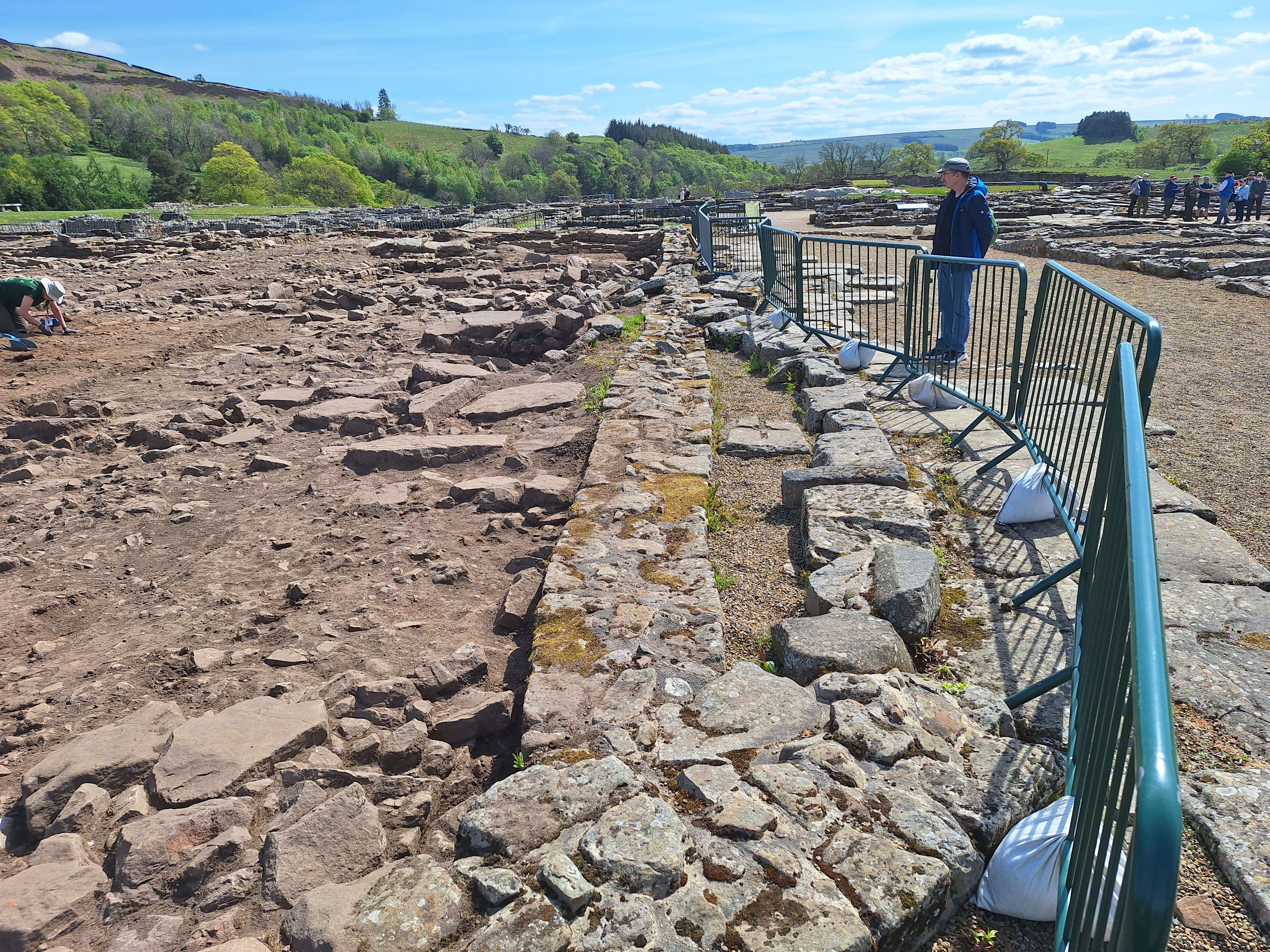
Current place I'm excavating is the apartment of the centurion. His room was always the largest and always at the end of the barracks block. Here's an overview. I know, making surfaces look interesting in a photo is a challenge.
The very observant among you might note that the floor is not buckled and bowed like the other barracks rooms. In addition to quite probably better maintenance, it seems likely that the earlier wall that "broke the back" of the other rooms is not present at this end of the building.
Various small things turned up. Not all that exciting.
Lumpy iron thing. Probably a nail, but outside chance of it being a low grade "bow brooch". It goes in the general finds bag with the pottery, glass, bones, and, yes, nails. Let post ex figure it out.
This one I had figured out right away.
It is an iron ring...with a rust stained stone stuck in the middle. Use? Ah, who knows.
And lacking knowledge I can have a little fun with speculation.
One of the ladies digging the same trench is from New Zealand. In the course of chatting I learned that she had a side gig as an extra in movies filmed over there. Of which there are many.
In one production she wore pointy ears and was part of a fantasy genre. She had signed an NDA and so could not tell me which one. * But it got me to thinking......
Hmm, hobbit sized person. Comes from as close to Middle Earth as you can get on this planet. And I find a mysterious Ring. Knowing that The One Ring can change sizes based on its wearer it is probably for the best that there was a stone wedged in there. Otherwise I supposed I would by now be turning dark and hissing about "MY PRECIOUSSS...."
--------------------------------
* she showed me a photo of herself in full makeup and costume. At which point I asked if I would have to watch the execrable Rings of Power series on Amazon to see her. Thankfully, no.
The barracks room we were in was constructed circa 213 AD. On top of a different barracks from 50 years earlier. Presumably nobody on the later construction crew had any idea what was underneath, so things were plotted out nice and neat....and then started sinking into earlier ditches, pits and assorted features. Here's an example of what can happen:
Yes, this is a wall. Or rather the top of one.
It dates to the Antonine stone fort, so lets say 140's or 150's. It looks like junk at this level but I'm told is actually pretty nice down another foot or so.
What we had to work with was without question an annoying bump in the floor to the guys who lived in this barracks room in later years. And I mean lots of later years. After the 213 build was completed the space was occupied through the end of the Roman era in the early 400's, and to some extent on into the Dark Ages. So, a couple hundred years of slumping floors, patching and replacing floor levels. And through it all the big ridge right down the center of the room was just....there...
You can actually see evidence of this buried wall all up and down the length of the barracks block....
As viewed from the next barracks room over, you can see where the later wall has had its back "broken" where subsidence has happened on either side of the presumably solid wall beneath.
That's a bit more "feature" talk than many will find of interest. So here's a sight from my morning walk up to the site. It's about forty minutes of up and down hills. At one point I go past a riding stable. I'm becoming friends with the horses who continue to expect me to produce an apple or carrot out of my pocket some day. I like the zebra style horse coat....
The Romans actually knew about zebras. They called them Hippotigris, which means horse-tiger. Once in a while a live specimen would be brought back from the coast of East Africa. They were rare novelties that were occasionally seen pulling chariots in the circus or being dispatched in the Colosseum.
Nice weather, steady progress. But I didn't find anything novel. Just another spear point and I showed you one of those last time. Mostly we were chasing walls and trying to find the perimeters of an oven. Not glamorous stuff.
So instead, a few pictures from my in between weekend.
We did a number of things, some I'll report on presently. Among them was a visit to "Northumberlandia", purportedly the world's largest human figure sculpture.
112 feet tall. 1300 feet long. Yep, she's a big gal.
It's quite a climb up to her, er, features.
The view from nose level......
Evidently some bits are more popular with visitors than others, and people don't always stay on the appropriate paths. Hey, treat the Lady right...
Everyone at the fence and "out in the world" is always interested in whether I've found some clever artifact. OK, fine, that's part of what we do. I'll get to that in a bit. But almost nobody asks about interesting "features". So bear with me, I'll try to show you something.
The barracks room I have been working in was occupied for about 200 years. That is a ridiculous span of time. Over it there were certainly renovations, mishaps, additions and removals. Doorways come and go. Hearths appear. When floors get uneven piles of debris are added and a new floor level is added. In post Roman times there were Dark Age types building ramshackle structures on top, then later still farmers trying to plow the land for a meager living.
These photos show something unusual...
Here is a nice East - West wall inside an infantry barracks room. It has the usual configuration, decent stones lined up on the inner and outer faces with a bit of rubble core in the center. It's in decent shape for having been presumably laid down in 213 AD and then repaired and kept in service for about 200 years. It sits roughly on an earlier wall from perhaps 50 years previous.
But if you look in the middle portion of the photo you'll see a red and black trowel handle sticking up. This is sunk into a small more or less round hole in the wall.
Let's take a closer look, shall we?
And a look at the wall front below this....
This appears to be a "post hole", a little socket into which a wooden post would have been inserted. The packed stones around the hole held the post in place. So, what was it? When you see a line of these in soil you know you have a wooden building. But built into a wall is weird. Did it support a canopy? Had the back of the barracks collapsed at some point? I've seen a lot of walls but this looks like a first.
Oh, OK, you want a "find"? In keeping with my policy of not showing things that might attract "night hawks" looking for a quick nocturnal pay day let me say that this artifact was falling apart when I found it and has zero market value.
Photo One. Something vaguely pointed and made of disintegrating iron. Note the weird folded appearance of the central metal bits....
Photo Two. A bigger chunk. Man, that central area looks odd. Almost organic although it is of course highly degraded metal.
Last photo, three bits assembled.
Obvious now. I must say, while I've found a few of these before this is the first example that, by way of its deteriorating state, showed me a bit about how Romans worked metal. When making something substantial such as a knife, spear or sword, you started out with thin sheets of iron and combined them by a process of heating, folding and hammering at the forge. It seems plausible that this level of technology would have been available "on site" where it is known that metal smelting and working was carried on.
Usual parade of rain coat on/off/on/off but we got about 90% of a day in.
It was fun to have a full day of actual archaeology, although I did offer to pitch in with the tedious backfill clearing if extra hands were needed. And stuff was found.
Roman Glass. You can still see through it.
Bits of pottery. Sometimes they pop out of the ground, sometimes they are embedded in the layer you are supposed to go down to. I don't mind leaving the bits in situ. They look happy there and probably just appreciate some light, fresh air and a quick clean by the recurrent rain showers.
On occasion I have something that has to be carefully considered before posting. Anything metal for instance. The concern is that "night hawks", a contemptable species of nocturnal metal detectorists will hear about nice finds and show up after dark and pilfer. But....
This thin green line in the soil is copper alloy. When you are troweling away in dull greyish brown dirt and suddenly spot something the color of a motel swimming pool, well, you've got copper alloy, aka bronze.
I feel OK about posting this because it was the thinnest bit of copper alloy foil. No value, probably not even enough for a shady plunderer to detect.
It was in any case removed with great care and sent off to be studied. Who knows, there might be something inscribed on it in spidery letters too small for my over 60 eyes to spot.
There was something going on over at the other end of the site that caused a bit of excitement. I suspect The Trust will do a special posting on this find, so I'll just put up a distance shot.
If you can figure out from this angle exactly what is going on that is really rather remarkable, well, good for you. Otherwise I'll update this when the Official social media has had their reveal.........
Weather was The Usual. Alternating sun, clouds, rain, driving rain, birds singing happily. You get used to it after a while. Here's the site during one of the sunny spells.
I don't have photos of what I was working on today. It is work in progress and at this point does not photograph well. Why would there be a ridge of debris from the circa 150 AD fort be running smack through the middle of a barracks room from the fort of 50 years later? Something has been filled in or built up or dropped by aliens. I'll try to do better on current events tomorrow.
Another thing about this spot is that it is next to the fence, so I get to talk to visitors. Today I was chatting when a kid of about 11 asked me where I was from.
"Wisconsin", said I.
"Me too", said he.
OK that's unusual, and I wondered if just possibly the kid was putting me on. No judgement mind you, I'd actually admire that level of brass. So I asked him to prove it.
"Go Pack!"
"Nope, not good enough"
"Uh.....Culvers!!!" Yep, he's from Wisconsin. If you know you know.
Perhaps in a bit of similar vein is the fact that just this year wearing camo has become rather common. Excavators and visitors both. Here's a photo taken by my friend Pete. It's me with one of the supervising archaeologists. I suppose you could make up a story about how I ended up wearing her shirt or she my pants, but get real folks, these were in both cases outer layers!
Another day of "The Archaeology of Archaeology", sifting through refill layers after that 1980 excavation. This had been carried out by a fellow named Paul Bidwell, so I decided to start a small "Bidwell Shrine" with artifacts left behind by he and his workers
Dixie cup. Broken tea cup. Looks like the top of a beer can. Guess the boss must not have been watching the lads too closely....
As you can see from the photo, nice weather held for another day. I got my customary morning walk to the site in, and happily find that the passing of another year has not made the hills steeper.
Next up is tbd, but we are probably done with the drudge work and on to actual archaelogy tomorrow, weather permitting.
Here's a barracks room that needs some attention. The better walls are from 213 AD on to maybe 400 AD. The curved "thing" from about 208. The stuff under it is obviously earlier. Layers and layers, the bottom layer dates to before 100 AD, but we won't be going there this year.
Day One was part orientation, part drudge work. The are of current interest had a brief and somewhat chaotic excavation in 1980. They backfilled the area, leaving a layer of plastic where they had stopped downward progress.
If cleaning up stuff that should have no artifacts in it sounds tedious, well it is to some extent. But it is a necessary chore and should only take a day or two. Plus, I found a nail.
Weather better than expected, and even a tedious day of digging at Vindolanda is a treasure.
Of course certain traditions must be upheld. There is a spot where in 2010 a child's body was discovered under the floor of a barracks room. Foul play most foul in the First Century AD.
On my first day I always lay a few flowers on the site. Digging as I am at a later date the wild flowers are particularly beautiful...
Writing things in advance poses a challenge. This applies particularly when you are jumping time zones and anticipating events yet to come. Presumably at time of posting in the Western Lands I'll be awake and starting my walk up the hill to Vindolanda for the first day of excavating. I assume the effects of Jet Lag Drinks Hour will be shaken off by plenty of black coffee and sheer determination.
I never know exactly who will be on hand for the digging crew. Oh, the core group of The Anaerobes have been accounted for. Some will be there. Others are dealing with publishers, with nappies that need changing, with life in LA. Who knows, perhaps our young friend Will might turn up. He excavated for one year back in 2016, at which time I imagined his return to the site.....in 2066. So how are my predictions holding up at the ten year mark? Here's what I imagined him saying:
"Stop yer whinin' ya mewling cubs. Why I started digging here long before we had HoverBarrows and back when your fancy Excavator's Spa and Therapy Centre was nothin' more 'an a hut with mud on the floor." (1)
"Ah, we had some times back then, we did. The Terrible Ancients still strode the land. Their pint glasses held a gallon and every spade they threw filled a barrow. Gone they are now, all over the edge of the spoil heap to wherever we all tumble" "Except....except maybe The Old Badger. They say that years ago - this would be after Her Ladyship passed of course - he was tricked into entering a Care Centre. The day after his hundredth birthday party he opened his eyes and looked about slyly." (2) "He mumbled something about walking to Vindolanda, but of course none of the nursing staff paid him much mind. That was their mistake because before they knew it he had tossed the blanket off his lap and jumped up wearing a pair of old hiking boots he had been hiding somewhere." (3) "He was out door before they knew it and hasn't been seen since." "I've watched for him every May since then, but I'm getting a bit rusty myself and turn the task over to you now. Oh, m' Lads, Lassies and Othertypes, (4) you may think he'll never get here, but I wouldn't bet against him. It's a long walk and the road is not straight. But I never knew him to give up on a thing he set his mind to." "Yes, he's overdue, but when he felt like walking he never would consider accepting a ride."
-------------------------------
Our young friend Will went to Cambridge and has gone on to a career in comedy. He's toured the US, he's been to fringe fests. He's hard to find on social media, but actually did - here I'm being serious for once - win the 2025 UK Pun Competition. I think he'd approve of this future version of himself.
------------------------------
1. Nailed this one. A couple years later they built a very swanky, futuristic excavation centre. This is my third "hut", and I like it the least.
2. My father in law made it to 103, both my parents to mid 90's. So who knows. And of course my Badger Trowelsworthy alter ego did strike that strange bargain with the Old Gypsy Woman...
3. Easy enough to pull off. I still retire a pair of boots every three years or so and could start stashing them strategically any old time.
4. Was I prescient ten years ago anticipating the explosion of pronouns?
When I write things move along pretty quickly. I am after all approaching 3000 of these casual essays, so they clearly don't take all that much effort. So I'm seldom if ever pensive when at the keyboard.
Pensive. An interesting word. It can mean "sad, sorrowful" or alternatively, "meditative, contemplative". I guess there is some linkage, although I prefer to contemplate and to meditate on, happy thoughts.
Over the years pensive meandered through various French words such as pensif, but ultimately it comes from the Latin. Pensare, "to weigh or consider." Or also "to hang or cause to hang".
This makes perfect sense archaologically.
A few years back I was excavating down in the layers of perfect preservation and came up with parts of a Roman weighing device.
This was your basic scale, where there would be pans on either chain. You'd put a known weight on one side - I've found a couple of those over the years too - and the object to be weighed on the other. These chain and pan gadgets hung down, or were "dependent". In fact anything that hangs down could be called a pendent.
The other meaning for Pensare has also made it to the modern world. When something is left hanging it could be said to be pending. To get back to the darker sense of pensive, something that is both hanging and unpleasant could be impending. Something attached to something else is said to be appended. Let's hope if you ever have a vague achy sensation in your lower abdomen it is not appendicitis!
Ah, hard to think anything but happy thoughts on a cold winter day....but with spring and warm sunshine in the trenches not too many weeks off.....
The excavations at both of the sites run by the Vindolanda Trust have now wrapped it up for the year. Some really good work done at each of them.
There is a natural tendency to be very invested in the areas you've personally gotten down and dirty in. And in my case that enigmatic Dark Age structure that was slopped on top of the nice, neat right angled cornered Roman features. I've talked at length about it HERE
An end of season drone shot shows it in a bit more detail. I've put solid lines around the obvious parts and dashed lines where things are "maybe" extending further back. Weird...
I generally don't like to speculate too much on these things. I was only there for a single session, and have not had a chance to study the skimpy collection of artifacts that came out of this layer. But I can probably say one or two things it is not. Not Roman for instance. It's running right over late Roman structures, and besides, they would not build things in that shape. Or partly blocking the main road for that matter. From the outline you could speculate on it being a livestock pen, but the sheer volume of rocks in this heap make that implausible. Too much effort for penning up critters in a big, tall, sturdy enclosure. Besides, the fort walls were likely standing tall at this time so cattle thievery was probably not the major industry it became later.
Ah well, if I'm lucky enough to be back next year in May that will be about the time this area is finished off, so maybe I'll find out.
Here is the end of season Vindolanda video.
And I don't want to shortchange the Magna excavation which also finished up recently. A good season with much uncovered.
There are times when the world seems particularly illogical. Among the many reasons people give for this, our system of measuring things gets the occasional mention. Why, if only we used logical metric stuff everywhere!
In large measure the system you use on a daily basis is what you are used to. When in England I get acclimated, so to speak, and know that a 30 degree day there is sweltering hot, while the same 30 degree day back home (in my usual excavation time of April/May) is dreary and has a nasty chill.
If used regularly any system works. Perhaps not for scientific endeavors but just fine for staples of conversation like the weather. Some of the old measures actually have a basis in our daily lives, or at least the daily lives of our predecessors.
One foot used to be the length of, well, one human foot. Logical, although people have always had feet of variable sizes.....
Consider the "Big Foot" Roman shoes unearthed at the Magna site recently...
In fairness this specimen is being held close to the camera, in the manner of proud fishermen everywhere, but its pretty darned big. There's a whole video on these guys.... An inch derives from a foot. In Roman times an "uncia" was one twelfth of a foot. Uncia gives us the word inch. Efforts in later times to standardize it as say, the width of a thumb, encountered obvious difficulties.
If you are having a hard time fathoming these off hand measuring units, well, a fathom is simply the distance of the outstretched arms of a good sized mariner. That's about six feet.
Early folks were big on measurements that related to their daily lives. Most of them were farmers. So an acre - although initially just a term for forest land - evolved into the amount of land a team of oxen could plow in one day. Distantly the word might have a joint origin with agri as in agriculture.
And of course we have miles. As I have documented previously, one Roman mile was one thousand strides of a soldier, or mille pacem. As measurements go its pretty useful. As are yards, the rough distance of one such stride. I'm still using the latter getting ready for deer hunting season where distances to sight in rifles and crossbows are not given in meters.
The meter of course is a French construct. But lets not let them off the hook entirely. If you go back to define an acre it once was considered one furlong (660 feet) by four rods (66 feet). Rods are an almost entirely extinct form of measurement but weirdly portages in the Boundary Waters Canoe area are still given in rods. Why? Well its a bit obscure, but I blame the French. That part of the world was explored and mapped by Voyageurs, who were using canoes about one rod (16.5 feet) long. So a canoe length as a standard of measurement made as much sense as anything else. Considering that most of these guys were traveling light and not bringing along the marking chains to survey a furlong!
Well, Dark Ages is not considered an appropriate label any longer. Sub-Roman or Post-Roman are the preferred terms.
I've been puzzling over this feature for years. Since 2010 as I recall. That's the year I excavated the big paved road on the right side of the fence and wondered, why was there this odd curved "thing" built over the main road of the Roman fort? Had to be Sub-Roman, but what?
The arc seemed to enclose the jumbled mass of demolition that we had to pick through so carefully back in early May.
When digging at Vindolanda there are always those who come before you and those who follow after. A more recent crew has painstakingly cleared away the rubble. Before this "stuff" went away it was carefully recorded, and every nook, cranny and flat surface was examined for clues. Sub-Roman strata rarely give up much. More on that in a moment. From a recent session end video, here's the wall with its continuation.
It's big. It might have used the existing earlier wall as its back side. I am pretty sure I am seeing the other curved bit peeking out on the left side, although not having the yellow high light makes it a bit harder to say for sure.
So, what is this big, oval, decidedly non-Roman thing?
The Period 5 video round up discusses it a bit. Here's the full video for those interested.
If you want the short version, it could be a "hall" of some sort. Some Post Roman notable, perhaps a war lord or some such, lived and/or feasted there.
Things that were on a Roman site after the Romans are not as well documented as they should be. Early archaeologists were called Antiquarians, and their notion of proper excavation was to hire a bunch of local lads to swing pick axes and mattocks on their way straight down to where they thought the good stuff was. Temples, headquarters buildings, that sort of thing. Obvious later stuff, in addition to being more beat up by plows, was just considered shoddy rubbish to be bashed out and forgotten.
I suppose we have to cut them a little slack. Their understanding of history had a definite "Imperial" flair to it back then, and also, Sub-Roman structures did not have much for artifacts. When your political and economic world implodes you, for instance, stop having any new pottery. Oh, people still knew how to dig clay and probably how to make the stuff, but real expertise was gone, the roads were no longer safe for commerce, and coinage had gone away.
Hopefully the few bits and bobs that were found - and I only know some of them - will help tell the story of these people. People who lived sadly among the ruins of what must have seemed to them to be a lost, advanced civilization.
Or maybe not. Perhaps the freedom to build and to live any darned way they pleased was precious to them.
It's necessary, but a bit sad, to see delicate features like this go away as the excavations go deeper. But they've all been carefully documented. And besides, that mysterious arc extending out the front will be preserved forever.