Thursday, May 31, 2018

Digging Hill 80 - Eighth Report

Another hot and humid day on site.  We again had dire, stormy weather predicted but were spared all but a few passing sprinkles.  Honestly, Belgian weather forecasters must be the most pessimistic souls on earth.

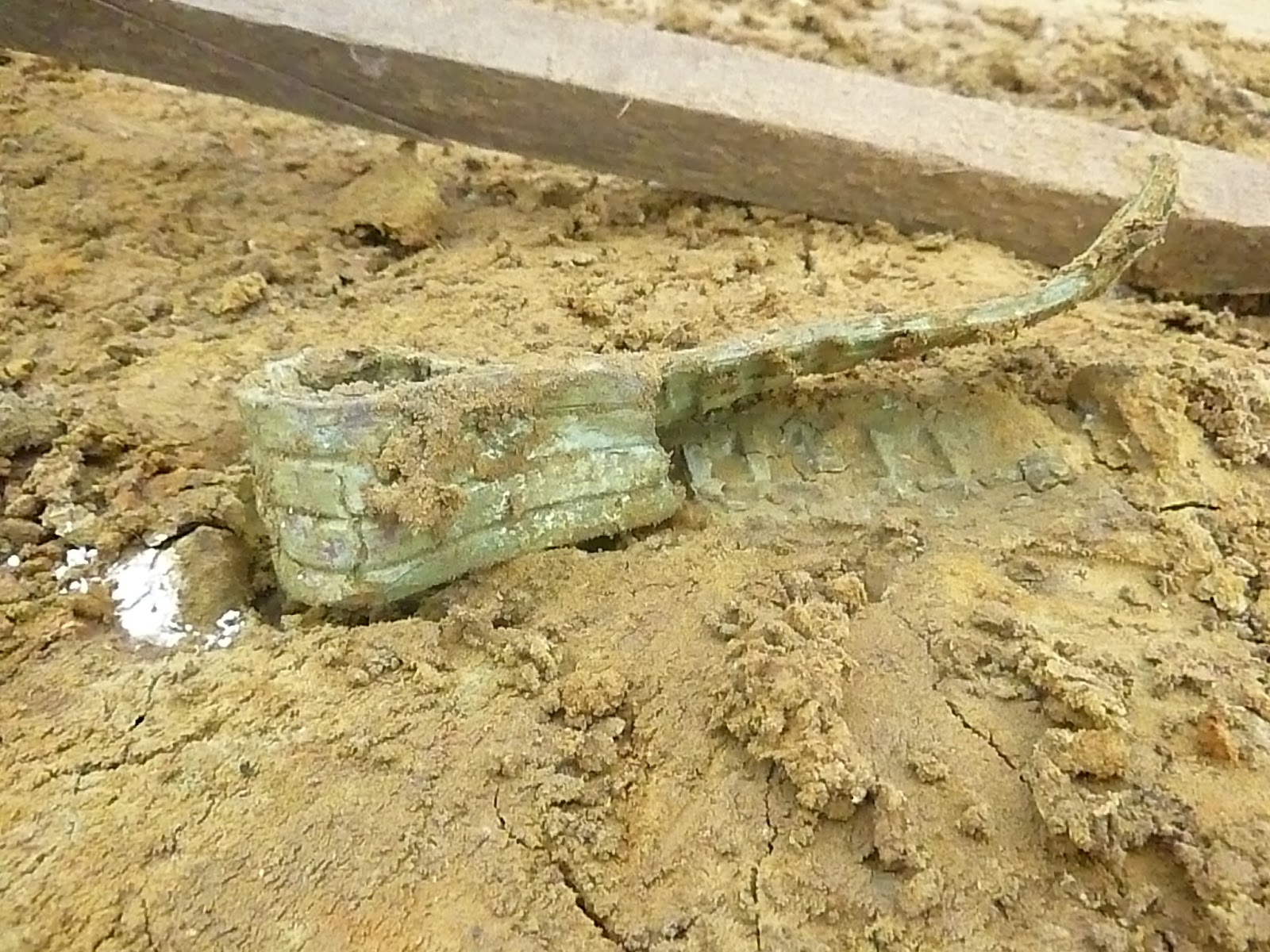
I spent the morning on some rather mundane trenches.  Pretty much just digging square holes with a nice cut face on one side to show changes in soil color.  Here are a couple of mystery objects that came out of the next trench over.  The bullet is for scale.  Guesses?


Trenches are usually spotted when the initial de turfing and scraping is done.  Here a squiggly trench - or maybe a squiggly something else - has been highlighted with spray paint.  I believe a wider part of this trench contained a mostly intact horse skeleton.


In the afternoon I was back working on the things I can't show you.  Helping define the perimeter of a burial site.  It is careful work on very complicated features.  Since ID tags did not seem to be in common use you would have to get very lucky to make a positive ID on any of these bodies.  One or two have had personal items that just might help us out but these take careful study.  But even being able to say with some confidence that it was a soldier from a certain country, who probably died in a certain year is worth something.  They will eventually rest in a grave yard surrounded by their comrades instead of under a wooden stake painted orange.


The Return of Badger Trowelsworthy

It was not a particular surprise to see him, even though he was dead.

Badger Trowelsworthy, you see, is a creature of habit.  In any drinking establishment - even this small cafe in rural Belgium - he will always take a seat at the optimal vantage point from which to have a good view of all exits and of the barmaid's decolletage.  After a while your eyes just locate that spot every time you enter a saloon.


I went to the bar to obtain a measure of Fortification and asked Emil about his guest.  He lowered his voice and whispered that Don Paleta had arrived from Paraguay just before dawn.  

I sat down without waiting for an invitation.

"Lord Trowelsworthy.  I am surprised to see you take less care with your aliases these days".

"Perhaps because the world takes less care in hunting for me.  My obituary after all was published one year ago today."

I raised my glass in salute and acknowledged that it was one of the better ones he had written.  Various small talk ensued.  Badger Trowelsworthy has always displayed great interest in my family, in particular my grandson who he refers to as "That Most Promising Scamp".  In exchange for a few amusing anecdotes of youthful doings I am granted the privilege of asking of him one or two questions of a personal nature.

"Yes, about that obituary.  It claims you were born in 1910, but that your birth certificate was an obvious forgery.  If I could see the real document what date would I find on it?"

"Oh, it would be somewhat earlier".

"A bold, if not bald faced claim.  Yet here you sit before me, visibly a vigorous fellow in his early sixties.  How do you reconcile that with being well over one hundred years old?"

For a brief moment, and only because I was looking for it, the usual Trowelsworthian expression of bemused vigilance was replaced by something.....indescribable.  He murmured something to the effect of: "The Gypsy Woman drove a hard bargain but a True One", and would say no more on the matter.

He made a subtle gesture and instantly Emil presented him with another drink.  This ability to telepathically communicate with barkeeps fascinates me and one day I must expend a precious Question or two to explore it....

"I must say your Lordship, rural Flanders seems a bit, well, rustic for your usual tastes."

He took a sip before answering.  "Yes, but it was not always thus. A century ago the attention of the entire world was on this spot.  The fate of Empires hung perfectly balanced as the outcome of the Great War was determined right here. Oh, it was a busy place.  The uniforms of many armies were to be seen in the predecessor of this establishment.  I know, I wore several different ones at various times."

"Oh, my.  A turncoat Trowelsworthy!.  That seems a bit outre' even for you!"

"Well, m' lad, bear in mind that all the Great Powers and most of the Second Stringers had declared me persona non grata by then.  It seemed mere poetic justice.  And besides, my intentions were Pure.  It would have been inappropriate for the personal treasury of King Albert to be spirited off to a foreign capital, be it Berlin or Paris.  No, far better that it remain here, buried in proper Belgian soil."

"Ah, I see.  So it would be our little excavation on the edge of the village that has brought you here.  I suppose you would like me to keep a close eye out for something interesting?"

"Would you be so kind?"

"I would not.  I have come to know you too well.  Your reason for coming here must be to divert attention from some other location you would like to visit with, shall we say, more discretion."

He smiled as he finished his drink in one great draught.  He tossed out on the table several garishly tinted banknotes of a currency I did not recognize as he bid me farewell.

"Tim, it is such a shame you likely have only a few more decades for further improvement, because you have in your own right the makings of a Most Promising Scamp."


Wednesday, May 30, 2018

Digging Hill 80 - Seventh Report

Another day of sunny skies, the predicted rain never arrived.

My morning was not very exciting.  Sometimes you just have to dig the trenches you are assigned.  One was all natural clay and rock.  Another was noteworthy only for the large pile of shrapnel that came out of it.  In fact it was probably a shell hole instead of a trench, or a trench that got hit by a shell.


Early in the day, before the mist had burned off, some Belgian army guys pulled up in this truck.  We figured they were there to haul away the 8 inch shell still parked in the middle of the dig site.  But they were just a couple of jolly middle aged reservists whose job it was to take some photos.  They seemed to particularly enjoy chatting with the ladies on the excavation team.


Later in the day a couple of much fitter and more serious looking guys from the Army demolition team turned up and hauled our pet explosive device away to be dealt with.

My afternoon trench was quite a bit more interesting but unfortunately this is the kind of stuff I can't show you.  Suffice it to say that we are hoping to do our small part for Individual 65.  We won't likely know his name but from artifacts and such can perhaps at least get him into the correct national cemetery....

But I feel I should show you something interesting.  Have a look at this and see if you can figure out its purpose.


Tuesday, May 29, 2018

Digging Hill 80 - Sixth Report

The Ypres Salient was known during the Great War for its deep, clinging, foul smelling mud.  Sometimes weary soldiers would simply be unable to move at all and would just sink out of sight. Today we got just a little taste of it.  After a night time thunderstorm that perhaps recalled a little of the artillery battles of a century ago the site was awash.


This is the line of the German trenches, the steel revetments still in place.  And remember, the Germans occupied the high ground.  Down the slope where the British lines were it was probably like this even with gentle rains.  Clearly there was ingenuity involved in surviving under these circumstances.

I was excavating a trench a bit higher up the slope.  This is probably not in the category of news you can actually put to good use, but if you are ever happily digging, say in your garden, and see something that looks like this, you should step away and summon Gerhardt the ammunition specialist.  I had carefully troweled away just enough soil to identify this as a hand grenade.   


Most of our finds today were British, presumably from their occupation of the site from mid 1917 to Spring of 1918.  Below is a brass cylinder that contains the cleaning kit for a Lee Enfield rifle.


Here is our trench nicely cleaned up.  Notice the wooden duckboards down at the bottom.   There was a drain running below it.  It might have helped some.


Here making their first appearance since 1918, wooden planks placed to keep the boots of soldiers long dead from getting as clogged with clinging mud as mine got today.


Monday, May 28, 2018

Digging Hill 80 - Fifth Report

No silly photo to lead off today.  It was a good day of work, one with sunny weather, good company and interesting finds.  But a bit of a somber day as well.

With the cellars essentially done the focus of work shifted today to trenches.  There is quite a network of these known or suspected, and many segments that are designated for at least a cross section.  Some of these turn out to be just shell holes or natural features.  The bona fide trenches we do find are surprisingly shallow, but to be fair there has been quite a bit of archaeologically uninformative top soil that was scraped off at the beginning of the project.   

The day started off with a nice find:


Here we have a British "Brodie" helmet being carefully excavated.  It turned out to be an isolated find, its owner not in the area.

I was working with an American couple who had never done any archaeology before.  We had a good time working a couple of trench sites that turned out to be nothing much, maybe just shell holes.  Here's a nice picture of them as a background for me holding up a bit of brass timing band from a shell.


Below is a somewhat bigger piece of same.  These were made of high quality brass. One imagines that most of the church bells of Europe were melted down for this profane purpose....


They seemed to be getting along pretty well, so they were put into a section of trench right next to where I was finishing up.  And wouldn't you know....in minutes they had encountered human remains.

No photos of that trench or of any finds associated with it.  We just tidied up for the anthropology crew to do a proper job of exhumation.

Then onto another trench section where I finished the day by finding a shovel.  Not much difference in this technology from a hundred years ago to today.


Saturday, May 26, 2018

Digging Hill 80 Humble Abode

Those of us on a prolonged stay at Hill 80 are living in a dilapidated house.  It used to be a Parsonage.  This Disturbing Photo of the Day is of a series of murals on the wall.  I dunno, was this supposed to be Mary Magdalene?  The pallets are what all the dig equipment came to town on.  Now it is furniture after a fashion....


It is kind of an odd place.  Magnificent wifi, a shower that works, wood pallets for furniture.  I have however been working hard enough that a foam mattress on - you guessed it - wood pallets has been very comfortable....zzzzz

Saturday so no digging today.  I went for a bit of a wander.  No goal in mind but the theme turned out to be:  Bunkers.

In the woods a few hundred yards - I mean meters - from the dig site:


Notice the little "mail slot" in the door?  This German front line bunker has been converted into a bat sanctuary.  The perfect place to hibernate.


I've mentioned that in June 1917 the British set off a series of deep underground mines and blew up many German front line positions.  Well, the Germans were not entirely clueless.  They had attempted to dig a series of shafts to intercept the British efforts.  The picture above is of a German mine dubbed "Dietrich".  Now filled with water the unsuccessful effort went down 25 meters then over 180 meters towards the British lines.  It is now full to the top with water.  In this case the German tendency to occupy the commanding high ground backfired on them.  They had a lot further to go to reach those British tunnels.

When the British blew up the German front lines in 1917 they did a very efficient job. But they missed a few.  This bunker on the road between Kemmel and Wychaete survived the attack and caused many casualties to the Irish Division advancing through this sector.  The barbed wire is modern and for no more militant purpose than containing cows.


Kemmel is a couple of kilometers east of Wychaete.  It was a significant British stronghold during the 1915-1917 period when the lines were pretty static.  It fell to the Germans in their last ditch 1918 offensive.  Later in the year the Allies took it back.  This is one area where American troops did come into play, but the Germans had withdrawn without a fight.  These Bunkers were British, but with temporary German residents for a few months in 1918.


The inside structure is made of this precast concrete.  You see a lot of it still in use in local farms.  I assume it is "vintage".


Some of the bunkers have a few signs of damage. 


A hot and sunny day for walking, 81 degrees Fahrenheit, which is about 800 degrees Celsius.  I've been typing with a cold beer at hand and with my enthusiasm for much needed house cleaning steadily but near completely slipping away.....
--------------------------------
Addendum.  I have since learned that the odd decor is due to the house being used as a filming location for a Belgian mini series called Eigen Kweek .  It is speculated that the lady on the murals is one of the actresses in the series but I have not been able to learn much more on it.  The descriptions I have found of the show make it sound like a Flemish "Breaking Bad" where a potato farmer swindled by his stock broker turns to growing marijuana.  

Friday, May 25, 2018

Digging Hill 80 Fourth Report

Concerning Photo of the Day, Week and perhaps longer time interval.  Also the Best Work Photo Ever Taken!


I am on the left side sitting behind our Explosives Tech who has just "dealt" with the British 8 inch shell that is sitting in front of our group.  Somebody in jest called out "Team Photo", and it actually seemed like a good plan.  An international group, Germany, Belgium, UK, US, Slovenia, Spain and maybe one or two I have not figured out yet.  Photo credit to Helen the Wedding Photographer!

In any case that was yesterday.  Today started out less sunny.  In fact Flanders was a grey, mysterious place on my walk to the dig site.  The local cemetery.  All post war of course, the original one was destroyed.


More work on our cellar.  We moved a lot of bricks and debris today.  Finds were few but interesting.

The fuse from a good sized artillery shell.


A German army issue folding spoon and knife kit. Not exactly a Spork but kind of like one.

And the best find of today.  This is the metal trimming on a German army "Pickelhaube" helmet.  Those are the ones with the spikes on the top.  They were actually quite useless in modern war, being made of leather, and were replaced fairly early on.


Of course the main job is not finding stuff but defining the structures and figuring out how all the pieces of the puzzle fit together.  I spent this entire week clearing out a cellar.  The other cellars that had been done were all just scooped out with the excavator and then tidied up.  For us it was shovels, buckets and barrows.  It seems our cellar was in an inaccessible corner where the digger could not reach properly.

Here we are, end of Friday.


A nice bit of work if you don't mind my saying so.  One of the other excavators who hand not been over for a day or two asked "Machine dug?"  I just flexed a bicep.  The last corner and those big cement bunker blocks can be reached by the excavator so I'll let the machine do a little of the work.

Our cellar has a connection to another cellar next door.  It looks to have been made during the war, as a way for troops to safely move about under ground level.  We were the first to go through this passage way in 100 years.  From the obvious cracks appearing above me in this photo it is fair to say that we will quite likely be the last to ever do so.