Wednesday, June 28, 2017

Protestant Cemetery Rome - A classic in distress

One thing that is not obvious to somebody visiting from the U.S. is just how...Catholic Rome is.  Even those who are not observant in a religious sense are almost universally Catholic from a cultural perspective.  Coming from a part of the world where Protestants outnumber Catholics it required a little adjustment to my thinking.

Because of course when non Catholics were so rare, and the prospect of burying them alongside the loyal flock of the Papacy so unthinkable, there would have to be a Protestant Cemetery.  Or to call it by its official name, Cimitero Acattolico.

Before the Reformation there would have been no need for one.  The only religious minority worth mentioning was the Jews, and they had their own succession of burial grounds.  Unknown in the earliest days, then in several Jewish catacombs.  A Jewish cemetery in Trastevere was recently discovered dating to the Medieval period.  

The first burial in the Protestant Cemetery dates to 1716. Exiled members of the Stuart court were at that time given dispensation by the Pope to be buried here, joined later by unfortunates whose Grand Tour had come to a sudden end.  It has been in continuous use ever since, and even with a couple of extensions it is a crowded place.
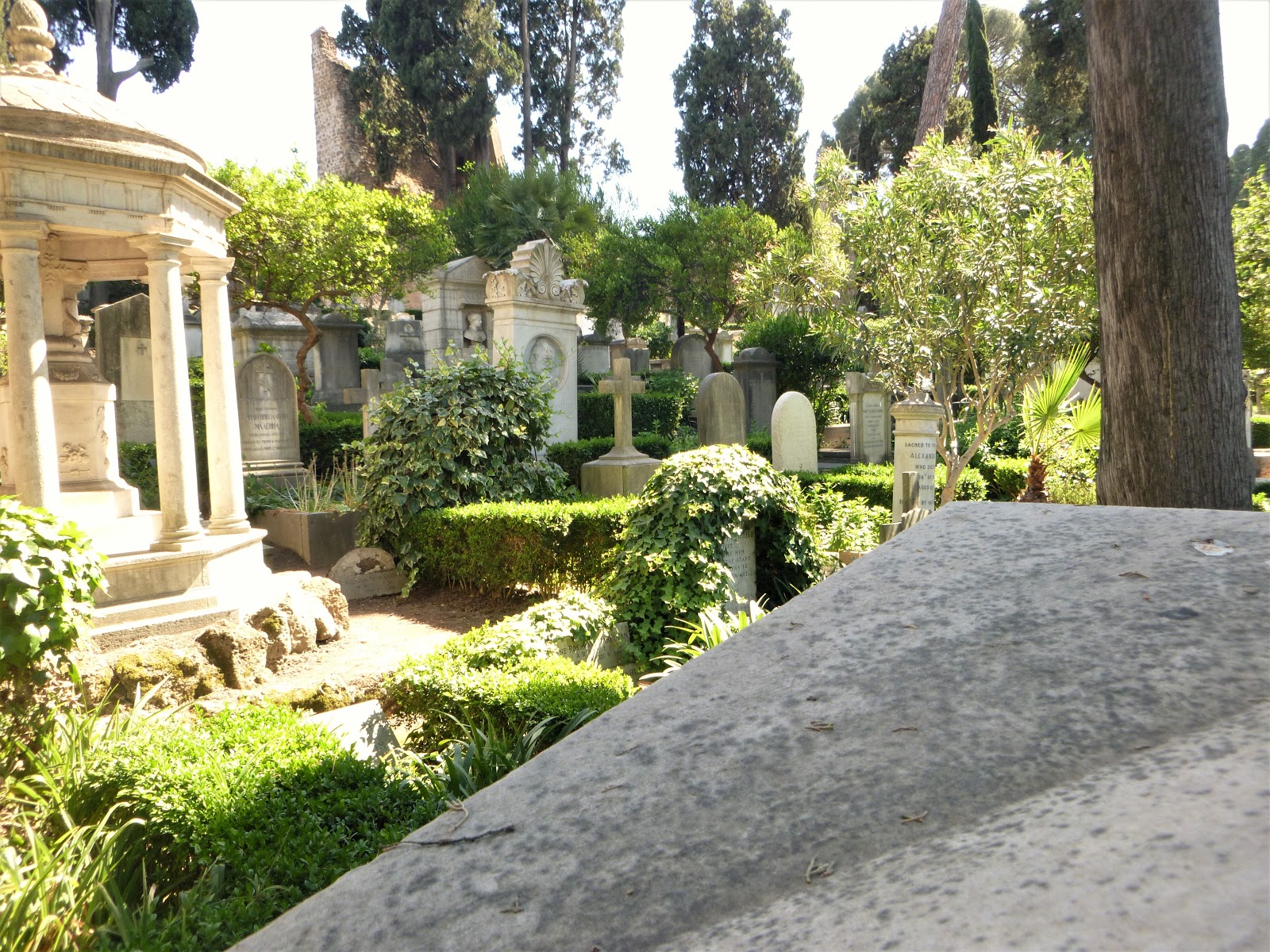

It is most famous for its "celebrity" graves, those of the poets Keats and Shelly.  But it has an eclectic population.  Protestant, Jew, Eastern Orthodox faiths are represented. Englishmen are probably the largest group but Russians, Germans and Americans also turn up.  Diplomats, artists, archaeologists all have their contingents.  In fact the cemetery is governed by a board made up of various Ambassadors of the foreign community.  In times recent funds have been in short supply and its financial status has become shaky.

What a marvelous place for a cemetery!  It is adjacent to the Pyramid of Cestius and has as one boundary nothing less than the Aurelian Wall!


Here a finely executed memorial is set into a niche in the wall.  If that is not original Roman opus reticulatum brick work it is a damned good imitation.


The oldest section of the cemetery runs right up to the edge of the pyramid.  Actually that is set down a ways, no doubt reflecting the original ground level.  You can just see peeking out one of the four pillars that at one time stood sentinel around the monument.


We shall ignore the well known graves - Keats and Shelley get plenty of attention. Here are a couple of interesting ones:

This is part of the family tomb of Thomas Jefferson Page.  Yes, he was a Major in the Confederate Army.  Prior to that he was an officer in the United States navy.  His was an eventful life....fighting Japanese pirates, exploring South American rivers...his connection with Europe was that he was sent there during the Civil War to purchase naval vessels.  He eventually did succeed at this, captaining the powerful iron clad C.S.S. Stonewall but arriving back in home waters just after the war ended.  Man, what a bio!


Artists are well represented here.  But this is actually the grave of a dancer, John Louis Piccoli, an American who died in 1955.


Historic sites in Rome tend to be very cat friendly.  The Protestant Cemetery is no exception.


Cats don't spend much time pondering their own mortality.

And they don't spend any pondering yours.


Worth a visit if you are interested in the intersection of ancient and more modern history.  They very much appreciate donations to keep the place up.  

Monday, June 26, 2017

Porta San Paulo - Defending Rome, sort of, for 18 Centuries

This week's edition of History in a Place is centered here:


Quite a lot to take in really.  This is a view from 1747 when a man named Giuseppi Vasi published a book of views of Rome.  His focus was on places important to pilgrims and this was included because it was the road to the Basilica of San Paulo, better known as St. Paul's outside the Walls.  This is the traditional location of St. Paul's grave.

But so much more going on here.  How 'bout a modern view.


I could not exactly duplicate the perspective of the early engraving, at least not without being run over by multiple vehicles.  

The first thing that grabs your eye is of course the Pyramid.  This is by far the oldest thing in the picture, being the 1st Century BC tomb of Caius Cestius.  It was built in the days when all things Egyptian were quite the rage following the Roman conquest of Egypt.  From inscriptions it is known to have been completed when Agrippa - a friend of Cestius - was still alive.  (Agrippa, son in law of Augustus, died in 12 BC). It is also recorded that the Pyramid was completed in just 330 days, quite the remarkable feat by the inefficient standards of modern Rome!  As you can see in the early view, it was one of the existing structures built into the Aurelian Walls. Although it is impressive the Pyramid is not our main focus today so lets look a bit to the east...


Here we see the Porto San Paulo, looking a bit adrift with its adjacent walls chopped off by assorted mishaps and for the benefit of modern traffic. It is similar to the previous gate we visited along the Aurelian Way.  Note again the accumulated upgrades from the time of Aurelian onwards...the addition of rounded towers, the two stages of height, the double doorway blocked down to one.  It also has a courtyard behind it with two surviving gates out into the city.  


During the Gothic Wars a group of Isaurian soldiers, who had gone unpaid for too long, opened this gate to Totila and his Goths in AD 549.  This seems to have been part of a repeating pattern, another bunch of Isaurian's had opened the nearby Asinarian gate during another Goth incursian in 546.  Isaurians it seems, just can't be trusted as guards.

The Aurelian Walls served as deterrents in the long centuries that followed.  Saracen raiders, feuding locals, other European powers that took exception to Papal policy all came and went.  But the Porta San Paulo had one last battle to witness.

It was September 10th 1943.  Two days earlier Italy had agreed to an Armistice, effectively ditching Germany for the Allies.  At first it seemed as if Rome would be left alone, declared an open city.  But Hitler changed his mind, and German forces marched north towards the Eternal City.  

Confusing battles ensued with Italian forces fighting on one side or another or just trying to stay out of the way.  The Last Stand was here at the Porta San Paulo where a mixed force of Italian soldiers, Communist resistance fighters and poorly equipped citizens attempted to hold the ancient walls against modern artillery and flamethrowers.

Of course this ended badly, with 570 Italian dead and minimal inconvenience to the occupying German army.  To one side of the gate is a surviving section of wall.  The plaque reads:  TO THE RESISTANCE THAT HEROICALLY MARKS HERE ON 10 SEPTEMBER 1943 THE SECOND RESURGENCE.  


On the other side of the gate the wall was destroyed in a later bombing raid.  On the new wall is a marker remembering one of the fallen of 10 September.


Italian military monuments are few in number.  But at the Porta an Paulo you see numerous memorials.  Here is a plaque honoring the first Allied troops who entered Rome in 1944.  Alongside are other memorials that mention the "Tedesco Invasore" - the German Invaders.  And the Nazifascista, which hardly needs translating.


For all its reverence for the distant past, for all honor given to the accomplishments of the Roman Republic and Empire, Italy very much downplays its recent history.  I am sure there is a collective sense of guilt for being the birth place of the Fascist movement.  I'll close with one final view of the Porta San Paulo.

This was intended to be one of the centerpieces of Mussolini's new Rome.  From this gate went the road to Ostia, which was to be excavated as a display of Ancient Glory. Also on this road was the EUR Center, a sort of Fascist Disneyland of concrete.  The display below is right outside the Ostiense Station, a rail center specifically built for the arrival of Adolf Hitler on a state visit  in 1938. The road you see in front of you was once named Via Adolf Hitler.

The mute statues, chains binding them together, represent the victims of the Fascist plague that Italy helped unleash on the world.


Friday, June 23, 2017

A Tax Free Lunch?

One of the difficulties Italy has in collecting taxes is that a lot of the economy is still on a cash basis.  When you for instance pay for several nights lodging with a big roll of Euros you do wonder if this income ever gets reported.  Oh, credit cards are accepted some places.  Restaurants for instance will usually take them.

On our last day in Rome I snapped a quick picture of this place on the Via Trastevere. I wonder if the credit card machine ( called a Point of Service) was really broken or not.  And I do like the inadvertant pun!


Wednesday, June 21, 2017

The Finance Police on the Case!

I guess its not exactly a secret that Italians are, shall we say, less than diligent in paying their taxes.  People who actually understand the intricacies of the VAT tax estimate that in 2014 Italians "evaded" 27.5% of what they should have paid. That makes for a not insignificant 36.9 billion Euros.  And that is just for VAT, one of the many taxes that Italy has on the books. The actual, total scope of tax evasion?  Who knows. Lots is a fair statement.  And it takes a toll, our trips to Italy have been made a bit less enjoyable by trash in the streets and archaeological sites closed because the government is chronically underfunded.

I was a bit taken aback to find out that the Tax Police actually have squad cars!


But I was really surprised to find out that they in addition have an "air force" of 100 planes and helicopters and a "navy" of 600 vessels.

If that seems a bit over the top for the purpose of persuading people to take paying taxes seriously I suppose it is only fair to mention that this branch of what are called "militarized police" also have responsibility for many other functions including preventing drug trafficking.

Wikipedia of course has so  Much More.  The Guardia works to track down illegal art sales.  They fight credit card fraud.  They run mountain rescue stations.  They even have nominal duties to prevent illegal immigration.  I wonder if their ships and that of the Italian Navy ever fire shots across the bow as the latter is currently tasked with rounding up ramshackle refugee vessels off the coast of Libya and towing them back to Italy.


Here's the current commander of the Guardia Finanza.  Although the Italians are not notably proficient at either military or police matters they do have the best damn uniforms.

Monday, June 19, 2017

Bernie and Donald have a Thrift Sale

In small town America there are certain things that are just givens.  You want to have a yard/garage sale?  Go ahead and put up some signs.  So there was considerable consternation last year when the city "decided" to enforce an ordinance regardings signs. No more putting them out on the curb where they would be seen.  They had to be in your yard and set back a ways.  And you could just forget about putting them up on one of the high traffic public corners that were known for being "the place" for yard sale signs.

The long standing ordinance no doubt was originally intended to prevent ugly commercial clutter, but for signs that were dutifully put up on Thursday night and taken down on Saturday afternoon this was overkill.  Signs were even confiscated by city workers!

This was before the election and some speculate that the Civic Powers that Be did not want to see too many political signs out there.

Well the election is over.  The signs are back in their traditional places.  Any lasting effects?  Well, just maybe.


A very odd juxtapositon of elements here.  A Trumpian phrase.  Bernie Sanders' unkempt hair and oversized glasses.  And...the twitter bird?

I suppose the basic message is one of bipartisanship.  Come to the Yuge Sale. Your money is good no matter your politics.  

Of course Bernie would probably charge you a higher sales tax!

Hmmm, I had not set out to do so but it seems this week will be about taxes.  Only reasonable as recently on the Appian Way we had a full week of the other Immutable - Death.


Friday, June 16, 2017

The Baths of Caracalla - A Negative Review

Sigh.  Lets get this one over with.

As you can tell I love Roman sites.  It takes a lot for me to dislike one.  But the Baths of Caracalla worked hard to get this negative review.

As you go here and there in Rome you can see the Baths from afar.  They are huge. The location is near the beginning of the Appian Way, but on this "History in a Place" stroll we visited it on a walk that started out near the Circus Maximus.

Here's the complex up close:


You need to think of Roman Baths as being a sort of full service public entertainment complex.  You had your swimming pools, hot and cold baths but also libraries, gardens, an exercise area.  All built by the Emperor for the pleasure of his people.


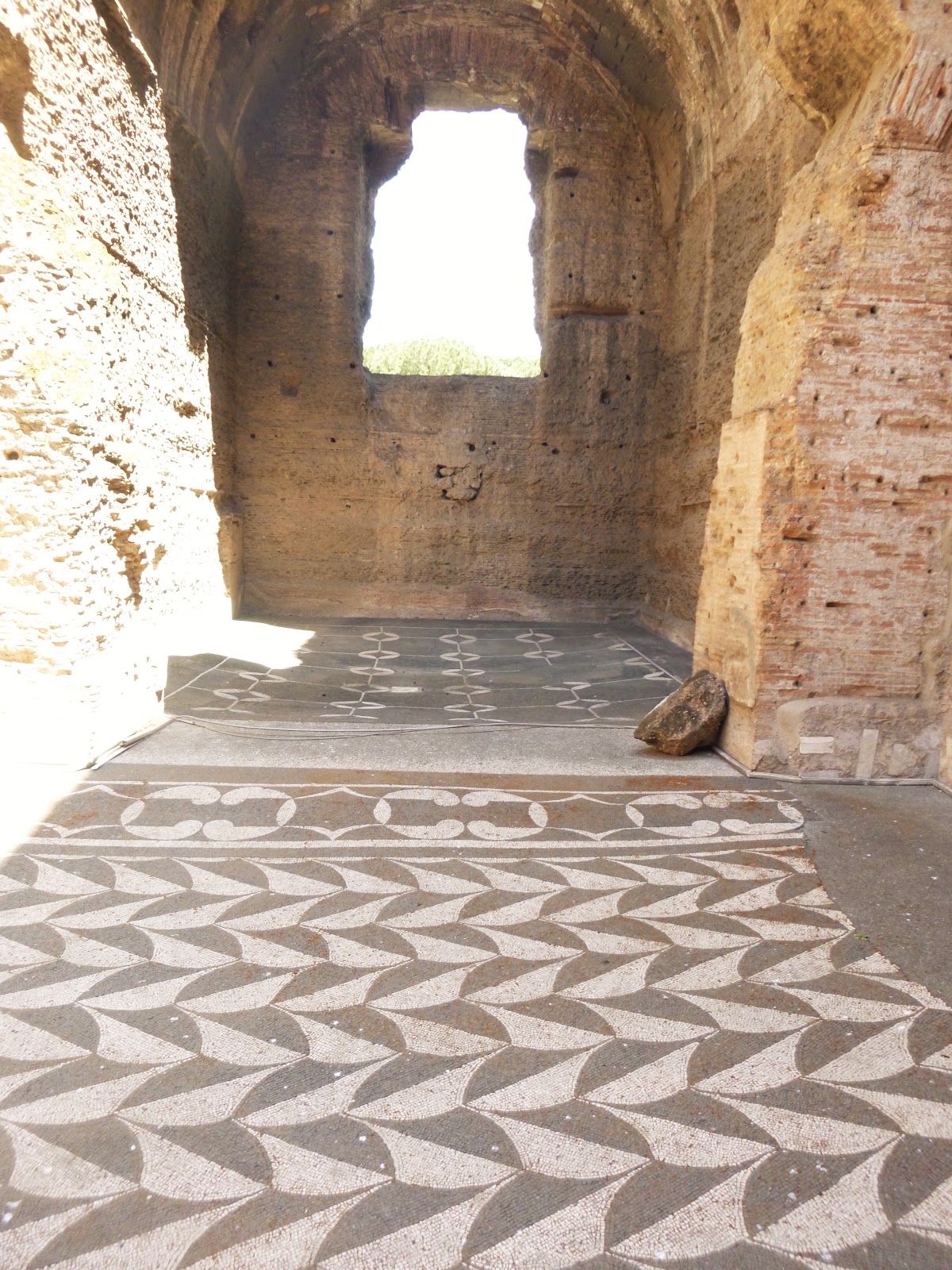
Many of the best mosaics - and some really first rate statues - have been removed to various museums.  But of the plainer mosaics there are plenty. Below a team is stabilizing one of them.  Note also the wall decoration...few people realize that mosaics could be vertical as well as horizontal.


So what's my gripe with the Baths of Caracalla?  The above photos have just shown you all there is to see.  Its fine, but if you are into this sort of thing there are other, if smaller, baths that show you more.  The main reason we wanted to visit this one was to see the extensive network of underground service tunnels, drains, cisterns etc. Heck there is even Rome's largest Mithraeum down there.  So lets get out of that hot sun and see neat things!


A locked gate.  No notice that this part of the site was not open.  For that matter the officious guy at the ticket office who refused to honor the 3 site pass I had acquired (I had not been able to specify the exact time of our visit) rubbed me the wrong way too.

So my advice is take a look at the marvelous Baths of Caracalla from some nice vantage point.  The Palatine Hill or the Aurelian Wall gate of San Sebastiano give you a nice view.  
--------------
Wrapping up this week's "History in one place" visits:

1. Case Romane del Celio was very much worth the visit.  Strolling up that more or less original Roman Imperial street coming up from the Colosseum area was a nice lead in.  Opening hours are listed as 10 - 1 and 3 - 6.  Closed Tuesday and Wednesday.

2. From Case Romane its just a short stroll past the Basilica and into the park where you can visit the obelisk.  We had the place to ourselves other than a shabby looking guy snoozing on a bench.  If you need a bathroom there is actually a decent looking public facility in the park.  It costs one euro but heck, in Rome the alternative is usually going to a cafe or bar and buying something.

3. We exited the Celimontana park next to the "little ship" on Via Navicella.  We should have stopped in at Basilica di Santo Stefano Rodondo which was right in front of us.  Its a fifth century church with some extremely over the top frescoes depicting every form of martyrdom you can imagine.  And a few you probably didn't.

4.As I said, skip the Baths of Caracalla.  But as we were strolling towards our next destination we did find something interesting and useful on Via Aventino.  At number 32 you will find....a buffet.  In Italy, where meals are supposed to take forever and you only get one course at a time!  It was a revelation and when you have places to get to having things go at your pace is welcome.  Food was quite good too.
-------------
I actually have at least four more weeks of "History in one place" features, but lets take a break next week.  Pot luck.

Wednesday, June 14, 2017

The Celimontana Obelisk

With a dozen obelisks scattered around Rome - not counting a few modern examples - it can happen that you just stumble across one.  That's how I found the Celimontana Obelisk.

We had been visiting the delightful Casa Romane del Celio site and decided to walk over to the Baths of Caracalla.  When the gates of a pleasant garden appeared along my proposed route it was easy enough to nip on in.  The gate we entered was off of the Via di S. Paolo della Croce, and brought us into the gardens associated with the Villa Celimontana.  This is on the Caelian Hill, perhaps the least known of The Seven Hills.

The villa is much renovated and now serves as the headquarters of the Italian Geographic Society.  The associated gardens are a public space, and are a delicious quiet retreat from the nearby Tourist Chaos of central Rome.  And the best part was that we rounded a corner and saw this:


If you think this obelisk looks to be a bit of a hodge podge, you are correct.

The history of the obelisk follows some familiar routes.  It  erected by Ramses II, and was one of a pair that stood in front of the Temple of Ra in Heliopolis near modern day Cairo.  They were transported to Rome in Imperial times and were part of the Iseum, the Temple of Isis, that stood near the Pantheon.  This site was the source of numerous extant obelisks. 

At some point this one was moved to the Church of Santa Maria in Aracoeli on the Capitoline Hill.  It was in any event there in the 14th Century.  It appears to have fallen down and/or been moved elsewhere.

Fast forward to circa 1582 when the Senators of Rome gave the Obelisk as a present to Duke Mattei to help decorate the grounds of his new villa on the Caelian Hill.  As a present it was a bit of a Dog's Breakfast, composing parts of several other unidentified obelisks mated to the upper section from Heliopolis.

The villa and grounds were not kept up all that well, and the obelisk again fell over. It's not all that surprising, the patched up bits of several structures must have been rather unstable.

A Spanish stateman named Manuel de Godoy lived in the manor in the early 19th century and undertook to restore the obelisk and to have it moved to a better location. In the process of reseating the obelisk a workman had his arm accidently pinned under the base and amputated.  Because they were not about to lift the obelisk up again it is still in there.