Tuesday, January 12, 2016

Archaeology at the Drive In Theater

If you knock around assorted Roman sites for a while you find recurring themes. The Roman Empire was in many cases literally the foundation upon which Western Civilization was built.  So seeing what was left over after the Fall - the Detritus of Empire - fascinates me.

In many instances Roman structures were repurposed to a latter and lesser age.  Theaters and amphitheaters were reinforced and became fortresses. Streets and public buildings became out door markets where rustics bartered their wares.

Oddly in the modern age this sort of thing still happens.

Drive in theaters were a distinctive feature of American life in the post WWII era.  They combined automobile culture, suburban expansion and a classic era in cinema.  You loaded up the car, perhaps with a few extra kids hiding in the trunk, and settled in at dusk for a long night of watching movies and the opposite sex.

Almost all the drive in theaters are gone now.  The land they were on got too valuable.  The seasonal nature of the business in many climes was difficult.  (Probably) movies got worse.  Certainly they became more available elsewhere....first in mall multiplexes then on your VCR and now on Netflix.

One recent morning I went to a flea market in Florida.  It was on the site of a classic drive in.  The Northside was built in 1949, enjoyed the boom then limped along for decades.  Here it is today...

The asphalt roadways snake back and forth.  These were the parking stalls in its earlier life, now it is where the flea market vendors park their pickup trucks and set up their tables.  There are various levels of fading paint from the row and stall markers from both eras.  And of course beyond we have the screen.


But first lets check out the snack bar.  This looks to be 1970s to me but perhaps turquoise was a popular color on the Florida Gulf before and after that ill styled decade.  Nice round curves to the building and of course up top we have the projection booths.  The apertures for the projectors are still in place in those narrow vertical windows.


The big screen.  It has certainly seen better days.  That fringe of stuff on the top and on the right side is foliage growing right out of it.  Curious of course, I had to have a peek behind.


It was more substantial than I had predicted.  That is a cinderblock support building behind it, and on the sides you can see some big steel pipes.  In my part of the world drive in screens were simple affairs made from wood.  This puzzled me for a moment but then I remembered, oh yes, hurricanes.


It had such a familiar look to it, one that recalled Roman theaters I had seen in southern France.  Of course there are only so many ways to build a theater but note the similarities between the Northside screen and the equivalent structure (called a Scaenae by the way) at Orange in France.


And as to reuse of a place for a low end market it brought to mind one of my first years excavating at the Vindolanda site in northern England.  The granaries were the most substantial buildings in the place and the main fort road went right in front of them.  During the time when the fort was in Roman operation the buildings and road would have been swept clean and been a place for orderly and official business.  But in the Dark Ages things went to pot. The granary became a feasting hall for some local chieftain.  And the street out front became a market where low value coins of a vanished Empire seem to have remained in use a while, until at last they had such minimal value that nobody would bother to pick them up when they fell onto the mud and filth covered roadway.

My better half advised me that taking pictures of the flea market wares was bad manners unless I was buying.  But when I look at the peculiar array of items present - and you know some of them drop to the ground every market day - archaeologists of the far future are going to be very, very confused about this site!

Monday, January 11, 2016

The long farewell

My father was a good man.  He was honest and hard working.  No, that understates it. I cannot imagine him ever doing a dishonest thing.  And even by the standards of The Greatest Generation he put in long, long hours.

For Good People this wicked world can be a perilous place.  Dad was occasionally taken advantage of by insurance companies, by investment advisers, even by some of his patients if they had a particularly convincing if not especially true sob story.

I remember going with dad on a trip to the used car lot. Oh, Dad loved cars.  He never bought new and was a sucker for anything with chrome and a comfy seat.

He saw one that he liked.  It had a price on the window.  I told him to offer a number that was about 20% less than that.  At age 18 I was already wiser in the ways of the world.

"Really?" he said, with genuine incredulity.

In his final years Alzheimers robbed him of a lot of memories.  All the difficult patients, all the hard decisions.  He forgot the one time he got sued, this being for a problem in which he had no real fault, but happened to be peripherally involved with a case.  

When I was in college dad had me come over to the hospital and spend time with a couple of his colleagues.  One of them referred to him as "one of the last True Gentlemen in Medicine".  It was said with respect of course, but with a sort of wonder and wistfulness as well.  I am sure that the younger, sharper physicians considered dad to be an anomaly, a horse and buggy doctor lingering on into the era of CAT scans and open heart surgery.  Being a physician myself I know we are not perfect.  So probably there were a few smiles and mild jokes at his expense.  If he recognized any of them then those memories also went away early.

My dad was a draft horse, so like the gentle hard working farm animals he recalled with great fondness in his final years.  He plowed straight ahead.  He was content to do so day after day.  He was happy with the human equivalent of a bag of oats and maybe an apple once in a while.  (On Sundays he might for instance smoke a cigar.)

After a certain point you have to regard each visit as possibly your last.  My older brother and I tried hard to visit often.  Oddly, our visits tended to have different themes.

My brother is more like my dad.  He would of course never pay full price at the used car lot but I don't think he would disagree with the observation that he does not have the intensity and determination that is my own personal Virtue and Vice.  But my dad would open up to him, talking about serious matters.  Troubles he had earlier in life.  Things he wishes he had done differently. 

When I tried to bring up this sort of stuff dad would just wave it off, showing no interest at all. With me he wanted to talk about family, about the next generations.

I always started our visits by coming into the room, letting him focus on me for a bit, then when he started to smile telling him he had to come up with my name before I sat down.  This may seem a bit mean but he was so happy when he came up with names. It was like finding a treasure.  And comparing my brother's visits to mine I usually had him talking longer, more on topic and with more smiles and laughter.

He would think hard when I asked him the names of my sons and my daughter in law.  Usually he got a few of them but with no particular pattern as to which.  He had a chance to meet his first great grandchild but never did manage to get that name.  But when I showed him a picture on my phone he would smile and say "that's your grandson!"

At one of our last visits he thanked me for carrying on the family line.

Then one day he wouldn't open his eyes, as if it was too much effort.  He had not been eating or drinking and his voice was weak and hoarse.  I think he squinted just enough to see me.  I know he heard me.  But he could not say my name.  Whether he no longer knew it or just did not have the energy for a single clear word does not really matter.

We had a conference that day.  It was clear to even the less realistic family members that the end was near. It was time to call upon hospice, those kindly angels of the health care system who inhabit that ambiguous place between this world and the next.

Sometimes you just sit a while, realizing that the being there matters more to you than to the person whose bed side you are at.  I left him a picture of his great grandson in case he woke up and had a moment of clarity.

He did not fear death.  Very good men rarely do.  But I thought that if he woke up in an unfamiliar place he might be happy to see the picture.  One small, smiling bald guy looking over at another, older bald guy.  It would be my last image of Dad.  One that reminded me of those old cartoon depictions of New Years Eve where a saucy, smiling baby and a tired old man exchange a salute.

He made it to New Years and to his 94th birthday.  They were on the same day you see.  A few days later the Long Farewell was over.


Friday, January 8, 2016

The impermanence of Beach Art

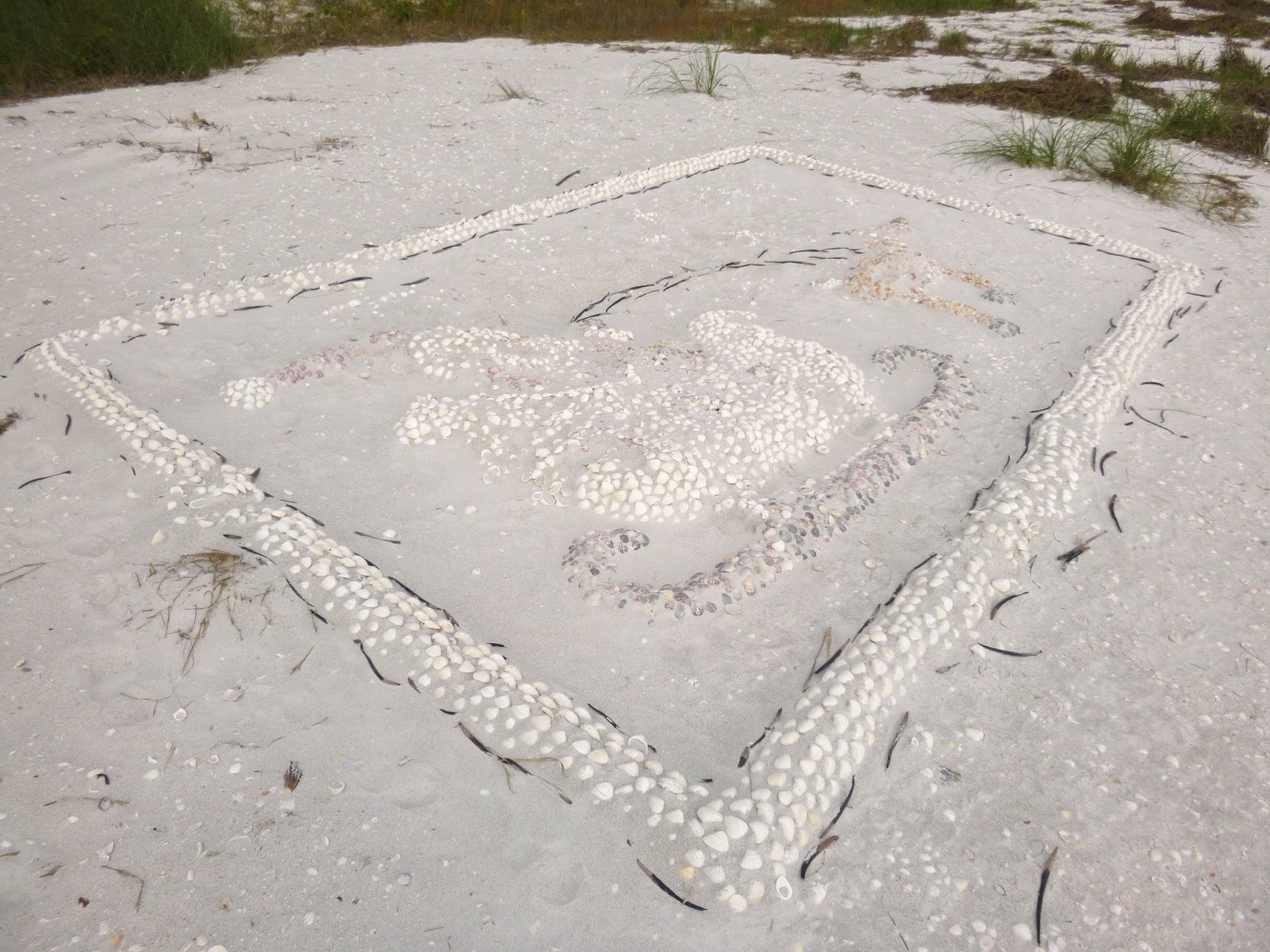
On a day where I was musing on the impermanence of things a stroll on the beach.  Tides come and go, wind blows the sand about.  Shore birds pick at things and perhaps the occasional vandal-tyke gives a big ol' stomp.

Sand sculpture on a somber day.


Mermaids are a common theme.  The one above just needs to run a comb through her sea weed hair and re-do her face a bit.  The one below has a nice shell afro intact but is crumbling in the hot Florida weather.

A alligator whose head has eroded away.  I think that must have been just where the high tide and its lapping waves stopped.


Almost two weeks after Christmas and we still have a shell Santa and his sleigh. This was placed high above the tide line.


A sea turtle that looks like a soccer ball.  I hope it does not confuse the real sea turtle hatchlings that sometimes trek across this very beach.


Thursday, January 7, 2016

Nothing Personal....its just Business Mike.

Hey, remember this guy from the Godfather?


Virgil Sollozzo, alias "The Turk".  He had a rather abrupt end to his nice dinner with Michael Corleone.

So I was rather startled to be walking in downtown Fort Meyers Florida and saw this:


Is it the final resting place of The Turk?

Wednesday, January 6, 2016

A walk on the beach

Eh, winter in Wisconsin gets kind of long.  So when we got a chance for a few days of low cost warmth in Florida we jumped at it.

Coastal Florida is an odd place....I am a youngster in these parts!

Sanibel Island to be specific.  The main activity here is walking the beach looking for shells.  I have enough shells but still follow the habit of getting up early for a walk.


A bunch of seabirds, very sure of themselves, in that odd light that you get just before the sun comes up over the waves.


You see some very nice sand sculptures here.  I don't think this is the work of any of the retirees who are the main population of the place.  But you do see a fair number of idle, bored grandkids about. This ensemble has a macabre look to it.


Not picking up shells I needed a different destination.  There is a lighthouse at one end of the island. It made for a nice stroll.


History is a bit on the new side here in Florida.  Oh, there were a few pirates about but nobody has every found any treasure here.  A light house for Sanibel Island was proposed way back in the early 19th century but there did not seem to be a pressing need for it given the minimal population of the area. Oh, and the Civil War kind of got in the way.  Finally they got around to it in the 1880s....only to have the ship carrying the steel components sink off shore!  Pluckily they salvaged the parts and assembled it anyway.

Monday, January 4, 2016

CCC Camp Gegoka

CCC camps were scattered widely across America in the 1930s.  I try to visit sites when they are convenient but many are in remote places far from my usual haunts.  But sometimes you can "visit" them from afar.

My brother recently gave me a copy of the newsletter from CCC Company 701.  Their camp was near Finland Minnesota and was called Camp Gegoka.  The name appears to have Ojibwa origins. In common with many camps of the time their newsletter was thoughtfully composed and this one has survived well despite being printed on paper with high acidity.


The contents of course are the usual stuff of camp life.  Sports teams, fishing reports, classes.  There were ads for businesses in Ely Minnesota.  Included in same were three taverns, a brewery, a liquor store, a clothier, a laundry, a movie theater, two cafes and a newspaper/tobacconist shop.

Some matters of greater import were brought up.  An essay on Memorial Day extols the virtues of raising "...the rights of the weakest and humblest to a higher place in society."

There were some fun cartoons.


This second one is a bit political.  In 1933 the public is cheering for Organized Crime, who have run up a pretty impressive score over the "US" team.  In the 1936 image "crime" is breaking a sweat because the ball - labeled Easy Money- is clearly something they can't handle.  And the score has been reversed.  It is not often you see monetary policy as the subject matter of cartoons these days.

Minnesota CCC camps have some excellent photographic records.  When perusing these I of course encountered the typical images of rustic barracks and of lined up recruits and staff.  On close scrutiny of one of these I noticed a detail I had not encountered before:


Yep, up in the back row we clearly have African American CCC men at Camp Gegoka.

The history of the CCC with respect to racial equality is mixed.  At its inception a provision was entered into law (by a black Republican congressman from Illinois!) that there would be no racial discrimination in the ranks.  Supposedly 10% of the CCC was to be made up of African Americans although in reality this was not always the case.

With most recruitment being local it came to pass that in the South there were all black CCC companies.  In the North were the ethnic mix was much different, the companies were integrated...at least at first.

The CCC is remembered with such fondness today that it is often forgotten that at the time the presence of a bunch of young men in a barracks type environment was regarded with suspicion and alarm by many rural communities.  This was true generally and perhaps the black CCC recruits felt it more acutely.  A few echos of this suspicion even carry through on the pages of the Pioneer News where an ad for the Mary L Eat House specifies "CCC Boys Invited".  Maybe with Depression era unemployment on the Iron range approaching 70% the wisdom of welcoming any customer with money in his pocket overcame local suspicions.

But elsewhere all black CCC companies were sometimes moved to areas where local complaints were not an issue; federal lands for instance.

Finally in 1936, soon after this newsletter came out, integration of CCC companies officially ended. So much perhaps for the "rights of the weakest and humblest".  But being based on a military model from a then still segregated US Army perhaps this is not surprising.

The site of Camp Gegoka is on the western side of Lake McDougal.  The land was purchased by the Federal Government from its original owners, the St. Croix Lumber Company.  With the onset of the Second World War the "CCC boys" put on different uniforms and marched off, still of course in their segregated formations.

The property apparently was purchased by a group of (First War) veterans who tried to keep it up as a holiday retreat.  They, as well as a later group of investors from St. Louis, were unable to make a go of it and the property lay idle.

Idle that is until 1959 which was the beginning of a new era.  It is now a place called Camp Buckskin and has been serving children with autism, attention deficit disorder and related conditions for 55 years and counting.

It seems a fitting tribute to the spirit of the place.  With the exception of a somewhat vintage looking water tower I am unable in the images I have found to see anything that looks old enough to be from the CCC era.


Friday, January 1, 2016

Nuts and Bolts


My brother and his wife attend a lot of estate sales.  For my UK pals I should explain that these are not sales held at Stately Houses.  No, these are more along the lines of what you would call "Jumble Sales" held after the residents of the usually modest abodes have died or gone off to a care center. Everything gets hauled out and sold off.

In any house with a male presence you can expect to see containers of nuts, bolts, nails and screws. They will be numerous. They will be in the garage or basement. They will be carefully sorted by size. There will be more of them than any reasonable person could have needed.  They have effectively zero value and my brother says he has picked up enough of these that I can have as many as I want. All that hardware was carefully selected for specific projects.  Now it is scrap metal.

So why do Old Guys sort out nuts and bolts?

I thought on that point the other day, as I was doing that very thing.

Here's a batch of quarter inch bolts...plink....plink...plink.  If you went back a generation or two it might be fair to say that most men did work with their hands.  Not all were blacksmiths or assembly line workers.  But even if you ran a store, or farmed, or worked for the local utility company, you had solid metal in your hands in your daily labors.  They may have continued to sort and organize out of simple force of habit.

Here's a strata of larger three eighths stuff....plonk...thud...plonk.  They were men of substance our fathers and grandfathers.  They would have regarded smart phones as clever toys and the information age as largely irrelevant folly.  It has been and will continue to be agonizing to see these strong men with strong hands fade and fail.  Perhaps to some extent they felt it coming.  The vision not quite sharp enough to tell fine thread from coarse.  The faint speckles of paint on those washers recalled a project from many years ago, but which one was it?  Maybe they decided to organize things in the workshop to make it easier for themselves.

What was I doing with these huge half inch nuts and bolts? This was over engineering even back in the day when I was making ambitious stuff.  They make a distinctive noise...clank...clank...clank.Usually you find Old Guy Hoards in coffee cans or mayonnaise jars.  I have most of my stuff sorted out into a series of wood and metal boxes that were once drawers in a long vanished workshop bench. It was there when we bought the house thirty years ago, and it was not new then.  When one of my sons started to show eldritch mechanical skills at a young age we needed a place for him to work. I tore out the bench and built one suited to his height.  The drawers I kept, they were still useful. Perhaps some old guys, another morning of post retirement stretching idly before them, thought about how it would be handy if their son or grandson ever needed some parts.  No sense making them fumble around looking for stuff.

And so comes another year.  The generation above me wavers and fades.  My wife and I dig in and hold our ground doggedly.  Our children are ascendant, reaching to take up the tools of the modern age and build with them.

And the generation that follows......moon faced and happy, a grinning audience for our grand parental antics.  Too small for a work bench of course.

The workshop is cleaned up and everything is sorted out nicely.  2016 will be a different year. It will be a jumbled mixture I suspect.  Work, play, family obligations.  I hope for good health and the time to sort it all out.  Plink, plonk, clank....everything into its designated container.  The next generations will find that I have put things into good order and if I am fortunate, will consider my efforts to be worth more than scrap metal prices.