Monday, June 22, 2015

More Obelisks of Isis

Last week when I was rounding up the various remnants from the Isis/Serapis/Minerva complex in Rome's Campus Marti I alluded to there being additional obelisks.  These are similar in size to my favorite Roman obelisk, the one in front of Santa Maria sopra Minerva.

The Iseum/Serapeum complex must have been a most impressive place.  Don't you wish you could have a peek at it in its prime?  Well, you can.  But only a tiny peek.

Even many fans of things Roman have never heard of the Severan Marble Plan.  This was a huge, highly detailed map of the city of Rome that was mounted on a wall near the Forum.  Think of one of the modern day city maps you encounter, but without the "You are Here" arrow to help orient you.

The Plan has suffered the usual fate of Roman antiquities, it has been battered, burned and burgled. But maybe 15% of it survives.  And happily for our tale it has fragments that depict the Serepeum. (There were actually other Iseum/Serapeum complexes in Rome, but that is another story).


These are from the Stanford University reconstruction of the Severan Plan, a most impressive on line effort.  You can see the word SERAPAEUM in the two pieces.  The little dots probably represent obelisks.  The exact number of them is unclear.  But lets visit a few.....

Here we are on the steps of the Pantheon.  In front of us is the Piazza della Rotanda.  It's a fun place, lots of people around, lots of things happening.  Tourists taking pictures, merchants hawking stuff, a discrete presence of Italian police watching out for any nefarious activity by modern day followers of a far darker ISIS.  In the background is the sound of a busker band playing Pink Floyd's "The Wall".


The obelisk only had to travel about 500 feet,  but did so by an indirect route.  It was found in 1373 near the church of San Macuto.  It was moved to the Capitoline Hill before being brought back in 1711 to be added to an existing fountain by Barigioni.  It is close enough to its mate in front of Maria sopra Minerva that you would be able to see both if not for the corner of a building being in the way.

This obelisk originally was made for Rameses II who had it adorning the temple of Ra in Heliopolis. The star, mountains and cross on top are the emblems of the Pope who was responsible for its final move, Clement XI.

The fountain is pretty swell.

Here is another obelisk.  Not quite as much fun.  This was one of the last pair found, only turning up in 1883 near sopra Minerva.  This was shortly after Italian reunification and the country was in a feisty, expansionist mode.  It was set up near Termini, the main rail station in Rome.  It became a commemorative marker for the 500 Italian soldiers who died in an obscure colonial war battle at Dogali in Ethiopia.  In 1924 it was moved to its current location near the Baths of Diocletian close to the Piazza della Republica.


Oh, this obelisk saw some grandeur in its day.  Like our earlier specimen it was a Ramses II item from Heliopolis.  Nowadays it is getting along in much reduced circumstances.  There is graffiti on the wall behind it.  Derelicts sleep on the benches in the little park that surrounds it.  A close up of the plinth:


A lion to recall Africa.  An empty bottle and a scrawl to show its current circumstances.

Other obelisks from the Iseum/Serapeum complex have ended up here and there.  The relatively small size of these makes them something that is easier to related to on a human scale.  It also makes it easier to haul them off to other places.

In the Villa Celimontana on the Celian Hill of Rome there is an obelisk cobbled together from the parts of several.  At least some of these came from near Maria sopra Minerva.

Another can be found in the Boboni Gardens in Florence.

And still one more, a twin to the Dogali obelisk,  can be found in the small town of Urbino.

Some sources make the claim that the larger obelisk in the Piazza Navona is from the Serepeum, but this is not certain.  It is for one thing a Roman copy of an Egyptian original, and one would imagine that honoring an Egyptian god with a knock off would have been bad form.

Friday, June 19, 2015

Minerva's Leftovers

In a previous post Elephant and Obelisk I touched upon the subject of ancient decor from the religious complex in the Campus Marti region of Rome surviving into the future.  The association with Minerva is actually a mistake, most of the fancy remnants probably came from a large temple complex devoted to the Egyptian deities Isis and Serapis.  By the time the obelisk was placed in front of the church of St. Maria sopra Minerva they had figured this out.  Part of the 17th century inscription - dictated personally by the Pope - reads:

ALEXANDER THE SEVENTH DEDICATED
TO THE DIVINE WISDOM
THIS ANCIENT OBELISK, 
A MONUMENT OF THE EGYPTIAN ATHENA,
UNEARTHED FROM THE GROUND
AND SET UP IN THE SQUARE
ONCE MINERVA'S
NOW BELONGING TO THE MOTHER OF GOD
IN THE YEAR OF SALVATION 1667.

As it happens there are a number of other survivals from the Iseum/Serapeum complex in the Campus Marti.  Some are on display, others alas are remembered less substantially.

We can start with another cat.  Just south of St. Maria Sopra Minerva we have a street named....


The "Gatta" that gives the street its name has a perch high up on a ledge.  It is watching us with a decidedly superior attitude.  The Egyptians put some ridiculous notions of divinity into the empty heads of felines and we have been living with it ever since.


Via Della Gatta intersects with Via di Pi di Marmo.  The street of the marble foot.  There can only be one reason for a name like that and here it is:


Near at hand is an obscure little church called Santo Stefano del Cacco, or alternatively as Santo Stefano de Pinea.  This structure actually reuses in its nave 12 columns from the Temple of Isis, and gets its name from a statue - sadly now lost - that also turned up.  Perhaps the Egyptian god Thot, who has a dog's head, it was felt to look more like a monkey.  Cacco is a corruption of the word Macaque, a much later word for monkey that while originally of African origin, wandered into wider use via Portuguese in the 1700s.

Isis herself might be making a cameo appearance in modern day Rome, although she has wandered a ways out of her usual neighborhood.  Over in Piazza San Marco stands a statue dubbed "Madame Lucrezia".


The style of dress is similar to contemporary depictions of Isis or one of her priestesses.  This is one of the six Talking Statues of Rome which were - and to some extent still are - places where satirical anonymous notes criticizing the politically powerful of the day get posted for the general amusement of all. Madame Lucrezia gets her name from her one time owner, Lucrezia d'Alagno who had a rather saucy affair with the King of Naples back in the 1400s.

Several more obelisks from the Iseum/Serapeum complex are also extant, they deserve their own posts on another day.

Recalling the alternate name for Santo Stefano I will finish by pointing out that the entire region, or Rione, of Rome in which the ancient temples existed is now called Pigna, or "Pine Cone".  This is after a huge bronze pine cone that once graced a fountain near the temple complex but probably associated with a public bath.  I did not make it over to the Vatican where it now resides, so this photo is via Wikipedia and credited to Lance Mountain.


Really quite the collection of odds and ends still in or near their original locations.  Other items including a rather nice crocodile and some sphinxes are to be found in the various museums of Rome.

Wednesday, June 17, 2015

Wild Life of Rome

Rome is a very busy city so as you go here and there it is surprising to see the occasional non-human resident living a relaxed life alongside all the bustle.  I made it a sort of game....lets see just how close you can get for a picture.


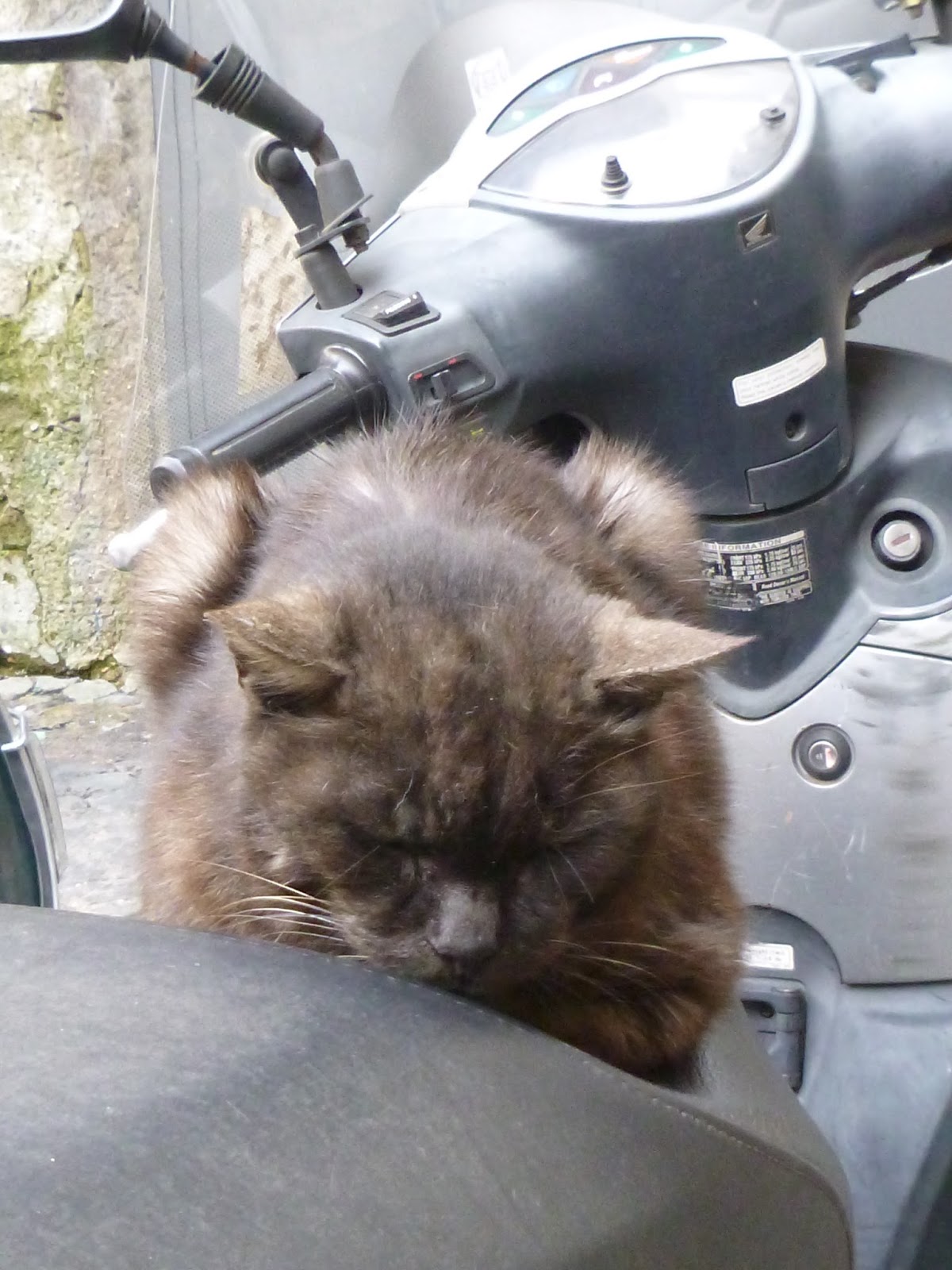
A cat snoozing on the seat of a parked scooter.  Near the Theater of Marcellus.


To give equal time to dogs, some nice paw prints in a tile.  Ostia.  You can generally tell dogs from cats by the claw prints left by the former.


A rather self important looking seagull.  He is perched atop the "Ponte dei Quattro Capi", a Republican era bridge that has linked Tiber Island with Rome since 62 BC.


A little green lizard scampers over stones where the history is layered thick.  On a nameless structure in the Roman Forum.


A pigeon contemplates the ruins of the Imperial Palace on the Palatine Hill.  All the bloodshed, all the dynastic strife.  And it appears as if the Meek actually do Inherit the Earth....

Monday, June 15, 2015

Temples of the Kitty Cats

If you have been to Rome you have almost certainly seen the archaeological site referred to as "Largo Argentina".  It is in the Campus Marti section of town and sits smack at the intersection of the bus and tram lines.  People waiting for public transit get an inspirational view over an entire city block of ruins.

Ah, and what history there is there.  We have deeds pious and villainous stretching all the way back to the grand days of the Roman Republic.  There are still some serene but vaguely sinister types lurking about the place, but I shall get to the cats a bit later.

It was already known that there were two Republican era temples on the site when urban renewal projects in the 1920s began.  They kept hitting more and more archaeology, to the point that even Mussolini - who seldom let a few old stones stand in the way of his plans - gave up and just dedicated the site as an archeological park.  There ended up being a total of four temples, with the likely dedications being to the "Temple of Today's Fortune", to a goddess named "Feronia", to the "Lares Permanarii" and to either "Juturna" or "Juno Curitis".

Three of the four deities so recognized were water related, and ancient records indicate that the official who supervised the aqueducts had his headquarters here.  Right around the corner stands another structure associated with the free distribution of grain.

Along the western side of the Largo Argentina complex stood the Curia of Pompey, which is where Julius Caesar met his end on the Ides of May in 44 BC.  The presumptive site has been identified in recent years but is not publicly marked.  I suspect they don't want flowers, coins and other memorials tossed onto the site.

In the way of more recent misdeeds, the upper levels of the site contain the ruins of a church built in the 9th century.  It was called Saint Nicolo dei Calcari, and was a parish church for the guys working so hard to turn ancient marble statues and inscriptions into nice new lime by burning it in kilns.  Darn 'em.

A few pictures of Largo Argentina in the spring of 2015.


The site has been bashed about a bit over the millenia.  Fires destroyed the area more than once.  Later buildings were put in on top.  Don't get me going on about those lime kilns.  The fact that it looks this nice is probably due to a combination of factors.  The Campus Marti region was one of the few parts of Rome that was never entirely abandoned.  Its water supply was not dependent on the severed aqueducts so medieval buildings surrounded and to some extent protected the ancient structures. Oh, and recall that if Mussolini didn't like how things looked he just had his guys improve things a bit.

Recent accounts of the "discovery" of the exact site of Caesar's assassination make their case by indicating that a square bit of stone work - presumably the base for a commemorative statue put up by Augustus - were found near the entrance to Pompey's Curia.  This is where the Senate was meeting because the official Senate building had been, well, burned down by and angry mob.  If you like the notion of Caesar falling near the entrance to the building, this would be about the right spot.  In this picture look for the white square this side of the tall tree in roughly the middle of the image.  Now don't go throwing swag down there.


The church of the lime makers has survived the years fairly well.


Ah yes, I promised cats.  Well, if you are the kind of person who enjoys felines and ruins - and you know who you are - this is the place for you.  The entire city of Rome is a sort of unofficial cat sanctuary.  I understand that there is a law that if an area has a certain number of resident cats then they have to be left alone.  The Largo Argentina site is closed to the public apart from the rare tours that are allowed.  The stray cats just settled in.  Eventually a volunteer organization was formed to take care of them.  They get fed, neutered, put up for adoption.  The cats have run of the place while we have to look over the fences:


Hey, I am not a cat lover.  But I do recognize in them a certain inner calmness that serves them well. As I am anticipating a rather stressful week I will - most atypically for me - also feature cats in my Wednesday and Friday posts.

Friday, June 12, 2015

Why we need Pubs

Here we have an important landmark for humanity.


St. Mary's Hospital, London.  Near Paddington Station.  It's importance?  Turn around.


I have managed, well  to accidentally capture the reflection of the red brick building.  That was where Sir Alexander Fleming discovered Penicillin! Now, did mold spores from his favorite pub waft across the street to help mankind vanquish disease?  I'm going with probably here.  Yeast and deep thoughts....that's what pubs are all about really.

Wednesday, June 10, 2015

Secrets of Tiber Island

Welcome back to Tiber Island.  It really does rather look like a ship, don't you think?  For reference that is the main Synagogue of Rome peeking over the trees on the far shore.


There is a modern stone platform around the island, just right for a nice stroll.  You access it by stairs near the bridge you can see above. This is the "new"  Ponte Cestio bridge that leads to the Trastevere side of the river. Built between 62 and 27 BC but it has had some work done in modern times.

After you check out the "ship" at the down stream side of the island it is time to wander a bit.  Here is the other bridge:


This is the more famous bridge, built by a fellow named Fabricus in 62   BC.  Unlike its slightly newer twin it is almost entirely unchanged.  It is also called the "Ponte dei Quattro Capi", or the bridge of the four heads.  This is because it has mounted on it a pair of ancient sculptures that each have four faces.  These are a sort of "double Janus" design that may have been intended to watch over an important four way intersection or alternatively a road and river intersection.  Although now mounted on the bridge they were actually found a short distance inland and their exact relationship to the bridge is speculative.  There used to be four of them but a pair have gone missing over the long years.


If you look up at the medieval buildings on the island you see something odd:


I could be mistaken but I think this is a "garderobe".  Basically an outhouse stuck onto the side of a building with, shall we say a "clean drop" below.  You see these often on castle walls.  Thankfully it appears to have been retrofitted with modern plumbing, but that foliage down below does appear pretty lush.

Heading back up top it is time to take a peek at the upstream end of the island.  This has been the site of a hospital since 1584.  I was a little uncertain as to where I was allowed to walk, but a sign that said "Pronto Succorso" seemed inviting.  I was able to puzzle out that it meant something along the lines of "Urgent Care".

Out back you find various jumbled up archeological remains.  Essentially their garden wall and the area supporting their trash bins are made of old Roman stuff.


And shockingly, back there among the odds and ends I found this:


This is a dedication stone to Jupiter Dolichenus.  This was an Eastern cult, originating in Turkey and seemingly related to Baal.  As they tended to do, the Romans shrugged, let people go on worshiping Dolichenus but added Jupiter to the name.  The Romans were certainly not monotheists but the concept of diverse names for different aspects of the same deity seems to me to be tiptoeing in that direction.

A few years back the excavators at Vindolanda were very excited to unearth an altar to Dolichenus. This god was often associated with the Roman military and his worship was often centered in military communities.  The stone above does not have all the classic features of an altar - it should have Dolichenus astride a bull for instance - but the slots in the top do make me wonder if there was a decorated screen on the top of it at some point.  And there is a little bit of sculpture work tacked onto the modern brick plinth that sort of looks like Dolichenus in a cap.  Perhaps a fragment of the altar iconography?

Sorry fellow Vindo excavators, in Rome it seems Dolichenus altars are no great shakes.  Just go looking out back by the bins.

As to a tentative interpretation of the inscriptions:  The upper one is rather long, but to summarize it says approximately:

IOM Dolicheno (Jupiter Optimus Maximus Dolichenus) for the welfare of the Emperor Septimius Severus, Caesar (Crown Prince) Caracalla, Julia Domna Augusta and the whole of the 'divine' household* dedicated by Marcus Valerius Valentinus an optio in the Praetorian Fleet at Ravenna. He did this himself with the soldiers of the fleet in the year of the two consuls:
AD196C. Domitius Dexter IIL. Valerius Messalla Thrasea Priscus

The side reads: IUSSO CAECILIUSERVIALLI NO COL III KIV LIAS

This shakes out to be:  "Placed under the orders of Caecilius Servilianus 3 days before the Kalends of July"**

As best I can determine this monument was unearthed during expansion work on the hospital in the 1930s.  More recent excavations have been better documented.  There is fabulous stuff in the storage areas under the hospital, alas not open to view.

I liked Tiber Island. It was right on the walking route from our lodgings on into town.  We crossed the ancient bridges every day.  It is a peculiar place.  Plenty of tourists, sure, but they are just streaming across it going to other places.  Step off the beaten path and it is a quiet refuge.  Locals are out for walks or fishing off the banks.  On the upstream end of the island I found a final enigma. Several messages similar to this, weighted down by rocks so that they would not blow away.  The translation here is, approximately:

"The waters surrounded  me.  The abyss swallowed me.  The weeds were twisted everywhere"


Kind of a creepy message actually.  But on a brilliant warm spring day in the Eternal City it just seemed to be another oddity on an island full of such.

---------
*AD 196 was early enough that Caracalla's brother Geta does not get a mention.  They would later have an Imperial level falling out!

**Thanks to Catherine Jarvis for help with the inscriptions! Catherine@Hands-on-Latin.com

Monday, June 8, 2015

Exploring Tiber Island

There are some implausible "origin" stories regarding Isola Tiber, the only island within the boundaries of Rome.  One tale says that when the Romans drove out their last king they took all the grain from his estates and chucked it into the river, where it formed an island.  Eh, probably not.  The first thing revolutionary mobs generally do is confiscate wealth, not throw it away.

A more amusing if only slightly less believable story involves ships and snakes.

The year was 292 BC. A plague was festering in the city.  It was decided that Rome needed a temple to Aesculapius, the Greek god of healing.  A ship was dispatched to Epidaurus where this cult had its main temple.  A statue of the god was obtained and for good measure a large snake - sacred to Aesculapius - was taken on board.

On arrival in Rome there was a debate as to where the new temple should be established.  The decision was finally made by the snake, who slithered off the ship, swam the narrow channel to Tiber Island and curled up in a comfy spot.  This became the site of the Temple to Aesculapius, and the start of the 23 century long association of the island with the healing arts.  Practically speaking it also made sense to keep sick people on an island with limited access, for quarantine reasons for instance.

Because the island is roughly shaped like a ship the legend became the substance.  Here is the downstream side of Tiber Island with the original Roman stonework reproducing the end of a trireme!


I like the orange life preservers up above.  Helpful hint, don't try to swim in the Tiber. It looks nasty and the current would pull you under long before help could arrive.  If you look closely at the ship-shape above you will see....


The serpent of Aesculapius, in the form of a caduceus, then as now symbol of the healing arts.

The portico outside the temple seems to have served as a place to care for the sick, a function that continued after the repudiation of paganism in the late Empire. In the 10th century a Christian Church was build on the site, initially dedicated to St. Adalbert of Prague.  In 1180 it was rededicated and renamed after receiving some more upscale relics, those of St. Bartholomew the Apostle.  Because said relics include a rather large piece of the saint's skin, the hospital that continued on at the site developed something of a reputation in the medieval era as being especially adept at healing maladies of this sort.  In the 12th century English pilgrim named Rahere fell ill when in Rome, and based on his recovery at St. Bartholomew's returned to England and founded the still extant Hospital of the same name in London.

The basilica of St. Bartholomew has been damaged and repaired quite a few times in its long history, but traces of the earlier ages persist. Many of the marble columns are reused from Roman times, presumably having served in the Temple.  And on the steps leading up to the main altar is a 10th century well head.  It is said to be on the site of the spring that existed in the Temple of Aesculapius. Also to mark the spot where the snake curled up.  I looked down in there and did not see him, but those metal bars over the top must be there for some reason...


The themes of holiness and health still exist today, the northern half of the island is still an active hospital.  One day when we walked past a little procession came out of its doors.  Darkly dressed morticians carried a casket.  A doctor saw them to the door.  A priest walked alongside.  Japanese tourists snapped pictures.

There is some debate as to how much the island was actually engineered to look like the ship of legend.  There was probably a ship's prow at the upstream end.  But the small obelisk that once stood in front of the Temple probably was not intended to represent a mast.  The surviving fragments of the obelisk suggest it may have been a late Roman imitation rather than an Egyptian original.

The obelisk broke and fell in the Middle ages.  It was replaced by a simple column, possibly from the temple,  with a cross atop it.  Every year on August 24th a list would be posted on this colonna infama of all the local citizens who had not fulfilled their obligation to attend Mass and give confession at least once a year.

In 1867 this tradition came to an end when someone ran into the column with a carriage and knocked it down.  It was replaced with the current monument featuring four saints each looking in a different direction.  Note the sturdy protective stonework at the base.  No chances are being taken on one of the infrequent motorists on the island getting frisky.


This "looking all ways" monument has a famous counterpart not far away.  Next time we will pay a visit and will look into some of the odd corners of the Island, places that don't get many visitors.

And advance warning to my fellow Vindolanda excavators.......prepare for a shock.

Addendum.  A well done survey of the Tiber Island sites can be found here.  The author is conversant with a variety of source material that is not widely available and is of course mostly in Italian.