When excavating at the Vindolanda Roman fort site we get the weekends off. In theory this is to rest sore muscles and do laundry. In practice we usually pack Saturday and Sunday with expeditions to other area Roman sites, shamelessly exploiting diggers who brought cars!
Last time up several of us went to a place called Bewcastle. Stepping onto the site I realized, and said aloud, "This church yard has more history than all of Wisconsin combined". Quite true, and that is not even making allowances for the many things that have been forgotten at this lonesome spot.
We tend to think of Hadrian's Wall as the frontier of the Roman Empire. While convenient for reference it is not strictly speaking true. There were Imperial incursions short and long north of the Wall. But if for several centuries the Wall was the boundary, you can imagine Bewcastle as being an observation post out beyond, out in Hostile Territory. It had a garrison and fortifications and was linked to the more organized forces seven miles to the south by a series of signal towers.
It was an odd fort. Most Roman forts are of a standard type. Roughly the shape of a playing card and with the usual structures - granary, headquarters, latrines - in the usual locations. Bewcastle fort was in the shape of an irregular hexagon. It probably was built by simply using the footprint of an already extant British village or hill fort. This would never pass muster within the Empire proper!
Even the name of the place speaks to its origins. According to the Ravenna Cosmology - one of those maddening fragmentary Dark Ages sources - there was a fort in these parts called Fanum Cocidi. Since Cocidius was a local British deity, and since six altars to same were found on site, the conclusions are that this was indeed the "Shrine of Cocidius" and that the name preserves the earlier British identity of the spot.
Maybe in fact it preserved it for quite a while. In 1937 excavations at the site uncovered what was thought to be the fort's strongroom. In material dated by pottery and coin evidence to circa 266-273 there were found two votive silver plaques of Cocidius.
This raises some interesting questions. The known garrisons at Bewcastle were from the Provinces of Dacia and Germania. Does the presence of a Celtic religious item in such a place of prominence mean that the continental troops adopted the local religion? Or was there extensive recruitment among the local peoples? If so, does that have something to say about the loyalty of the troops? Bewcastle, unlike most forts along the frontier, does show convincing evidence of destruction on two occasions.
In the general smash up that was the 5th century collapse of Roman power Bewcastle drops out of history for a while. Something was certainly going on here, probably a thriving monastic community. As a location for such it did have advantages. Isolation for serenity and residual fortifications for security. And who knows, did the early Anglo Saxon (or Irish?) monks specifically chose a spot with strong religious roots? And if so, did they do it to tap into existing spirituality or to plant the cross of Christ defiantly on the grave of paganism?
Because plant a cross they did. Bewcastle is the location of what has been described as the best example of an Anglo-Saxon cross still in existence. It dates to the late 7th or early 8th century.
The crossbars are gone, time has weathered the carvings tragically, but it is still a magnificent specimen. Scholars have been arguing about its content for over four centuries. It has weird reliefs of animals and birds, England's oldest sun dial, and runic letters that may link it to Efgrid, nephew of our old pal the far flung St. Oswald. I refer the interested to a more in depth study of the cross. Wikipedia is a decent starting point. But here is one image that caught both the light and the mood of the place nicely.
Somewhere in the medieval period the site became known as "Bothycaster". This combines the Latin term "Castrum" for fortress with an old English word, "Bothy". The latter means sheds or enclosures for animals. I presume the term "booth" descends from this root. So at some point the monastic era ended and "Bewcastle" was a ruin with sheds.
But the location remained strategic, so the Normans built a castle there in the 1090's. They probably found the local population just as suspect as every government before or since. The somewhat redundantly named Bewcastle Castle was the site of much fighting between rival families of "Reivers" up until the point of its final destruction by the forces of Oliver Cromwell in 1641.
Celtic shrine, Roman fort, Dark Ages monastery, Norman castle. It is a lot to pack into one small place. Bewcastle has been ruled - if often rather loosely - by Emperors, by Kings great and petty, by Abbots and Knights and various levels of war lords and plain brigands. Sometimes it has in all likelihood been ruled by no man.
It has seen the march of disciplined Roman troops. Once there was a garrison of 1,000 men here. It has seen barbarian hordes besieging the place or swarming past it for better pickings in the more civilized lands to the south. Grim Normans glowered out of stone ramparts and dreamed of sunny, far away France. Feuding Reivers, those borderland equivalents of the Hatfields and McCoys, carried on their endless cycle of cattle theft and murder and vengeance.
For all that it is an idyllic place today. There is one farm where nobody seemed to be about. And a church, open but empty on a Sunday afternoon. Everything from the ruined castle to the field walls was constructed of robbed out stones from the Roman fort.
A quiet place indeed. But still a border land. If Scotland indeed votes for independence there may well be a frontier crossing right down the road. Times have become less militant of course, so there may be no need to upgrade the current garrison of Bewcastle....which consists of a small troop of placid llamas.
Wandering unsupervised in various real and imaginary places. Detritus reflects my interests in robotics, travel, history and the odder aspects of the world around me.
Monday, June 16, 2014
Sunday, June 15, 2014
Dad
My father started out life as an uncomplicated farm boy. Uncomplicated is not the same as simple. In fact the farm was an extremely complex place, one with rhythms and cycles of its own. There was the annual cycle of spring and fall, of planting and of harvest. And the longer cycles that represented the lives of the farm animals. Later in life he would often speak of the quiet dignity of the horses and the clever loyalty of the farm dogs.
It was an old school farm, they still had a few of those horses in the 1920's. And they still spoke German three generations after their emigration.
But the modern world eventually came barreling down the dirt road in the form of a brand new school bus that took students to the nearby town. My father did well there. He was valedictorian of his high school class, and near as I can figure was the first of our tribe to attend college. For sure he was the first to go further in his education, racing through medical school under a wartime program designed to turn out physicians for the armed forces.
Later while serving post war in Germany he dabbled with the idea of becoming a psychiatrist, that being all the rage back then. He even visited Vienna, and told me he once was "analyzed". I suspect it was the whole Freudian, lay on the sofa kind of deal. It makes for one of those great "could have beens", but I am by no means sure he would have been a good psychiatrist. He had an abundance of empathy for people and their troubles, but being as I said a little uncomplicated I can't see how he would have been good at understanding the true dark places of the human heart.
We shall never know. He came back from the service, did a little more training and followed the old school medicine track of that time. He married a nurse, hung out a shingle as a Family Doctor, had a bunch of kids.
I am sure he was a good family doc. In that day, and even today somewhat, it was rare that the patient actually needed a complex procedure or an exotic prescription. More often, most often, they needed a good listener with common sense.
He threw himself completely into his practice, or perhaps it was that his practice dragged him in completely. We boys saw him late, tired and sometimes not at all. It was not until I went off to college that I had the revelation that normal dinner time was 5 or 6. Gee, I figured everyone sat down at about 8pm.
But I at least got to know him a little better over time. Through some mixture of admiration and lack of imagination I followed in the paternal footsteps and became a family doctor myself. So our conversations through my residency and early practice years were interesting ones. I would tell him about the latest diagnostic technologies. He had a genuine surprise and delight hearing about them, no doubt the same sentiments he had as a young lad on the farm seeing his first airplane or his first glimpse of a big city.
Nothing lasts forever. My father practiced until he was 70 years old. By then he had taken the logical step of joining a group as a part timer. But they had a mandatory retirement age.
So one morning, medicine just stopped. Or rather, it went on and left him behind.
He did not know what to do. He kept a huge batch of journals and browsed them from time to time. He went to hospital staff meetings as an emeritus member, but eventually the city driving got too much for him. He tried a few hobbies, joined a few groups and such but his heart was not in it.
Once my older brother and I took him on a fishing trip. He seemed apathetic. It was a lack luster experiment that we did not repeat.
But oddly enough, after his 80th birthday he started to get....happier. It seems strange to say that dementia has a good side but in dad's case I think it does. We no longer talk about medicine and I get the sense that he wants it that way. He has forgotten the sense of loss. He has forgotten the dark moments that we all have in our careers. He no longer broods on the one time he got sued. The many aggravations of trying to run a one man practice, all the vacations deferred, all the personnel decisions, all the insurance hassles....gone.
So distant when we were growing up, he now finds that visits from his children and grandchildren are his great joy in life. Although as his 90th birthday came and went he had more difficulty telling the grand kids apart, and spends more time snoozing on the sofa. Yogi, a dim-witted dust mop of a dog, became his constant companion. And if he is a poor substitute for the cleverness of the long ago farm dogs he makes up for it with his unquestioning loyalty.
The farm days were featured more and more in his conversations. He was so happy there as a child, so eager to get out as a young man. He went through a phase where the farm worried him a bit. It was abandoned now, and there was discussion about what to do about it. But after a while he no longer cared about that.
His memories of the farm became brighter, more vivid, complete with sights and sounds, and smells and a cast of characters. And they went farther and farther back.
I recall one conversation where he was describing the experience of walking behind the plow (horse drawn I think) looking with fascination at the things unearthed. Rocks, worms, the hope for an indian arrowhead. It was the memory seen from age 90 of being perhaps 5 years old again.
And he was happy. The cares and troubles of the adult world had all been set aside. The cycle had run to completion and he was once again an uncomplicated farm boy.
I wrote that last year, at a time when Dad's health appeared to be failing fast. But we are a durable bunch we children and grandchildren of the farm. He is still with us this Father's Day, still snoozing on the sofa a lot of the time. Still seeing the past more clearly than the present.
Or is he?
A couple of months back I visited and was telling him the family news. "Hey, M____ and B____ (my son and his wife) are going to have........chickens."
I saw his eyes spark to life at the pause before the punch line. Clearly he was one step ahead and was thinking he was about to become a great grandfather. So, Happy Father's Day Dad. If you are in fact smarter than you let on, well, it has always been that way.
It was an old school farm, they still had a few of those horses in the 1920's. And they still spoke German three generations after their emigration.
But the modern world eventually came barreling down the dirt road in the form of a brand new school bus that took students to the nearby town. My father did well there. He was valedictorian of his high school class, and near as I can figure was the first of our tribe to attend college. For sure he was the first to go further in his education, racing through medical school under a wartime program designed to turn out physicians for the armed forces.
Later while serving post war in Germany he dabbled with the idea of becoming a psychiatrist, that being all the rage back then. He even visited Vienna, and told me he once was "analyzed". I suspect it was the whole Freudian, lay on the sofa kind of deal. It makes for one of those great "could have beens", but I am by no means sure he would have been a good psychiatrist. He had an abundance of empathy for people and their troubles, but being as I said a little uncomplicated I can't see how he would have been good at understanding the true dark places of the human heart.
We shall never know. He came back from the service, did a little more training and followed the old school medicine track of that time. He married a nurse, hung out a shingle as a Family Doctor, had a bunch of kids.
I am sure he was a good family doc. In that day, and even today somewhat, it was rare that the patient actually needed a complex procedure or an exotic prescription. More often, most often, they needed a good listener with common sense.
He threw himself completely into his practice, or perhaps it was that his practice dragged him in completely. We boys saw him late, tired and sometimes not at all. It was not until I went off to college that I had the revelation that normal dinner time was 5 or 6. Gee, I figured everyone sat down at about 8pm.
But I at least got to know him a little better over time. Through some mixture of admiration and lack of imagination I followed in the paternal footsteps and became a family doctor myself. So our conversations through my residency and early practice years were interesting ones. I would tell him about the latest diagnostic technologies. He had a genuine surprise and delight hearing about them, no doubt the same sentiments he had as a young lad on the farm seeing his first airplane or his first glimpse of a big city.
Nothing lasts forever. My father practiced until he was 70 years old. By then he had taken the logical step of joining a group as a part timer. But they had a mandatory retirement age.
So one morning, medicine just stopped. Or rather, it went on and left him behind.
He did not know what to do. He kept a huge batch of journals and browsed them from time to time. He went to hospital staff meetings as an emeritus member, but eventually the city driving got too much for him. He tried a few hobbies, joined a few groups and such but his heart was not in it.
Once my older brother and I took him on a fishing trip. He seemed apathetic. It was a lack luster experiment that we did not repeat.
But oddly enough, after his 80th birthday he started to get....happier. It seems strange to say that dementia has a good side but in dad's case I think it does. We no longer talk about medicine and I get the sense that he wants it that way. He has forgotten the sense of loss. He has forgotten the dark moments that we all have in our careers. He no longer broods on the one time he got sued. The many aggravations of trying to run a one man practice, all the vacations deferred, all the personnel decisions, all the insurance hassles....gone.
So distant when we were growing up, he now finds that visits from his children and grandchildren are his great joy in life. Although as his 90th birthday came and went he had more difficulty telling the grand kids apart, and spends more time snoozing on the sofa. Yogi, a dim-witted dust mop of a dog, became his constant companion. And if he is a poor substitute for the cleverness of the long ago farm dogs he makes up for it with his unquestioning loyalty.
The farm days were featured more and more in his conversations. He was so happy there as a child, so eager to get out as a young man. He went through a phase where the farm worried him a bit. It was abandoned now, and there was discussion about what to do about it. But after a while he no longer cared about that.
His memories of the farm became brighter, more vivid, complete with sights and sounds, and smells and a cast of characters. And they went farther and farther back.
I recall one conversation where he was describing the experience of walking behind the plow (horse drawn I think) looking with fascination at the things unearthed. Rocks, worms, the hope for an indian arrowhead. It was the memory seen from age 90 of being perhaps 5 years old again.
And he was happy. The cares and troubles of the adult world had all been set aside. The cycle had run to completion and he was once again an uncomplicated farm boy.
I wrote that last year, at a time when Dad's health appeared to be failing fast. But we are a durable bunch we children and grandchildren of the farm. He is still with us this Father's Day, still snoozing on the sofa a lot of the time. Still seeing the past more clearly than the present.
Or is he?
A couple of months back I visited and was telling him the family news. "Hey, M____ and B____ (my son and his wife) are going to have........chickens."
I saw his eyes spark to life at the pause before the punch line. Clearly he was one step ahead and was thinking he was about to become a great grandfather. So, Happy Father's Day Dad. If you are in fact smarter than you let on, well, it has always been that way.
Friday, June 13, 2014
Wednesday, June 11, 2014
Stranded in Istanbul
Hello,
I hope you get this on time,I made a trip to Istanbul (Turkey)and i had my bag stolen from me with my passport and personal effects therein. (Gee Mary Ann, I asked my wife and she said you had just gone to Milwaukee. Must have been quite the detour. Savvy move bringing the passport though, you can just never tell sometimes.) The embassy has just issued me a temporary passport but i have to pay for a ticket and settle my hotel bills with the Manager. (I am inferring that this Manager is a towering authority figure. You capitalize His name. And refer to yourself as "i", lower case. He must have you really cowed.)
I have made contact with my bank but it would take me 3-5 working days to access funds in my account,the bad news is my flight will be leaving in Few Hours (wait...how can your flight leave in a Few Hours if you do not have money to buy a ticket?) from now but I am having problem settling the hotel bills and the hotel manager won't let me leave until I settle the bills,I need you to help me with LOAN financially($2,450) and I promise to make the refunds once i get back home,you are my last resort and hope,Please let me know if i can count on you and i need you to keep checking your email because it's the only way I can reach you. (Mary Ann, I really feel that I should help you out. I mean, it looks to me as if you have become so distraught as to forget everything you learned during your long career as an editor. Punctuation for instance. Have you considered just hanging out in Turkey for a few more days? It is nice, your bank is going to come through for you shortly, so perhaps something can be salvaged from this situation. Oh, and while I am offering you, my now close friend, some useful advice might I suggest you cancel your credit cards right away? Shockingly, appallingly, there are some in the world who try to take advantage of others.)
And as to the last sentence of yours - which by the way ran on for a stunning 105 rambling words - I am flattered to be your friend in a time of great need. "Last Resort"....that sounds a little familiar:
Monday, June 9, 2014
Defending the Homestead
I have written a few posts on the matter of our family closing up the old homestead over in Minnesota. (Here and here and especially here) It is where our family got its start in America and we have always had an interest in the place. So you can imagine my excitement when I got a call from my older brother. He had gone out for one last look around, and had found something remarkable.
Up in the attic of the 1875 farm house he found a sealed off area. As the house was slated for demolition this summer he had no qualms about knocking off a couple of boards for a peek inside. Along with some more mundane artifacts he discovered a firearm. He described it to me over the phone as being a "musket" or rife, with a large bore. It looked old.
This got my imagination going. To review the Family History - and making a few needed allowances for exaggeration - it seemed to me that he might have found a gun that could have:
A: come over with the family from Germany in 1859
B: could have been one of the weapons they had on hand for defense when they briefly fled the Sioux Uprising in August of 1862.
Or,
C: been a "take home" weapon from one of the several young men of that generation who served in the Union Army.
So, lets have a look see and try to solve the mystery of the Gun in the Attic.
Well for sure it is old. This is a weapon that was fired with a percussion cap. That is, it was a muzzle loaded gun with the black powder being ignited when the hammer came down on a special explosive cap. This was a style intermediate between the flint locks of the Revolutionary War and the more familiar cartridge firing guns of the modern era. The innovations of the Civil War era pretty much made these obsolete. Date of manufacture? Could be anywhere from the 1820s to perhaps into the 1870s, but lets say 1850s or 1860s as most probable.
No, it was just the camera staring down the muzzle, not my nose. What this shows is that it is a single barrel shotgun. No weapon firing a solid slug this size could get away with having walls that thin. At least not for very long.
The quality of the gun is "ok". Frugality is a dominant trait in my family. No fancy design work but a little bit of silvering still hanging on. Condition of course is very poor, the stock will need to be glued together. And the degree of rust is such that making it safe to fire again is simply out of the question. Now, as to details. We do have a few:
Here is a bit of clumsy repair work. There must have been a ramrod holder on the undersurface of the barrel. It broke off, was crudely welded back on. And then broke off for good.
Up in the attic of the 1875 farm house he found a sealed off area. As the house was slated for demolition this summer he had no qualms about knocking off a couple of boards for a peek inside. Along with some more mundane artifacts he discovered a firearm. He described it to me over the phone as being a "musket" or rife, with a large bore. It looked old.
This got my imagination going. To review the Family History - and making a few needed allowances for exaggeration - it seemed to me that he might have found a gun that could have:
A: come over with the family from Germany in 1859
B: could have been one of the weapons they had on hand for defense when they briefly fled the Sioux Uprising in August of 1862.
Or,
C: been a "take home" weapon from one of the several young men of that generation who served in the Union Army.
So, lets have a look see and try to solve the mystery of the Gun in the Attic.
Well for sure it is old. This is a weapon that was fired with a percussion cap. That is, it was a muzzle loaded gun with the black powder being ignited when the hammer came down on a special explosive cap. This was a style intermediate between the flint locks of the Revolutionary War and the more familiar cartridge firing guns of the modern era. The innovations of the Civil War era pretty much made these obsolete. Date of manufacture? Could be anywhere from the 1820s to perhaps into the 1870s, but lets say 1850s or 1860s as most probable.
No, it was just the camera staring down the muzzle, not my nose. What this shows is that it is a single barrel shotgun. No weapon firing a solid slug this size could get away with having walls that thin. At least not for very long.
The quality of the gun is "ok". Frugality is a dominant trait in my family. No fancy design work but a little bit of silvering still hanging on. Condition of course is very poor, the stock will need to be glued together. And the degree of rust is such that making it safe to fire again is simply out of the question. Now, as to details. We do have a few:
Here is a bit of clumsy repair work. There must have been a ramrod holder on the undersurface of the barrel. It broke off, was crudely welded back on. And then broke off for good.
This is a proof mark. They are usually stamped on the bottom of the barrel and indicated successful firing at the factory. This one is on the top for some reason. The ELG over a small star indicates the barrel at least was made at Liege, Belgium. This style of mark was in use from the early 1800s up to 1893. Removing the barrel I did find a mark hidden underneath. It is not all that helpful but may indicate the specific maker of this unit or a certain workshop within a larger factory.
And finally the stock of the gun. It is of an unusual shape, one that my limited research to date suggests was more common in European made guns than in the US.
So, how do we put it all together? I think we can dismiss the notion that one of the ancestral Boys in Blue brought this home. Shotguns were occasionally used early in the war by cavalry who had nothing better, but a ridiculously long and heavy single shot weapon would be out of the question.
Liege was a major supplier of weaponry. There are references both to complete weapons and to large lots of barrels being shipped to the US. In the latter instance the weapons would be completed here, usually in New York state or St. Louis. The European looking stock makes me lean towards it being a gun completed in Liege.
Now, there is no way to be sure whether this was a weapon brought over from Germany or one bought in some pioneer emporium on their arrival. Both stories are cool. But given the age of the weapon, the context in which it was found and the evidence of long hard use, I am inclined to think it was once loaded and pointed nervously out into the dark thickets as my pioneer forebears scampered off to Carver, Minnesota after hearing word that the town of New Ulm - less than fifty miles as the crow or the rumor flies - was under attack.
Sunday, June 8, 2014
Old Patients Telling Half the Truth
An interesting shift. I had an 87 year old trauma patient in. He had a sort of military bearing about him so I asked. He said he did his time at various places in the Southern US. True, but only half true. His grandson told me that the old gent had lied about his age to join the 101st Airborne Division. He parachuted into Normandy and fought at Bastogne.
Earlier in the day I had a 94 year old former policewoman in. It seems she worked undercover when she was a young woman. After hearing her tale I stuck out my hand because I simply had to shake the hand that had shaken the hand of Al Capone.
"He was a nice guy", she said. I asked if she ever had a drink with him.
She claims that the answer is no.
Earlier in the day I had a 94 year old former policewoman in. It seems she worked undercover when she was a young woman. After hearing her tale I stuck out my hand because I simply had to shake the hand that had shaken the hand of Al Capone.
"He was a nice guy", she said. I asked if she ever had a drink with him.
She claims that the answer is no.
Friday, June 6, 2014
York - Whittling away at History
Last post I mentioned the portcullis at Monk's Bar. For those of you less into medieval fortifications a portcullis is a wooden screen that would be lowered down to block a roadway below. As it turns out, there was also a portcullis at Bootham Bar, one that was of considerable antiquity. But it fell on hard times.
During the Second World War, the area around York had lots of air bases. British, American, Canadian, Free Polish. When off duty the dashing airmen did the logical thing, they came to town and tried to woo the local girls. With some success it appears. When in York I went on a marvelous free walking tour by the York Voluntary Guides Association. I recommend it.
Our guide took us up into Bootham Bar and told us the following story. Evidently it was customary for the soldiers to walk the course of the York walls with their sweeties. And when inside the Bootham Bar - it is by the way a nice dark place for a quick smooch - to carve off a bit of the portcullis as something of a souvenir. Eventually the whole thing was in ruins and had to be replaced.
The portcullis today:
If you look very closely indeed, you will see evidence that the tradition has not quite vanished.
When you wander into York proper you find a wealth of ancient buildings. Here is an interesting one, it is the front door of St. Williams College. It was founded in 1461 and served as a residence for the priests who chanted commemorative prayers at York Minster. Later it served as the location for Charles I's printing press during the English Civil War. But it is just the front door that interests us today:
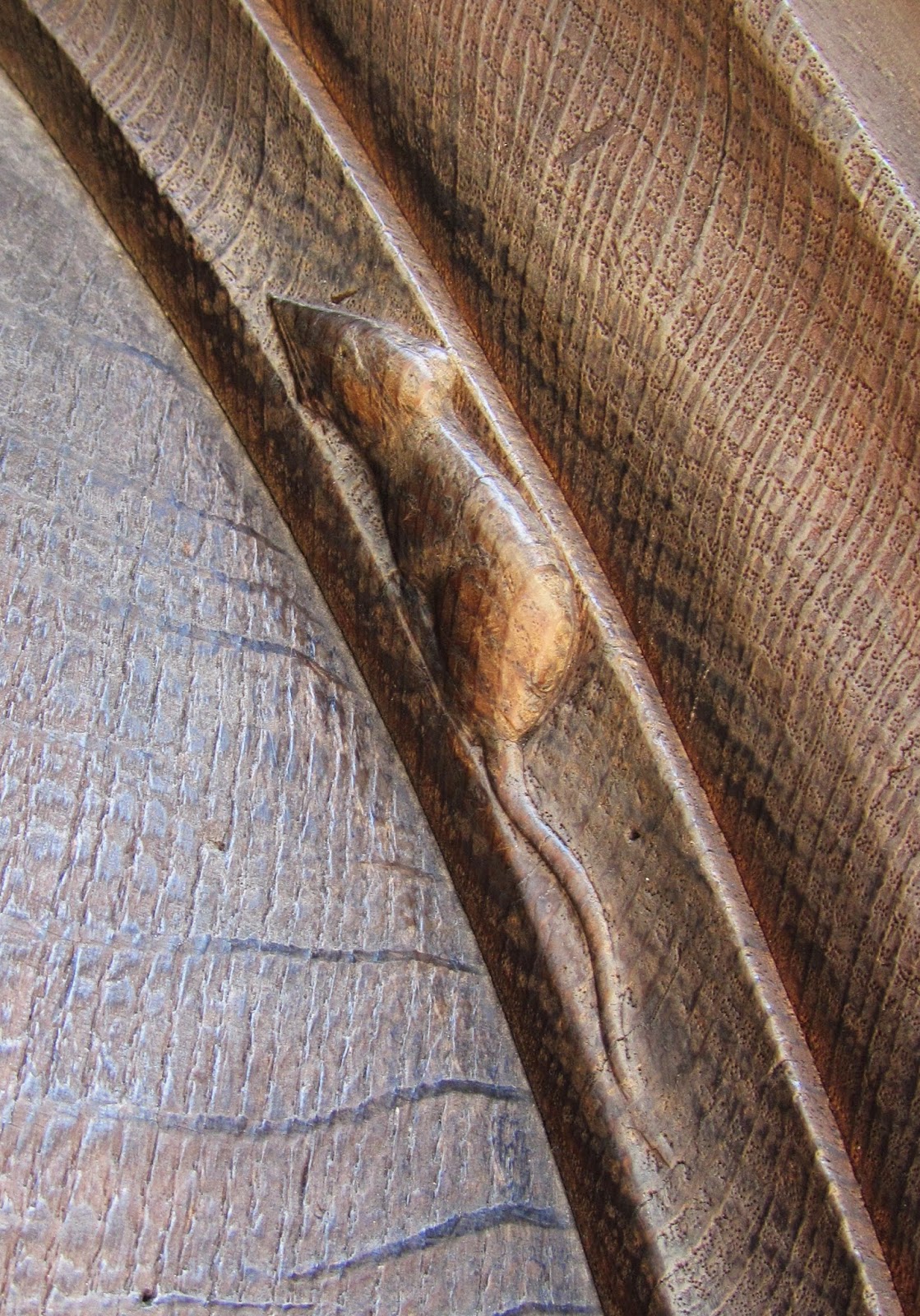
The door is modern. It was a custom job by the Robert Thompson workshop. It is run by his descendants now but Robert "Mouseman" Thompson specialized in very high end oak furniture. Today it is a highly profitable enterprise but back in 1919 Thompson was complaining to a fellow craftsman that he was "as poor as a church mouse". As a joke he carved a mouse into the project at hand. It became his trademark. Now a mouse on a bit of oak furniture is a symbol of high status. Lets peek at the St. Williams doors. First the right hand one:
Then the left:
I don't think this is petty vandalism, I figure somebody shaved this off to take home and glue it onto their charity shop quality furnishings!
If Mouseman furniture interests you, visit their site HERE. Warning, keep the credit card in your pocket unless you really need a $10,000 dining room table. Charmingly the "Mouseman" has prompted other craftsmen to adopt similar trademarks. Other Yorkshire workers in oak adopted monikers such as "Gnomeman", "Beaverman", "Eagleman" and "Squirrelman".
History. The fun thing is that it is still being made.
During the Second World War, the area around York had lots of air bases. British, American, Canadian, Free Polish. When off duty the dashing airmen did the logical thing, they came to town and tried to woo the local girls. With some success it appears. When in York I went on a marvelous free walking tour by the York Voluntary Guides Association. I recommend it.
Our guide took us up into Bootham Bar and told us the following story. Evidently it was customary for the soldiers to walk the course of the York walls with their sweeties. And when inside the Bootham Bar - it is by the way a nice dark place for a quick smooch - to carve off a bit of the portcullis as something of a souvenir. Eventually the whole thing was in ruins and had to be replaced.
The portcullis today:
If you look very closely indeed, you will see evidence that the tradition has not quite vanished.
When you wander into York proper you find a wealth of ancient buildings. Here is an interesting one, it is the front door of St. Williams College. It was founded in 1461 and served as a residence for the priests who chanted commemorative prayers at York Minster. Later it served as the location for Charles I's printing press during the English Civil War. But it is just the front door that interests us today:
The door is modern. It was a custom job by the Robert Thompson workshop. It is run by his descendants now but Robert "Mouseman" Thompson specialized in very high end oak furniture. Today it is a highly profitable enterprise but back in 1919 Thompson was complaining to a fellow craftsman that he was "as poor as a church mouse". As a joke he carved a mouse into the project at hand. It became his trademark. Now a mouse on a bit of oak furniture is a symbol of high status. Lets peek at the St. Williams doors. First the right hand one:
Then the left:
I don't think this is petty vandalism, I figure somebody shaved this off to take home and glue it onto their charity shop quality furnishings!
If Mouseman furniture interests you, visit their site HERE. Warning, keep the credit card in your pocket unless you really need a $10,000 dining room table. Charmingly the "Mouseman" has prompted other craftsmen to adopt similar trademarks. Other Yorkshire workers in oak adopted monikers such as "Gnomeman", "Beaverman", "Eagleman" and "Squirrelman".
History. The fun thing is that it is still being made.
Subscribe to:
Posts (Atom)