Wednesday, July 5, 2017

Treasure City (Michigan) Another Classic Gone

A while back I wrote about "Treasure City", an over the top tourist trap in Minnesota. It was on the road to our cabin up north and on rare occasions our parents would give in to constant pleading and actually stop there.  It had rocks, minerals, lots of shells, cheap pirate themed stuff, etc.

It was one of many such establishments but seemed to be the most flamboyant, the most unapologetic.  Remarkably it has survived for over half a century even with the main road being routed elsewhere.

So I was pleased to learn that there was another, apparently related Treasure City along the route of our drive through the Upper Peninsula of Michigan.  Old images were promising (I think on study that this is the Michigan version).


The "U.P." as they call it is certainly not free of tacky commerce, so I had high hopes. Alas, it was not to be.  Here is Treasure City in early July of 2017.


Clearly it is a new building.  The snarling bear might look impressive but it is modern fiberglass, not in the spirit of the garish plywood of the original signage.  The sign says: Treasure City - This is It! Largest Gift Shop in the North.

As to the contents, I could not bear to take a single photo, or to linger long over how the kitchy have fallen.  It is a huge place, new, absolutely immaculate.  I did find a single table each of sad looking shells and unimpressive colored stones.  Otherwise it was T-shirts, sweat shirts, fake license plates, endless variations of cabin signs, cheap Chinese made toys... and not even any pirate stuff.  We just wanted a Jolly Roger flag and perhaps some fake doubloons for an upcoming "Treasure Hunt" when the extended family gathers.  But no.

It is the kind of place that grandma might go to and buy you a souvenir of your vacation.  Or in the case of the grandma in our party, not.

Contrast it with this recent(?) picture of the Minnesota incarnation of Treasure City:


Pirate Pete is not happy with you folks up in Michigan.  Not happy at all.

For more images of what I now consider The Real Treasure City, go HERE.   If you are in Michigan and want to find something similar, I suggest Shell City in Grayling.

For entirely forgettable stuff for your cabin and/or grand children, you can go anywhere.

Monday, July 3, 2017

Road Trip June 2017

Some pictures from the road.  Scenic beauty?  Nah, just the things I find odd and interesting.

First up, an establishment in Northern Wisconsin:


The sign reads SPA BAR-BOWLING.  Now, likely as not it just means that the name of the establishment is Spa, but I rather like the image of northwoodsy women, heck maybe some men too, lounging back in easy chairs getting pedicures with cucumber slices over their eyes...with the sound of crashing bowling pins in the back ground.

Next up, Christmas Michigan.  Which is pretty much a couple of tourist trap stores and this garish casino.  Hey, who's that in the background?


I'm afraid so.  Its a two story tall Santa beckoning you in to roll the dice on whether you can afford to buy your tots presents this year.  


 Sometimes the notices in bathrooms go beyond the basic, necessary info:


Destination for the journey was Ann Arbor Michigan.  A fun college town.  So all telephone poles in the hip down town area are festooned with posters for local bands. Except this one.  Did it just reach carrying capacity for staples?  Or is it in its own way some kind of performance art?


Friday, June 30, 2017

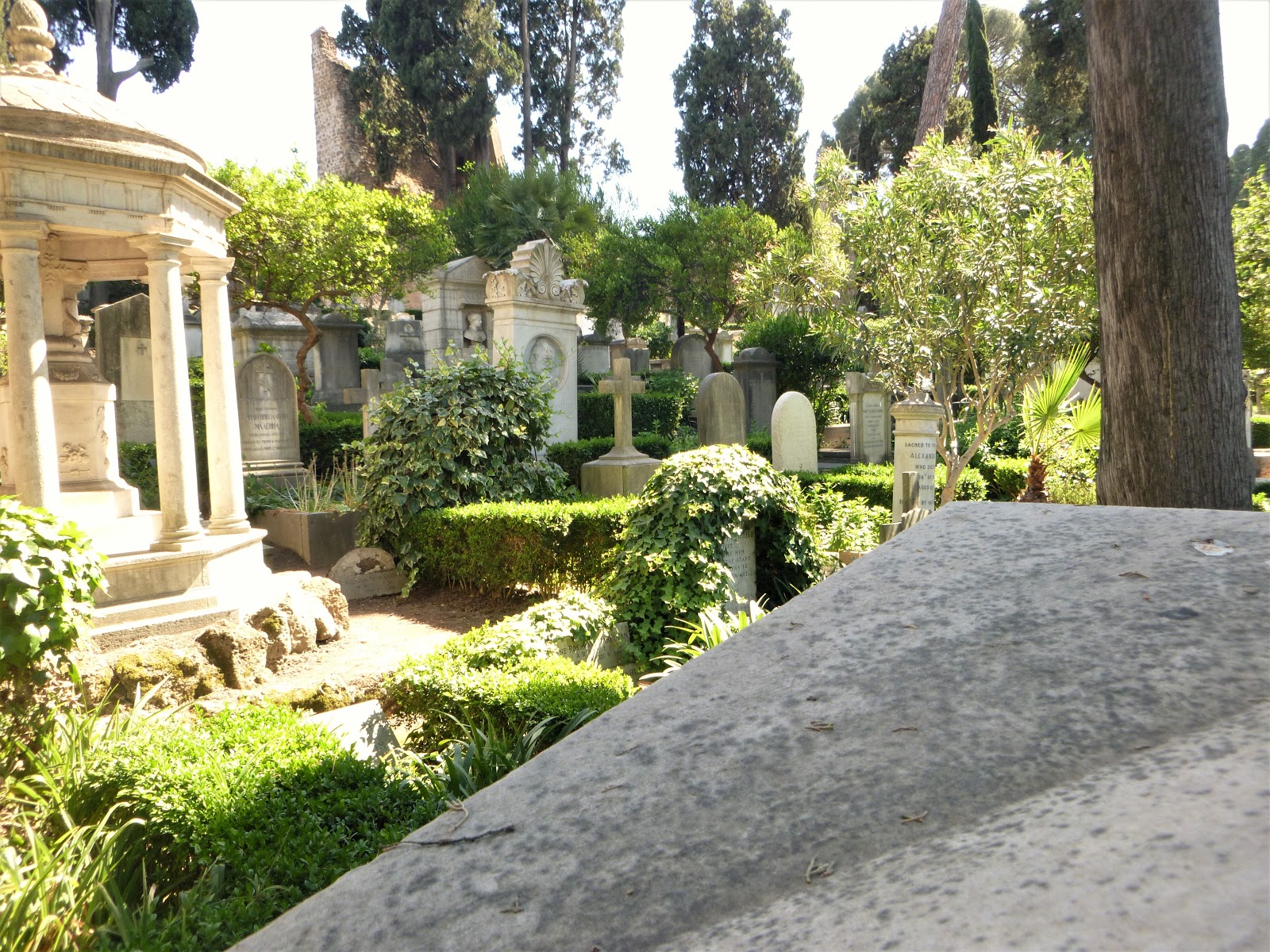
Tree Shaped Tombstones at the Protestant Cemetery, Rome

I readily admit that as "Tree Shaped Tombstones" these are not remarkable specimens. But when you visit a classic like the Protestant Cemetery in Rome you accept what you find.

A few comments then I'll finish up with summary of "History in One Place" for this week.


Perhaps the carved figure is actually a likeness of Alice Henry Mary, beloved daughter of James and Emma George.  She died in Rome in 1879.  I read by the way that crosses were not allowed in the Protestant Cemetery until circa 1870.  Alice died at age 21. Her epitaph reads "Where the Weary are at Rest".


A simple inscription Bonnouj, presumably a family name.  The data base I tried searching required the nationality of the departed.  I tried everything that fit...French, Belgian, Moroccan, US, UK. Nothing.  The cemetery contains a bewildering diversity of faiths and origins so I eventually gave up.  


The grave of Emma Ahlse Severin.  She lived a long life, 1844 - 1925.  She was German, born in Naples.  The inscriptions reads "Here Rests with our Father our Beloved Mother".  It might be meant either literally or theologically.


William Joseph Buckley.  He died in 1882 at age 36.  "Died of Diphtheria after four days of illness".  "In the Midst of Life we are in Death".  Somewhat cryptic and dour final words.

---------------
This week's "History in a Place" sites are all close together and easy to visit.  Please also include Monte Testaccio in your itinerary.  To visit them all you just need to take the Metro to Pyrimide Station or take any of the numerous buses that go to the Ostiense rail station.  You can hardly miss the gate and the pyramid when standing in front of the station.

As I mentioned in an earlier post there is not that much to see at Monte Testaccio but you are in the neighborhood so stroll a few blocks to the south west and have a look. On infrequent occasions they will unlock the gate and allow groups to climb to the top.

The Protestant Cemetery is open every day.  They rely on donations so please be generous.  9 - 5 Monday through Saturday, 9 - 1 on Sundays.  The entrance is on a back street behind the cemetery.  Via Caio Cestio.  The entrance is not obvious, so persevere.  If you are headed for Monte Testaccio this is probably the street you will be walking on.

At Porta San Paulo there is a little museum inside the gate.  Opening hours are listed as 9 - 1:30 every day but Monday.  Its free, but it seems a fairly modest little site so don't make a special trip to see it if you have already taken in the larger museum at Porta San Sebastiano.

Visiting the inside of the Pyramid of Cestius is possible but a little complicated.  If this interests you HERE is the information.

None of these sites take all that long to visit, and as long as you are right at the train station that goes to Ostia I recommend you hop on and go visit.  It's a really cheap ride to a really cool site.  We'll go there on our next "History in a Place" and a crowded place it is....

Wednesday, June 28, 2017

Protestant Cemetery Rome - A classic in distress

One thing that is not obvious to somebody visiting from the U.S. is just how...Catholic Rome is.  Even those who are not observant in a religious sense are almost universally Catholic from a cultural perspective.  Coming from a part of the world where Protestants outnumber Catholics it required a little adjustment to my thinking.

Because of course when non Catholics were so rare, and the prospect of burying them alongside the loyal flock of the Papacy so unthinkable, there would have to be a Protestant Cemetery.  Or to call it by its official name, Cimitero Acattolico.

Before the Reformation there would have been no need for one.  The only religious minority worth mentioning was the Jews, and they had their own succession of burial grounds.  Unknown in the earliest days, then in several Jewish catacombs.  A Jewish cemetery in Trastevere was recently discovered dating to the Medieval period.  

The first burial in the Protestant Cemetery dates to 1716. Exiled members of the Stuart court were at that time given dispensation by the Pope to be buried here, joined later by unfortunates whose Grand Tour had come to a sudden end.  It has been in continuous use ever since, and even with a couple of extensions it is a crowded place.


It is most famous for its "celebrity" graves, those of the poets Keats and Shelly.  But it has an eclectic population.  Protestant, Jew, Eastern Orthodox faiths are represented. Englishmen are probably the largest group but Russians, Germans and Americans also turn up.  Diplomats, artists, archaeologists all have their contingents.  In fact the cemetery is governed by a board made up of various Ambassadors of the foreign community.  In times recent funds have been in short supply and its financial status has become shaky.

What a marvelous place for a cemetery!  It is adjacent to the Pyramid of Cestius and has as one boundary nothing less than the Aurelian Wall!


Here a finely executed memorial is set into a niche in the wall.  If that is not original Roman opus reticulatum brick work it is a damned good imitation.


The oldest section of the cemetery runs right up to the edge of the pyramid.  Actually that is set down a ways, no doubt reflecting the original ground level.  You can just see peeking out one of the four pillars that at one time stood sentinel around the monument.


We shall ignore the well known graves - Keats and Shelley get plenty of attention. Here are a couple of interesting ones:

This is part of the family tomb of Thomas Jefferson Page.  Yes, he was a Major in the Confederate Army.  Prior to that he was an officer in the United States navy.  His was an eventful life....fighting Japanese pirates, exploring South American rivers...his connection with Europe was that he was sent there during the Civil War to purchase naval vessels.  He eventually did succeed at this, captaining the powerful iron clad C.S.S. Stonewall but arriving back in home waters just after the war ended.  Man, what a bio!


Artists are well represented here.  But this is actually the grave of a dancer, John Louis Piccoli, an American who died in 1955.


Historic sites in Rome tend to be very cat friendly.  The Protestant Cemetery is no exception.


Cats don't spend much time pondering their own mortality.

And they don't spend any pondering yours.


Worth a visit if you are interested in the intersection of ancient and more modern history.  They very much appreciate donations to keep the place up.  

Monday, June 26, 2017

Porta San Paulo - Defending Rome, sort of, for 18 Centuries

This week's edition of History in a Place is centered here:


Quite a lot to take in really.  This is a view from 1747 when a man named Giuseppi Vasi published a book of views of Rome.  His focus was on places important to pilgrims and this was included because it was the road to the Basilica of San Paulo, better known as St. Paul's outside the Walls.  This is the traditional location of St. Paul's grave.

But so much more going on here.  How 'bout a modern view.


I could not exactly duplicate the perspective of the early engraving, at least not without being run over by multiple vehicles.  

The first thing that grabs your eye is of course the Pyramid.  This is by far the oldest thing in the picture, being the 1st Century BC tomb of Caius Cestius.  It was built in the days when all things Egyptian were quite the rage following the Roman conquest of Egypt.  From inscriptions it is known to have been completed when Agrippa - a friend of Cestius - was still alive.  (Agrippa, son in law of Augustus, died in 12 BC). It is also recorded that the Pyramid was completed in just 330 days, quite the remarkable feat by the inefficient standards of modern Rome!  As you can see in the early view, it was one of the existing structures built into the Aurelian Walls. Although it is impressive the Pyramid is not our main focus today so lets look a bit to the east...


Here we see the Porto San Paulo, looking a bit adrift with its adjacent walls chopped off by assorted mishaps and for the benefit of modern traffic. It is similar to the previous gate we visited along the Aurelian Way.  Note again the accumulated upgrades from the time of Aurelian onwards...the addition of rounded towers, the two stages of height, the double doorway blocked down to one.  It also has a courtyard behind it with two surviving gates out into the city.  


During the Gothic Wars a group of Isaurian soldiers, who had gone unpaid for too long, opened this gate to Totila and his Goths in AD 549.  This seems to have been part of a repeating pattern, another bunch of Isaurian's had opened the nearby Asinarian gate during another Goth incursian in 546.  Isaurians it seems, just can't be trusted as guards.

The Aurelian Walls served as deterrents in the long centuries that followed.  Saracen raiders, feuding locals, other European powers that took exception to Papal policy all came and went.  But the Porta San Paulo had one last battle to witness.

It was September 10th 1943.  Two days earlier Italy had agreed to an Armistice, effectively ditching Germany for the Allies.  At first it seemed as if Rome would be left alone, declared an open city.  But Hitler changed his mind, and German forces marched north towards the Eternal City.  

Confusing battles ensued with Italian forces fighting on one side or another or just trying to stay out of the way.  The Last Stand was here at the Porta San Paulo where a mixed force of Italian soldiers, Communist resistance fighters and poorly equipped citizens attempted to hold the ancient walls against modern artillery and flamethrowers.

Of course this ended badly, with 570 Italian dead and minimal inconvenience to the occupying German army.  To one side of the gate is a surviving section of wall.  The plaque reads:  TO THE RESISTANCE THAT HEROICALLY MARKS HERE ON 10 SEPTEMBER 1943 THE SECOND RESURGENCE.  


On the other side of the gate the wall was destroyed in a later bombing raid.  On the new wall is a marker remembering one of the fallen of 10 September.


Italian military monuments are few in number.  But at the Porta an Paulo you see numerous memorials.  Here is a plaque honoring the first Allied troops who entered Rome in 1944.  Alongside are other memorials that mention the "Tedesco Invasore" - the German Invaders.  And the Nazifascista, which hardly needs translating.


For all its reverence for the distant past, for all honor given to the accomplishments of the Roman Republic and Empire, Italy very much downplays its recent history.  I am sure there is a collective sense of guilt for being the birth place of the Fascist movement.  I'll close with one final view of the Porta San Paulo.

This was intended to be one of the centerpieces of Mussolini's new Rome.  From this gate went the road to Ostia, which was to be excavated as a display of Ancient Glory. Also on this road was the EUR Center, a sort of Fascist Disneyland of concrete.  The display below is right outside the Ostiense Station, a rail center specifically built for the arrival of Adolf Hitler on a state visit  in 1938. The road you see in front of you was once named Via Adolf Hitler.

The mute statues, chains binding them together, represent the victims of the Fascist plague that Italy helped unleash on the world.


Friday, June 23, 2017

A Tax Free Lunch?

One of the difficulties Italy has in collecting taxes is that a lot of the economy is still on a cash basis.  When you for instance pay for several nights lodging with a big roll of Euros you do wonder if this income ever gets reported.  Oh, credit cards are accepted some places.  Restaurants for instance will usually take them.

On our last day in Rome I snapped a quick picture of this place on the Via Trastevere. I wonder if the credit card machine ( called a Point of Service) was really broken or not.  And I do like the inadvertant pun!


Wednesday, June 21, 2017

The Finance Police on the Case!

I guess its not exactly a secret that Italians are, shall we say, less than diligent in paying their taxes.  People who actually understand the intricacies of the VAT tax estimate that in 2014 Italians "evaded" 27.5% of what they should have paid. That makes for a not insignificant 36.9 billion Euros.  And that is just for VAT, one of the many taxes that Italy has on the books. The actual, total scope of tax evasion?  Who knows. Lots is a fair statement.  And it takes a toll, our trips to Italy have been made a bit less enjoyable by trash in the streets and archaeological sites closed because the government is chronically underfunded.

I was a bit taken aback to find out that the Tax Police actually have squad cars!


But I was really surprised to find out that they in addition have an "air force" of 100 planes and helicopters and a "navy" of 600 vessels.

If that seems a bit over the top for the purpose of persuading people to take paying taxes seriously I suppose it is only fair to mention that this branch of what are called "militarized police" also have responsibility for many other functions including preventing drug trafficking.

Wikipedia of course has so  Much More.  The Guardia works to track down illegal art sales.  They fight credit card fraud.  They run mountain rescue stations.  They even have nominal duties to prevent illegal immigration.  I wonder if their ships and that of the Italian Navy ever fire shots across the bow as the latter is currently tasked with rounding up ramshackle refugee vessels off the coast of Libya and towing them back to Italy.


Here's the current commander of the Guardia Finanza.  Although the Italians are not notably proficient at either military or police matters they do have the best damn uniforms.