Wednesday, October 12, 2016

Teaching Tools

Different lines of work have different equations that are important.  Back in my medical days for instance I was pretty good at quickly taking weight in pounds, converting it to kilograms and calculating doses of medications at milligrams per kilogram.

In my new undertaking, machining, the equation you see below is a biggie.  It is how you figure out the RPM setting for lathes and mills.  RPM is four times Cutting Speed divided by the diameter of the part you are working on.  You can see the Cutting Speeds listed, they vary on the basis of how hard the part is.


Obviously this is important enough to put on the shop wall in gigantic letters.  But perhaps this is even important enough that extraordinary measures must be taken to reinforce it.  Now, I do try to keep this blog set to high moral standards.  But what can I say.  You want a class of all guys to think about the diameter and hardness of parts?

Post the equation in the bathroom!


Tuesday, October 11, 2016

The Hot Metallic Smell of Victory

Here I am measuring a part I cut to a length of two inches.


I am, if ever so slowly, becoming a better machinist.  

That plus hearing last week that I would again be excavating at Vindolanda has put me in an upbeat mood albeit with an odd thematic mixture.

Amid the humming of the lathes and mills I thought I heard something like:

"Ave fabricator fortis. Vulcanus ipse saluto"

Monday, October 10, 2016

Rays and Root Vegetables

 I am busily learning the new language of machining.  Most of the interesting new words have some logical, mechanical meaning.  You may never have seen a Spring Collet,  a Retention Knob or a Pull Stud, but you could form a mental picture of what it might look like.  Apologies to my UK readers for what sounds like some slightly off color language.

Its fun, but I do miss my meanderings through the language of medicine, my previous career. There were so many small moments of insight.

Take for instance the term "Radiculopathy".  In Medicalese it indicates pain, usually in the arm or leg, due to pinching of a nerve in the spine.  When discussing the diagnosis with a school teacher a while back I had the realization that Radiculopathy and Radish as words must be not just cousins, but long separated siblings.  

Both descend from the Latin word Radix, meaning "root".  A radish is a root vegetable. Radiculopathy is  caused by irritation of a nerve at its origins, its "root" as it comes off the spinal cord and exits the bony confines of the vertebral column.  

Discussions like this are an excellent and diverting way to get behind in your daily schedule.


With Radix as a Latin origin meaning to come outward from a starting point there are obviously many words that grow from it.  Radiation, Rays, Radius (which is both a bone going outward from the elbow and the distance from the center of a circle to its perimeter).  A few words have picked up modern and unexpected encrustations.

A Radical in the modern political sense only goes back to the early 1800s when the extreme wing of the British Liberal party was felt to be in favor of extreme change "from the roots". Hopefully not by eradication.

And in the fields around stately Trowelsworthy Hall many farmers grow Horseradish.  It is a powerful, pungent root that can only be planted intermittently in any given field due to its severe impact on soil nutrients.  Horses do not, so far as I know, eat the stuff.

In this sense Horse is used as a synonym for "large, coarse".  "Courseradish" would be more accurate.  

Horse comes to us from the Proto-Germanic "hussa".  Until fairly recently it was preserved intact in the word "Hussar" which designated a fancy subset of cavalrymen.  And as to other odd variations on horse...

Horse mushroom, horse parsley and my personal favorite from the North of England: Horsegodmother, indicating a "large masculine wench".

My patient with radiculopathy may have also been complaining of a hoarse voice but my latitude with the daily schedule only goes so far and to consider horse versus hoarse was a bit too much.

Friday, October 7, 2016

Elephant and Obelisk

(Note.  Not sure quite why but when doing some routine blog maintenance this popped up and won't go back to 2014 where it belongs.  I don't want to delete it entirely. Sorry 'bout the rerun)

The most whimsical of the Obelisks of Rome is certainly one found outside the Church Santa Maria Sopra Minerva.

The church's name says a lot.  It is an early Christian church that was established in the ruins of, or at least on the site of, a pagan temple.  "Mary over Minerva".  A strong bit of symbolism even if the exact location of the temple to Minerva is off a bit.

This was a religious district and there were several temples in close proximity.  The Temple of Isis/Serapis of course had an Egyptian theme to it and was outfitted with numerous small obelisks. Several of these are known to have been installed fairly late, during the anti-Christian reign of Diocletian.

One of these was found in 1661 buried in the cloister of the church.  This obelisk was originally erected in Sais, Lower Egypt, by the Pharaoh Apries. It was decided that it would be erected near where it was found, and Pope Alexander VII commissioned the great Bernini to create a base for it.

The visual image he chose - and elephant holding up the obelisk - is an odd one.  It probably was inspired by this image:


This is from a rather odd book called Hypertomachia Poliphili.  First published in Venice in 1499 the authorship is not certain.  In English the title is Polyphilo's Strife of Love in a Dream.  It is a strange allegorical work, heavily illustrated with elegant woodcut illustrations.  Polyphilo "the friend of many" wanders through a dreamscape in search of his love, Polia.  Dragons, nymphs, exotic wild life, forbidden kisses.  There is a lot of swooning involved.

The book may be the work of Francesco Colonna, a Dominican priest and monk.  His reluctance to put his true name on a rather racy little romance is understandable given his vows.  If you read off the elaborately done first letters of each chapter it says:


POLIAM FRATER FRANCISCVS COLVMNA PERAMAVIT

This reads in Italian: "Brother Francesco Colonna has dearly loved Polia" !

Some pictures I took of Bernini's Elephant.  Or should we call it Colonna's?  Or even Polia's?


What a great location.  That's the Pantheon in the background.  Rome tended to group temples into religious districts.


Original hieroglyphics.  These were carved from really hard rock and tend to hold up well over time.


The star and mountain were the logo of Pope Alexander VII.


I really like this obelisk.  It is of a more human scale, being the smallest of the Egyptian obelisks to make the long ocean journey to Rome.  And the base statue is perfect.  Over the years the elephant has been known as Porcino, or "Piggy" but in recent years has been called Pulcino, which is "little chick".  Either way he seems to be a really happy guy.


Robotics Update 7 October

With the able help of my high school FIRST students we have the middle school class building away at a good clip.  Familiar designs of course recur but there are some interesting new themes as well.


This design has the new dense foam wheels on the back with styrofoam and some kind of shower floor traction stuff on the front.


The beige component here is our first 3D printed part.  Will it be strong enough to hold up in battle?  Stay tuned.


Form before function.  This student decided it was more important to have a drawing of "Mukanaus" than to have his wheels attached.  I am actually ok with "art bots".  The whole theme of the middle school class is free form building and there aren't many rules.


Its been great to have the high school kids there.  Some of the soldering gets a little tricky.  But it is consistently getting done right and without my needing to watch over them.  There are just too many other things I need to supervise at the same time.

In the spirit of "not many rules" a couple of interesting scenarios are developing.  One lad took his project home and had some productive and probably enjoyable build time with his dad. What they created is sturdy, looks effective, is nearly done....and is at least four ounces over weight.  So how hard should I make this kid sweat to get those four ounces off?  Pretty hard I figure.  He can learn a few things about attention to specifications and about how much lava flows of hot glue really weigh.  And as his reward for solid effort in these areas I think I will show him a trick by which drive and weapon power can be drawn off of a single battery.  He is a talented if somewhat challenging student who has considerable promise.

Another student had the idea that he could just haul in the battered wreckage of a large RC car and simply swap in the parts.  I let him flail away at it for a session or two.  But realistically there is no way he could manage it.  The cheap plastic gearboxes that they crank out in China never go back together again once broken open, and he had no idea of how to create from scratch a reasonable forward/reverse control system.

I told him it was time for a serious re-design.  He thought for a few minutes, reached into one of my bins of junk parts and said "How 'bout if I used this?".  Hmmmm, both this part selection and his ideas of how to adapt it were very solid thinking.  A few parts will have to be fabbed by me as our shop access and time budget are tight, but this could make for a very interesting and anomalous machine.

I will still make him think up the control system, but I can at least tell him that it can be done with the technology on hand.  If he can figure it out in time....


Wednesday, October 5, 2016

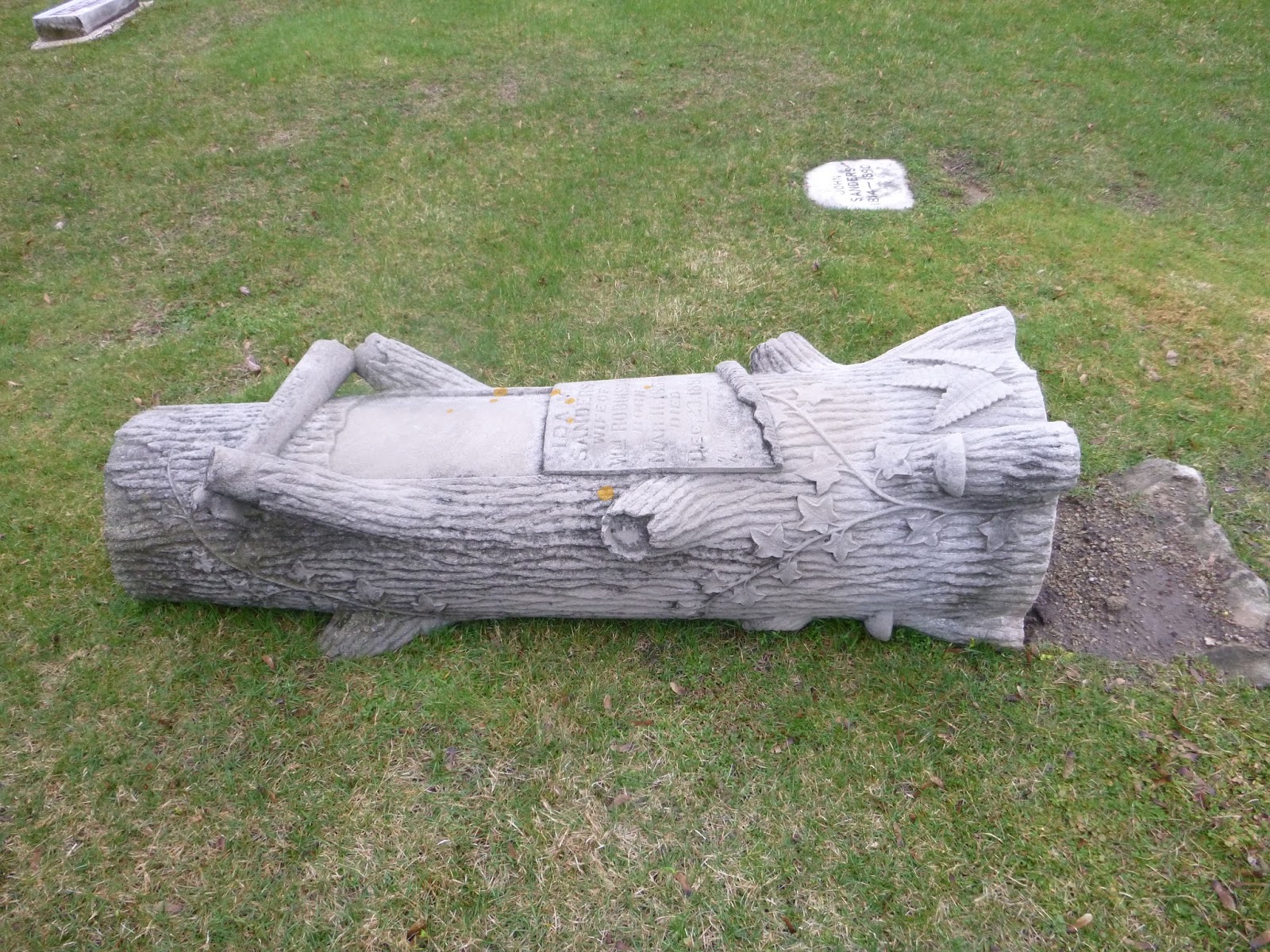
Tree Shaped Tombstones - Reedsburg, Wisconsin

I visited Reedsburg on a grey, drizzly day.  My main objective was the Reedsburg Brewery where I had found a detailed account of a brewery cave.  It even gave the distance and direction from the brewery.  I could see on Google Earth a nice cliff face of stone....

But alas, there was nothing to see but a curious grate set into an asphalt parking lot.  If you have to put in a parking lot over a cave complex I guess it can be done.  It must have been hard work.

But at least the local cemetery had a few Tree Shaped Tombstones for me.

When you see a monument made of this softer white stone it is almost always an early one. 1870s in most cases.  The inscriptions do not bear up well so often the dates are hard to read. And of course these short tombstones usually reflect a young life that ended before full growth.


I wonder if the carver was good enough to actually capture a likeness of young Laura.


These taller tombstones with clasped hands are invariably a married couple.  Often it seems to be a situation where one passed away many years before the other.  In that case the renewed clasping of hands is especially poignant.


Tombstones have a tendency to lean and shift a bit, especially when in low lying, wet ground. Or as in this case on a hill side.  You can see that this freshly toppled "Tree" was on a simple base that does not look too sturdy.  Some of the sturdier bases you see are likely retrofitted.  I would like to imagine that this tombstone tipped over of its own accord.  But it is spring and young people tend to be a bit high spirited this time of year.


Monday, October 3, 2016

Vindolanda Season in Review

The last dirt of the season has been tossed at the Vindolanda excavations.  Having been part of this enterprise for nine years now I think I am qualified to say this was one of the best seasons in a long time.  Such fascinating archeology.

Work went on in two different areas.  Inside the "later" fort artifacts from the 3rd and 4th century were being found.  These tend to be in somewhat rough shape as they are closer to the surface.  But deeper excavations into the earlier wooden forts have gone back to the 2nd century and have delved into layers where the preservation is astonishing.  Lets have a look at a few swell finds....

(these photos are from various sources and many are from the Vindolanda twitter feed and/or their excavation blog that I link to.)

You don't usually find intact pots.  But in this case it was a burial urn for a cremation.  These are never found inside Roman settlements but the boundaries of the fort and associated civilian community expanded over time and appear to have extended over an earlier cemetery.


Sometimes it is the most mundane little things that give us the strongest connection to the past. A section of iron chain.


I was there the day this was found.  It is heavy.  At first there was some debate as to what it was. But the final call is that it is an iron ingot with an official Roman government marking on it. The output of mines belonged to the state, and while marks like this are pretty common on lead ingots to find it on an iron one is rare.  It must have been difficult to inscribe.


As mentioned work went on in several areas this season.  This is a deep defensive ditch dating from the era of Septimus Severus.  (circa 200 AD).  Things from the bottom of this ditch survived in fabulous condition due to the anaerobic conditions.  Where the little group of excavators on the left side is working is an area I spent several frustrating days on, trying to puzzle out a jumbled array of stones.  Obviously a lot of stuff was settling down into that ditch.


Bronze items come up still looking bronze.  The god Apollo.


This, remarkably, is a wooden barrel stave.  It has a name stamped on it.  I have not heard if this designates the barrel maker or the purveyor of whatever was inside.  Darn that anaerobic preservation is impressive.  May I repeat, this is wood, 1800 year old wood.


Work went on up in the "newer" fort as well.  From time to time you find these little personal altars, often reused to repair crumbling walls.  Sometimes they have elaborate dedications that identify the deity being worshipped.  Some as in this case, are blank.  Perhaps the dedication was painted on.  Not everything survives from the Roman era.


This clever little item is a bronze brooch with colored enamel insets.  It would have had a bronze pin and was used to hold clothing together in an era when buttons as we know them did not exist.  I found one just like it my first year excavating.


A quern stone used to grind grain.  Broken ones are common.  To find one intact less so. Maybe the surface was worn down from long use or maybe it was too heavy to haul along one one of the periodic abandonment/demolition events of the Roman fort at Vindolanda.


What a year for finding Roman shoes!  I have not seen a final count but I know several hundred came up.  This was a particularly fancy one.  1800 years old.


Various writing tablets came up.  This one was of the "wax stylus" variety.  The raised edge went all the way around and the hollowed area was filled with bee's wax.  This surface could be written on with a sharp stylus then the surface smoothed over for another use.  Sort of a Roman era Etch-a-Sketch.  I found one of these a couple of years ago but not this nice.  It takes technology, time and a bit of luck to do so but sometimes they can still be read today.  The Post it notes of ancient times...


You do find some interesting artifacts.  The Romans had rather coarse sensibilities from our modern perspective.  Lots of phallic artifacts.  And this rather graphic bit of pottery.  I wonder if it was the tip jar at the local brothel!


To read more about these artifacts and the Vindolanda excavations in general I encourage a visit to the link marked "Excavation" over on the right.  Or if you are of the Twittery persuasion the Vindolanda folks do update it often during the season and periodically in the fall and winter "off season".  Vindolanda on Twitter .

Great stuff.  I am already dreaming of next season.