Monday, September 30, 2013

An Eye under the Rust?

In my last Vindolanda expedition I did not find much fascinating stuff.  Luck of the draw sometimes, I was in interesting areas but the the artifacts were elsewhere.  I was reduced to furrowing my brow over twisty nails and odd bits of rusted lumps.  Surely this was "something" back in Roman times?

One item I featured was an "unidentified metal bit".


Mostly iron one supposes, but a couple of enigmatic flecks of grey peeking through.

When perusing the excellent site on the Binchester excavations I came across this photo, with the similar looking object being identified as a "seal box".  Could my artifact have been one?


The shape and size seem about right.  Oh, this is the bottom, which always has three holes in it.  The fancier upper part looks like this:


I confess that seal boxes were an artifact type I was not familiar with. This is a site dealing with seal boxes found in the U.K.  The artifact from Binchester, and perhaps (?) my mystery lump, would be of the "vesica" or eye shaped variety.

Here is an image from the above link, a nicely done summary of the known/unknown aspects of seal boxes by Colin J. Andrews.


I am certainly indulging in a little "off season" speculation here.  But note the central dimple in both of the images above.  It does appear to have an analog in my encrusted specimen.....

It is worth noting that seal boxes are a rather atypical find in late Roman sites, but that various types of brooches are common.  This would not be a common style, but until the lab soaks the crud free this remains a possibility.  Or it could be something else altogether...at the time there was speculation that it might be a small knife blade.

Saturday, September 28, 2013

Woolly Bear Forecast, Fall 2013

Nobody much believes in using Woolly Bear caterpillers as a weather forecasting device.  But let it be noted that last fall I saw only one....and it was all black....and already dead.  A nasty winter ensued.

The folk lore has it that the more of the bear's 13 segments are light brown the milder the winter will be.

Filmed for what it is worth, on 23 September, 2013.  This little guy was bookin' it across a blacktop road.  Either because it was hot or because his tiny insect brain actually predicted a high chance of becoming a flat worm if he stayed on the road very long...


By my count 7 light brown segments.  Way to go little guy!  Mild winter ahead!

Friday, September 27, 2013

Strange Veg

There are quite a few folks who express concern over Genetically Modified Organisms.  Mostly they fret about plants that have had various genetic stuff spliced into them.  It seems a fair question, but  I have observed that the anti GMO crowd seem overall to be reasonably well fed and so I consider it unlikely that they are surviving entirely on acorns and walnuts harvested from the forest floor.

I wonder how they feel about Giant Vegetables?

I must confess my first exposure to the concept of growing huge vegetables came from a viewing of Wallace and Gromit, Curse of the Were Rabbit.


But as a hobby it has caught on, and our local Oktoberfest has had a "Giant Pumpkin" competition for the past two years.  Other "stuff" also gets brought.

I think it was an off growing season this year, or perhaps the real heavyweights were coming in at the last minute.  But here are a few, presumably modified, entrants shortly before the competition began.


These things get big enough that gravity, or perhaps tidal forces, have effects on them.  Middle aged slump is not exclusively a human problem.  The old gaffers on the park bench seem to be enjoying the spectacle.


A large punk, warts and all.  It looks like a beached technicolor manatee.


A turnip....I think.  For reference that is a three pound tomato on the left.

But my favorite Strange Veg of the year.  Not even on display, it was sitting on a counter back in the office.  Maybe a little too risque for small town America?

A Ruebenesque root of some sort.


Wednesday, September 25, 2013

A Roman Marching Camp in Wisconsin?

The Romans were very consistent folks with respect to their military architecture.  A legionary fort in Scotland would have the same layout as one in Syria.  The similarities even crossed different categories.  The forts manned by legionaries were larger than those staffed by auxiliaries but the basic geometry was the same.

In the later stages of the Empire cities acquired walls and gates that were modeled on the military template.

And sometimes the Romans took things to what we would regard as ridiculous extremes.  When the legions were on the march they would stop for the night, then build a temporary "marching camp".  It took three or four hours but they could then sleep securely behind a system of ditches and dirt walls...with the exact geometry of a conventional Roman army post!  In the morning they just packed up and moved on.

This of course was one reason why it was so difficult to dislodge the Romans once they took an interest in your land.  By the time you figured out where the Romans were, and got your fellow tribesmen rounded up and sober, the only way you could mount a night time sneak attack would be to go against some formidable defenses.  A five foot deep ditch, then a five foot tall wall with sharpened spikes on it.  Each Roman soldier carried a pre-sharpened spike with him!

A few images....

The "Porta Nigra", a marvelous surviving Roman city gate in Trier.

Note the similarity to this Roman coin of the same era.  This is referred to as a "camp gate" by numismatists, and is felt to reflect the less substantial - but clearly similar - gates of Roman forts.

Finally I offer this, my concept of what Roman marching forts might have evolved into had the Empire not fallen.  You need a temporary camp?  Why spend hours and hours moving dirt?

From our local Oktoberfest...


They actually got a lot of details spot on.  Even little things that essentially nobody but I would notice. On the left hand side we have a soldier in the uniform of an auxiliary.  On the right, a proper legionnaire.


I don't know if I should deduct one authenticity point for the "Crusader" cross on this fellow's shield. The unknown artist could I suppose argue that it was one of Constantine the Great's soldiers at the battle of Milvian Bridge.  That of course was where Constantine received his vision of "in this sign conquer" and had his men paint Christian symbols on their shields.

I would for sure give serious authenticity points if that was the intent, but would also point out that the symbol used is thought to have been the earlier Chi Rho monogram.

Monday, September 23, 2013

Unclear on the Product Line

I like vending machines.  In a world increasingly transient and electronic they are a reassuring, solid presence.  There are still some products that, when you need them, you can't apply some "app" as a substitute.

The first vending machine is said to have been in Alexandria during the Roman era.  You put in a coin of known denomination, most likely a tetradrachma.  And out comes a ration of "lustral water".  The use of same is not certain, most assume it was used in some sort of votive fashion at a nearby shrine. But for all we know it could have been an early energy drink.

The machinery was unknown, but probably the same system of slots, ramps and a weighing device that is still used in coin operated machines.

Because vending machines have this common DNA it is not always easy to tell the difference between machines selling various items.  Recently I encountered this:


If you don't have the context you might be, er, mistaken as to what is being sold.  Ultra Norsk...Super Truck...Armor All.  If you have keen eyes you will note the words Super Large on the right hand machine.

But this is actually outside a local car wash.  A closer view:


The Freshest Leaf in the World.  That clarifies things nicely.  At least until Wisconsin starts taking lessons from Oregon and Colorado and considers legalizing marijuana.

Friday, September 20, 2013

Everybody getting along

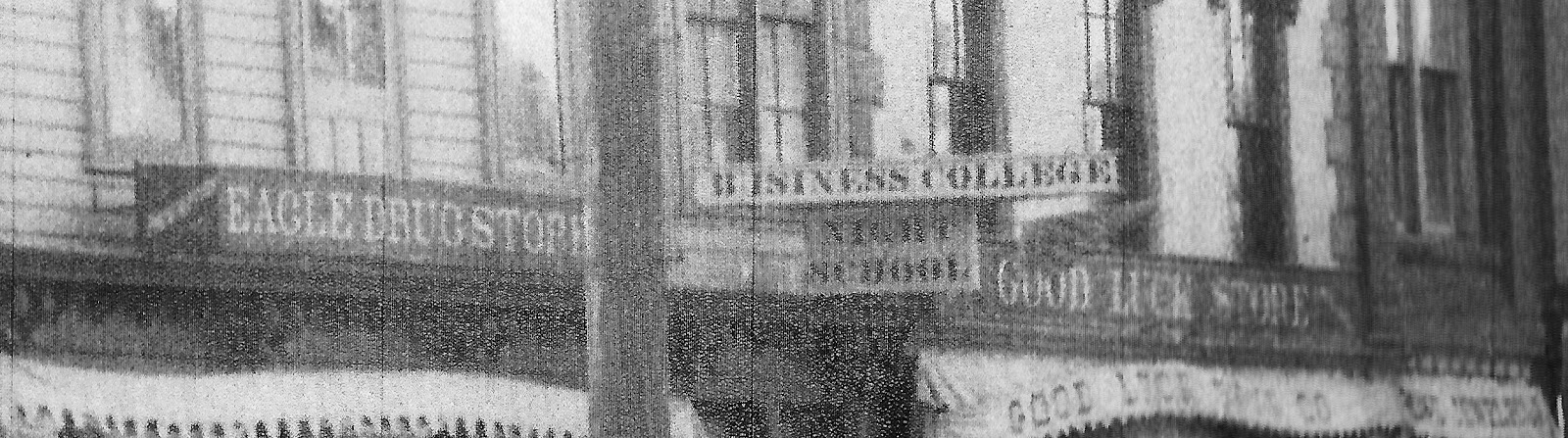
A street scene from the late 1800s:


No clue as to the reason for the photo.  Cold weather but some occasion serious enough that a bunch of men stood still and stared into the camera.  The white horses attached to the delivery wagons did likewise.

But the interesting details are hiding in the background:


In addition to the Business College with Night School we see two different drug stores. Next door to each other.

Back in the day drug stores were more abundant.  In a pre-automobile era you really needed one in every part of town.  And they sold a varied line of goods, paint, art supplies, hardware, fireworks, cosmetics and such like, in addition to the usual prescription and patent medicines.

But still, two drug stores side by side?

You would not think it likely, but they both were successful businesses for a long time.

On the left we have the Eagle Drug Store.  It was established in 1875 and stuck around until at least 1907.  At one point it had a large, gold leaf covered Eagle and Mortar emblem over the door.  Alas, not to be seen in this 1890's image, but recalled in a series of very fetching embossed bottles:


The drug store on the right was The Good Luck Store.  It was established in 1883 by David Chisholm, who split off from the Goddard and Chisholm partnership shown above.  Was there some sort of falling out between the men?  If so, setting up shop right next door would seem a bit....cheeky.  And the sort of venture that might not fly.  But the Good Luck store also did well, also surviving into the 20th century albeit with Mr. Chisholm moving on after a short time.   They also have some nice bottles:


Wednesday, September 18, 2013

The One that Didn't Get Away at the Thrift Sale

Walking on a Sunday morning we came across a thrift sale.  I stopped to look at one rather eye catching item.  The guy in charge said:

"Hey, you need a fish?"

"How much?"

".........Five bucks."

At that price, yes, yes I do need a fish.


This magnificent slab 'o Taxidermy is hanging out in my secret underground workshop as negotiations continue.  You'd think a majestic King salmon would look great anywhere, right?  If you think that you presumably have a Y chromosome.

On the back of the mount I found this:


There is no Burokek Taxidermy in Janesville Wisconsin at this time.  But of course the fish looks to be decades old.  Oddly, Janesville is something of a taxidermy mecca.  Why there is even a Rhinehart Taxidermy Institute there.

Go figure.