I am just back from the second annual Minor League baseball road trip. My brother and I started doing this as an excuse to get together and as a way to enjoy live baseball when our beloved Minnesota Twins are frankly hard to enjoy (48-60, and far out of contention).
So this year it was off to Iowa, on a winding journey of 900 miles. There were many diversions, many glimpses of America, but as to the actual baseball part of the trip...
First up was a Friday night game at the home park of the Clinton Lumber Kings.
We try to always walk to the ball park on these trips. Clinton is a town of 30,000 that has seen some economic hard times but is hanging in there. As we strolled up to the stadium it did not look to be a very big crowd attending, so the ticket lady said we could get some good seats.
"You want to be in the front row?"
We said sure, and asked if as VIPs there would be cold beer waiting for us there. She laughed and said that would cost us extra.
Excellent seats. We had to get our own beer but what a nice place to park them.
You see a different view of baseball from close up. Here for instance is a reminder that we are in the low Minors....
No way a player wears mended pants in "The Show".
There were about a thousand fans in attendance that night. And if our little section was any indicator they are serious fans. My brother sat next to an intent young woman keeping score. He can follow a game as closely as anyone. But once or twice she would correct him on some minor point, a late inning substitution and so forth. It was the only time she spoke with us. On the other hand, sitting right behind us was a genial pair of retired folks. He loved baseball and we carried on a long and often erudite conversation the whole game. His wife was less of a fan, he had brought her to the park for her 64th birthday. At the end of the game we all stood up and shook hands, something I had not encountered before but an excellent punctuation mark to an evening of shared experience.
A nice little park beside the river. Our local commentator told us that attendance was better back when the "gambling boat" was anchored a few hundred yards out past center field. They built a casino elsewhere and the boat, with its casual but probably free spending fans, went elsewhere. I also learned that about ten years ago they had a flood entirely inundate the park. It was necessary to excavate the field down 8 or 9 feet to repair the damage.
The score did not not matter to us, but for the record the Lumber Kings defeated the Beloit Snappers by 7-4. The quality of play was quite good. Much better in fact than we saw on last year's Road Trip. The Clinton manager got ejected from the game for his vociferous argument of a balk call late in the game. It was a Major League quality rant. Even the local fans had to admit that he was probably justified in his outrage.
Next up was a visit to Cedar Rapids. There we found the Kernels, who are the low A affiliate of the Twins. Generally we just cruise in and get whatever tickets are available, part of the point of this trip is being casual. But having noted an atypical start time I checked the Kernel's website that morning and noted that it was a special night. They were having a Beach Night/Jimmy Buffet theme. After the game there was to be a concert. And fireworks. Alarmingly they claimed it was Standing Room Only.
So I called the ticket office. A nice young lady said she could find us a couple of bleacher seats, or would we perhaps like to sit in a suite? One of these had not been reserved that night and they had just opened it up for individuals. We decided we could handle looking like big shots. Big shots who were staying in a faded motel that had cost us $48 bucks for the night!
The flamingo was part of the Beach Night theme.
The view from the Big Shot seats. This was as fans were filing in, they ended up with an announced crowd of over 5,000.
It is a different experience from these rarefied heights. Our "suite mates" hardly talked at all. We were sitting on the chairs out front of the enclosed area. I saw some kids who stayed back in the glassed in area behind us, twiddling with electronic devices. It was a long walk and an elevator ride down to get food and drink.
But a perfect evening for a game and it must be said, one very fine view. The Kernels alas had an off night. They did not look good at the plate, and were worse in the field. Four official errors. And two consecutive batters reached in what to a serious fan was an egregious bit of bad baseball. When an opposing batter lays down a good bunt it does not bode well for your team to have third baseman, pitcher and catcher all stand stock still like birds hypnotized by a snake. It almost seemed as if nobody knew what to do and they all feared looking foolish by trying. Well, there are reasons why these fellows are still in the low minors. Despite a last ditch rally the Kernels lost to the Quad City River Bandits 5-2. It should be noted that the Kernels are still in first place with the Bandits nipping at their heels.
Comparing the two experiences is difficult. Both were fun and we would/will certainly return. The Clinton game had more of a "Bull Durham" feel to it, but in part that may be because we had better information on the players. Who is on the way up, who is playing out the last days of a Minor career. I must say that neither park let the various gimmicks between innings - chicken tosses, silly races etc. - interfere with the Game. The food was OK at Clinton, sub-par in Cedar Rapids. The beer at both places was not up to Wisconsin standards. Parking was free, not that it mattered to us. We may have been the only pedestrians in attendance.
Fun. We are already starting to think about next year. Baseball is always about hope and renewal and continuity. I think making the trip earlier in the season was smart. Last year we went at the very tail end of summer and the quality of play was indifferent. This year you could see that there was still intensity in some player's eyes, they were still hoping to make that one great play when a scout was watching. Still hoping to get their chance to move up to The Show.
Buy me some Peanuts and Cracker Jack. And you can toss the shells anywhere you like.
Wandering unsupervised in various real and imaginary places. Detritus reflects my interests in robotics, travel, history and the odder aspects of the world around me.
Wednesday, August 7, 2013
Monday, August 5, 2013
Bits and Pieces of Saint Oswald
Happy Saint Oswald's Day (5 August).
You forgot again, didn't you.
We have so few windows into the Dark Ages. One of our better ones is a fellow called The Venerable Bede, who scribbled down maddeningly incomplete stories of the years after the Roman collapse in Britain. Much of what we know about Saint Oswald comes from him.
Last May on a day off from digging at Vindolanda I hiked over to this spot:
This is St. Oswald's church, about ten miles north east of Hexham and near Hadrian's Wall. And it was the scene of momentous events.
Oswald was born in 604 AD, just about the Darkest hour of the Dark Ages. His father was one of many squabbling Post-Roman kings. Life was continuous warfare between rival factions. Some were Anglo-Saxon, some Welch, some barbarian Scots and Picts. When an armed, shaggy horde appears at your frontiers it seems to modern sensibilities that their lineage and religious persuasion are matters of minor import.
Not so to The Venerable, who takes great pains to portray Oswald as being a good Christian prince, who found himself at the head of a small army facing off against a motley assortment of vile heathens under Penda of Mercia and Cadwallon of Gwynedd.
The date was probably 634 AD, and the location was certainly what we see above.
The night before battle King Oswald is said to have had a vision of Saint Columba which foretold victory. He had a wooden cross set up, prayed for victory and commended his troops to baptism and conversion.
The next day, in the shadow of Hadrian's Wall, Oswald was victorious, Cadwallon was slain and his Welsh soldiers were scattered to the winds.
On the site where Oswald raised the Cross an early Anglo Saxon church was erected. The Wooden Cross was still around almost a century later when Bede happened by and noted that:
"Even to this day, many cut off small chips from the wood of the Holy Cross, which being put in water, men or cattle drinking thereof, or being sprinkled with that water, are immediately restored to health."
As the cross was eventually whittled away it has always been replaced by another one, stone or wood,
Here is the current one.
Not quite historically true, this stands on the hill below St. Oswald's church by the edge of the "modern" military road and presumably overlooking the site of Hadrian's Wall, which is at this location not visible. The current St. Oswald's church is pretty darned new, built in 1817. It is probably the third church on the site, with various bits and bobs of earlier construction found in its walls and foundations. Oh, and there is also this:
Inside the church is this rather substantial bit of stone supporting a vase of flowers. It is a much weathered Roman altar, and is said to have once been the foundation stone of a stone cross on the site during Medieval times. The symbolism of having the Cross atop a relic of former pagan times is not subtle!
The day after Oswald raised the Cross and prayed a battle was fought. In recognition of the Divine Intervention it is recalled as the Battle of Heavenfield. The location is not certain, although local tradition says that in the fields just south of the current Cross location a large number of skulls and bones were once unearthed. That would make the Battle of Heavenfield fought right here:
But really, who knows. So much blood has been shed in these hills over the millenia. And if the battle was as tradition has it, really fought with Hadrian's Wall as the southern boundary...well, the Wall was probably exactly where I was standing when I took this shot. It was in modern times knocked down and reused to build the roadway. I suppose a mass grave could have been dug anywhere, but hauling smelly pagan corpses over a wall that still probably stood 20 feet tall at that point seems quite a bother.
With the victory Oswald re-established the Northumbrian kingdom as the most powerful in Britain, and he seems to have been acknowledged as "Bretwalda" or Overlord during his eight year reign. Bede really liked the guy, no doubt because he did much to promote Christianity in an era where pagan beliefs still appealed to many.
As to Oswald himself, well his life is not recalled in great detail, probably it was after the fashion of the day an endless succession of campaigns against assorted unhappy neighbors. Eventually he and Penda fought a rematch that ended badly. Oswald was slain, his body dismembered with the head and limbs mounted on pikes.
But in death Oswald became quite renowned. All manner of miracles were associated with his relics. Dirt from the place where he died was taken for its healing properties...a hole as deep as a man's height was made. A raven took one of his limbs to a nearby tree...the tree gained perpetual vigor and when the arm was dropped to the ground a miraculous healing spring arose. Paralytics were cured. Strange lights were seen in the sky.
The various sub units of Saint Oswald became very valued items among the monasteries and cathedrals of the day. It is said that a party of monks from the Peterborough Abbey once snuck into Bamburgh Abbey and stole one of the uncorrupted limbs of Oswald. After getting it back to their own abbey they realized the potential for another theft. So they put the relic in a room at the top of a narrow stair and had a monk guarding it 24/7!
By the way, this worked for quite a while but the arm disappeared during some of the anti-monastic troubles in the age of Henry VIII.
Durham Cathedral ended up getting all sorts of relics from saints of this era. Bede ended up there, I once stood in front of his tomb and scolded him for leaving out so much in his writings. Oswald's head is also there as is the tomb of St. Cuthbert a considerably later chap who is considered the Patron Saint of northern England. Truth and legend become intertwined....here is a stained glass window with Cuthbert holding the head of Oswald.
Dark Ages history is a funny business. Oswald got sainted because he is said to have converted his army to Christianity on the eve of battle. This is obviously an echo of Constantine and his dream of "In this Sign you will conquer". So who did the copying, Oswald or Bede?
I have no particular reason to believe that Oswald was better or worse than any other glorified war lord of the era. A fact that Bede seems to gloss over is that Ozzie was killed in battle at a location that suggests he had undertaken an invasion of Penda's kingdom.
In the end Oswald was effectively remembered for being dismembered. I think we can assume that the sheer volume of miracles attributed to the man was actually multiplied by the number of places that bits and pieces of him came to rest!
I suppose I should let Bede have the final word:
"If history relates good things of good men, the attentive hearer is excited to imitate that which is good."
You forgot again, didn't you.
We have so few windows into the Dark Ages. One of our better ones is a fellow called The Venerable Bede, who scribbled down maddeningly incomplete stories of the years after the Roman collapse in Britain. Much of what we know about Saint Oswald comes from him.
Last May on a day off from digging at Vindolanda I hiked over to this spot:
This is St. Oswald's church, about ten miles north east of Hexham and near Hadrian's Wall. And it was the scene of momentous events.
Oswald was born in 604 AD, just about the Darkest hour of the Dark Ages. His father was one of many squabbling Post-Roman kings. Life was continuous warfare between rival factions. Some were Anglo-Saxon, some Welch, some barbarian Scots and Picts. When an armed, shaggy horde appears at your frontiers it seems to modern sensibilities that their lineage and religious persuasion are matters of minor import.
Not so to The Venerable, who takes great pains to portray Oswald as being a good Christian prince, who found himself at the head of a small army facing off against a motley assortment of vile heathens under Penda of Mercia and Cadwallon of Gwynedd.
The date was probably 634 AD, and the location was certainly what we see above.
The night before battle King Oswald is said to have had a vision of Saint Columba which foretold victory. He had a wooden cross set up, prayed for victory and commended his troops to baptism and conversion.
The next day, in the shadow of Hadrian's Wall, Oswald was victorious, Cadwallon was slain and his Welsh soldiers were scattered to the winds.
On the site where Oswald raised the Cross an early Anglo Saxon church was erected. The Wooden Cross was still around almost a century later when Bede happened by and noted that:
"Even to this day, many cut off small chips from the wood of the Holy Cross, which being put in water, men or cattle drinking thereof, or being sprinkled with that water, are immediately restored to health."
As the cross was eventually whittled away it has always been replaced by another one, stone or wood,
Here is the current one.
Not quite historically true, this stands on the hill below St. Oswald's church by the edge of the "modern" military road and presumably overlooking the site of Hadrian's Wall, which is at this location not visible. The current St. Oswald's church is pretty darned new, built in 1817. It is probably the third church on the site, with various bits and bobs of earlier construction found in its walls and foundations. Oh, and there is also this:
Inside the church is this rather substantial bit of stone supporting a vase of flowers. It is a much weathered Roman altar, and is said to have once been the foundation stone of a stone cross on the site during Medieval times. The symbolism of having the Cross atop a relic of former pagan times is not subtle!
The day after Oswald raised the Cross and prayed a battle was fought. In recognition of the Divine Intervention it is recalled as the Battle of Heavenfield. The location is not certain, although local tradition says that in the fields just south of the current Cross location a large number of skulls and bones were once unearthed. That would make the Battle of Heavenfield fought right here:
But really, who knows. So much blood has been shed in these hills over the millenia. And if the battle was as tradition has it, really fought with Hadrian's Wall as the southern boundary...well, the Wall was probably exactly where I was standing when I took this shot. It was in modern times knocked down and reused to build the roadway. I suppose a mass grave could have been dug anywhere, but hauling smelly pagan corpses over a wall that still probably stood 20 feet tall at that point seems quite a bother.
With the victory Oswald re-established the Northumbrian kingdom as the most powerful in Britain, and he seems to have been acknowledged as "Bretwalda" or Overlord during his eight year reign. Bede really liked the guy, no doubt because he did much to promote Christianity in an era where pagan beliefs still appealed to many.
As to Oswald himself, well his life is not recalled in great detail, probably it was after the fashion of the day an endless succession of campaigns against assorted unhappy neighbors. Eventually he and Penda fought a rematch that ended badly. Oswald was slain, his body dismembered with the head and limbs mounted on pikes.
But in death Oswald became quite renowned. All manner of miracles were associated with his relics. Dirt from the place where he died was taken for its healing properties...a hole as deep as a man's height was made. A raven took one of his limbs to a nearby tree...the tree gained perpetual vigor and when the arm was dropped to the ground a miraculous healing spring arose. Paralytics were cured. Strange lights were seen in the sky.
The various sub units of Saint Oswald became very valued items among the monasteries and cathedrals of the day. It is said that a party of monks from the Peterborough Abbey once snuck into Bamburgh Abbey and stole one of the uncorrupted limbs of Oswald. After getting it back to their own abbey they realized the potential for another theft. So they put the relic in a room at the top of a narrow stair and had a monk guarding it 24/7!
By the way, this worked for quite a while but the arm disappeared during some of the anti-monastic troubles in the age of Henry VIII.
Durham Cathedral ended up getting all sorts of relics from saints of this era. Bede ended up there, I once stood in front of his tomb and scolded him for leaving out so much in his writings. Oswald's head is also there as is the tomb of St. Cuthbert a considerably later chap who is considered the Patron Saint of northern England. Truth and legend become intertwined....here is a stained glass window with Cuthbert holding the head of Oswald.
Dark Ages history is a funny business. Oswald got sainted because he is said to have converted his army to Christianity on the eve of battle. This is obviously an echo of Constantine and his dream of "In this Sign you will conquer". So who did the copying, Oswald or Bede?
I have no particular reason to believe that Oswald was better or worse than any other glorified war lord of the era. A fact that Bede seems to gloss over is that Ozzie was killed in battle at a location that suggests he had undertaken an invasion of Penda's kingdom.
In the end Oswald was effectively remembered for being dismembered. I think we can assume that the sheer volume of miracles attributed to the man was actually multiplied by the number of places that bits and pieces of him came to rest!
I suppose I should let Bede have the final word:
"If history relates good things of good men, the attentive hearer is excited to imitate that which is good."
Friday, August 2, 2013
Tree Shaped Tombstones - More from Forest Lawn
My visit to Forest Lawn Cemetery in St. Paul was quite productive. All sorts of interesting Tree Shaped Tombstones..
As previously noted, there seems to be a loose connection between this style of tombstone and membership in various fraternal organizations. At least you see that sort of imagery turn up pretty often. This fellow was a member of the Independent Order of Odd Fellows, the above initials reflecting their slogan of Friendship, Love and Truth.
This one had me stumped for a while. But it is not H.O.U.W. but actually A.O.U.W. This is the logo for the Ancient Order of United Workmen!
At the base of the same monument we find....
Two little lambs nose to nose. I hope the grounds crew knows they are there and is careful with them.
In my post on Some Really Sad Examples I showed you the hat of a little girl named Mary who died young. Here is another example of a "Mary's Hat". I am not sure if it makes it sadder or less sad to know that it was a stock item that you could order. Childhood death was common then.
Wow. The things they could carve out of stone. A drapery like this might indicate an occupational reference. The tassel seems atypical for the alternative explanation, a death shroud. Unless somebody decided to go in style.
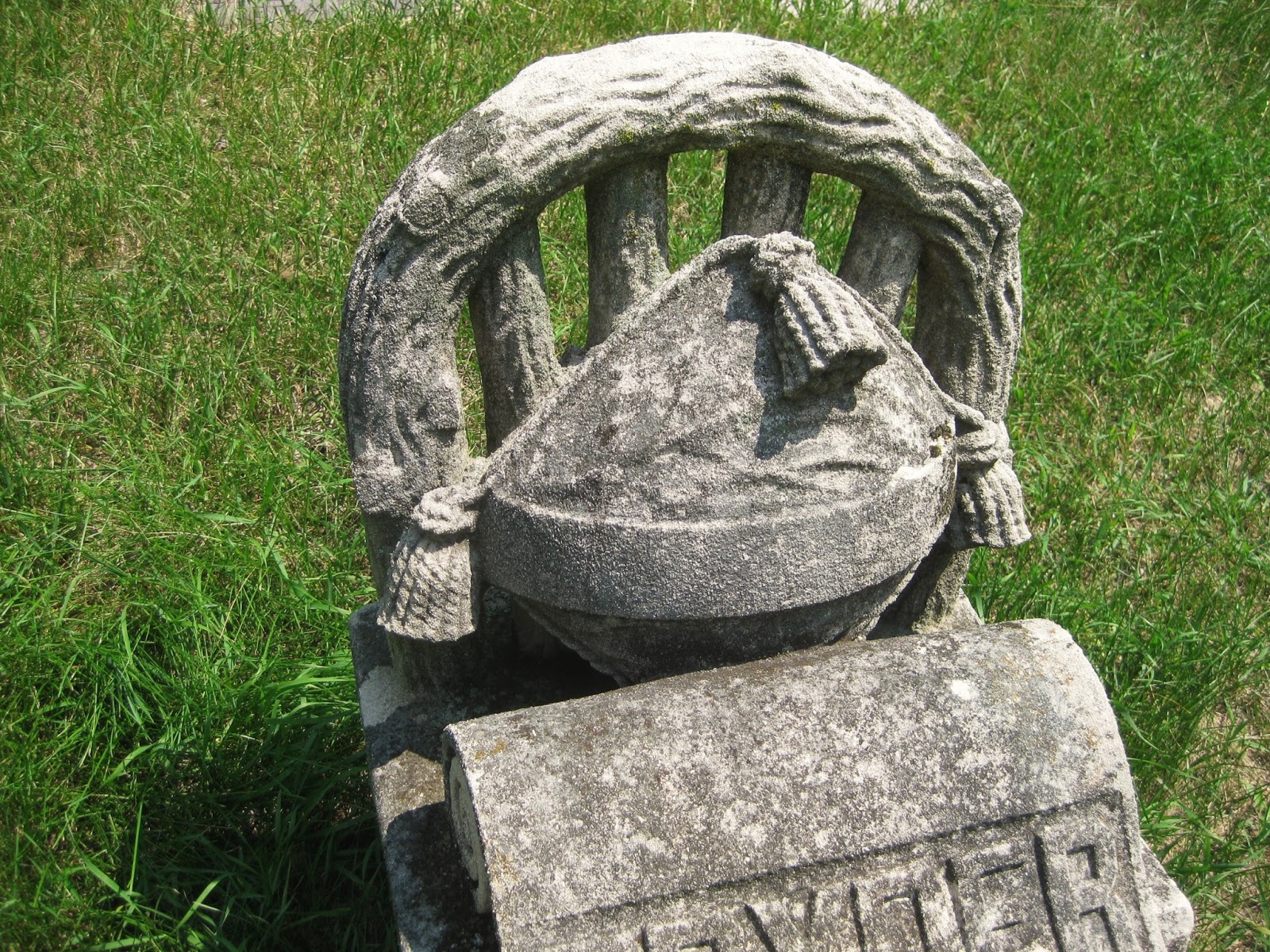
Here is a chair style, but not the more common Widow's Chairs that were designed to sit upon and contemplate the grave of your departed. You could not sit on this one if you wanted to. The seat is occupied by a large scroll, said to indicate the record of one's life. Oh, and also by this:
Yes, more tassels. I think this is supposed to represent a pillow. But I must admit, that is a guess. It certainly does not look like a very comfortable pillow but what else could it be?
Finally a nifty marker that I can neither classify as a genuine Tree Shaped Tombstone nor pass on including. Just because I like it. A Log Cabin Tombstone!
As previously noted, there seems to be a loose connection between this style of tombstone and membership in various fraternal organizations. At least you see that sort of imagery turn up pretty often. This fellow was a member of the Independent Order of Odd Fellows, the above initials reflecting their slogan of Friendship, Love and Truth.
This one had me stumped for a while. But it is not H.O.U.W. but actually A.O.U.W. This is the logo for the Ancient Order of United Workmen!
At the base of the same monument we find....
Two little lambs nose to nose. I hope the grounds crew knows they are there and is careful with them.
In my post on Some Really Sad Examples I showed you the hat of a little girl named Mary who died young. Here is another example of a "Mary's Hat". I am not sure if it makes it sadder or less sad to know that it was a stock item that you could order. Childhood death was common then.
Wow. The things they could carve out of stone. A drapery like this might indicate an occupational reference. The tassel seems atypical for the alternative explanation, a death shroud. Unless somebody decided to go in style.
Here is a chair style, but not the more common Widow's Chairs that were designed to sit upon and contemplate the grave of your departed. You could not sit on this one if you wanted to. The seat is occupied by a large scroll, said to indicate the record of one's life. Oh, and also by this:
Yes, more tassels. I think this is supposed to represent a pillow. But I must admit, that is a guess. It certainly does not look like a very comfortable pillow but what else could it be?
Finally a nifty marker that I can neither classify as a genuine Tree Shaped Tombstone nor pass on including. Just because I like it. A Log Cabin Tombstone!
Thursday, August 1, 2013
Scandal ! - Pleading the Belly
Here at Detritus of Empire we rarely speak of Political Scandals of the Day. Others do so with eloquence and unbridled glee, and I generally cede the territory to them. Besides, our history is replete with well meaning, chaste, ineffectual politicians. And also with rogues - likeable and otherwise - who had exactly the skill set for the challenges that the times called for.
But regards the latest imbroglio out of New York, well, something must be said.
But not his name. I give no publicity to base cads when I can avoid it. Besides, there are several such egotistical shysters on stage at present, so even narrowing it down to New York does not zero in on him.
This fellow was engaged in what I shall obliquely refer to as "sexual hijinks" that caused him to resign his previous office. Tears, contrition, unspecified therapy, by now we know the drill. Garden variety stuff from the sort of hubris engorged jerks who too often are drawn to politics.
But the remarkable thing is that after laying low for a short time he was "rehabilitated" by the press, ran for another prominent office.....and was shown to have continued in the same juvenile activities that got him fired once before. (For my non American readers I will spare you details, but think of the mating behavior of certain primates who display affection, or something, by displaying their bright red posteriors).
This time he is having a harder time finding sympathy.
He says there were really not that many women involved. Four. Maybe Six.
Uncharitable folks say that those are likely only the tip of the iceberg.
Really uncharitable folks point out that icebergs are actually pretty easy to visualize. They float fairly high in clear, pristine Arctic water. There are other things you find floating in sewers that are almost entirely below the surface.
Oh, I suppose part of the issue with our troubled politician is his name. Again for my British readers I encourage them to imagine the difficulties in life of being named something along the lines of, well, perhaps Willy Magnus. But his name is the same as in his last, largely successful attempt to avoid political extinction. So what else has changed?
Only this. When the scandal was at its peak last time his quite attractive wife announced she was pregnant. The wolves stopped howling. The circling vultures dispersed.
This is the modern day version of what was called in Elizabethan England "pleading the belly". Simply stated, if a woman convicted of a capitol crime was found to be pregnant her execution was stayed. Often as not she was later released or at worst transported to Australia as a convict. This legal dodge seems to have been used with some liberality, even in cases where pregnancy was implausible.
Let's be honest, if you were a judge forced to condemn a woman to hang for stealing a loaf of bread, would you not be willing to look the other way given an excuse for compassion?
All a woman needed to do was convince "a jury of matrons" as to the presence of pregnancy. The jury was apparently assembled from those attending the trial. It would not be too difficult for a woman to have a large number of her friends in attendance...
So our wayward politician now seems to be on the way to political "capitol punishment". Pregnancies being a little difficult to produce on short notice it is likely that there will be no second Pleading of the Belly by Proxy.
And even if there were.
I wonder, is it a little unfair to call our current national media a modern day "jury of matrons"?
Short answer, no. But I think even they have had enough of this nonsense.
But regards the latest imbroglio out of New York, well, something must be said.
But not his name. I give no publicity to base cads when I can avoid it. Besides, there are several such egotistical shysters on stage at present, so even narrowing it down to New York does not zero in on him.
This fellow was engaged in what I shall obliquely refer to as "sexual hijinks" that caused him to resign his previous office. Tears, contrition, unspecified therapy, by now we know the drill. Garden variety stuff from the sort of hubris engorged jerks who too often are drawn to politics.
But the remarkable thing is that after laying low for a short time he was "rehabilitated" by the press, ran for another prominent office.....and was shown to have continued in the same juvenile activities that got him fired once before. (For my non American readers I will spare you details, but think of the mating behavior of certain primates who display affection, or something, by displaying their bright red posteriors).
This time he is having a harder time finding sympathy.
He says there were really not that many women involved. Four. Maybe Six.
Uncharitable folks say that those are likely only the tip of the iceberg.
Really uncharitable folks point out that icebergs are actually pretty easy to visualize. They float fairly high in clear, pristine Arctic water. There are other things you find floating in sewers that are almost entirely below the surface.
Oh, I suppose part of the issue with our troubled politician is his name. Again for my British readers I encourage them to imagine the difficulties in life of being named something along the lines of, well, perhaps Willy Magnus. But his name is the same as in his last, largely successful attempt to avoid political extinction. So what else has changed?
Only this. When the scandal was at its peak last time his quite attractive wife announced she was pregnant. The wolves stopped howling. The circling vultures dispersed.
This is the modern day version of what was called in Elizabethan England "pleading the belly". Simply stated, if a woman convicted of a capitol crime was found to be pregnant her execution was stayed. Often as not she was later released or at worst transported to Australia as a convict. This legal dodge seems to have been used with some liberality, even in cases where pregnancy was implausible.
Let's be honest, if you were a judge forced to condemn a woman to hang for stealing a loaf of bread, would you not be willing to look the other way given an excuse for compassion?
All a woman needed to do was convince "a jury of matrons" as to the presence of pregnancy. The jury was apparently assembled from those attending the trial. It would not be too difficult for a woman to have a large number of her friends in attendance...
So our wayward politician now seems to be on the way to political "capitol punishment". Pregnancies being a little difficult to produce on short notice it is likely that there will be no second Pleading of the Belly by Proxy.
And even if there were.
I wonder, is it a little unfair to call our current national media a modern day "jury of matrons"?
Short answer, no. But I think even they have had enough of this nonsense.
Wednesday, July 31, 2013
Old Time Baseball
Baseball (or as it should be called base ball) teams playing under 19th century rules have become somewhat popular of late. They seem to divide up into teams playing under 1880's rules and those going way Retro and playing the 1860's version. While passing through Stillwater Minnesota recently we took in a couple of innings of Civil War era base ball.
I love the uniforms, although they look hot and itchy. At one point the Umpire made a general announcement that, in consultation with the Ladies present, it had been decided that Gentlemen may roll up their sleeves.
Even today Umpires wear a somewhat old fashioned uniform. But not this Old! I am sure he researched the gestures used to make rulings. This means, then as now, "safe".
Wooden bats of course. If you showed up with an Aluminum specimen you would probably have been fined two dozen cigars and thrown out of the league. Note also the galvanized pail of water with a dipper in it. A nice touch on a hot thirsty day.
In 1860's rules the players do not wear gloves. On the other hand if they catch a ball on one hop it records an out, so there is that. The anachronistic sunglasses seem to have been allowed. It is a stretch, but in the 19th century green tinted glasses were in use...but to protect eyes from overuse not from the sun.
Although nobody seemed very concerned about the outcome of the game, for the record the above team, The Rochester Roosters, lost to the Arlington squad by a final score of five aces to three. Or perhaps four, nobody could recall.
With the casual nature of the competition, combined with the physiques and facial hair on display above, I could totally see myself catching on with a team next season.
I love the uniforms, although they look hot and itchy. At one point the Umpire made a general announcement that, in consultation with the Ladies present, it had been decided that Gentlemen may roll up their sleeves.
Even today Umpires wear a somewhat old fashioned uniform. But not this Old! I am sure he researched the gestures used to make rulings. This means, then as now, "safe".
Wooden bats of course. If you showed up with an Aluminum specimen you would probably have been fined two dozen cigars and thrown out of the league. Note also the galvanized pail of water with a dipper in it. A nice touch on a hot thirsty day.
In 1860's rules the players do not wear gloves. On the other hand if they catch a ball on one hop it records an out, so there is that. The anachronistic sunglasses seem to have been allowed. It is a stretch, but in the 19th century green tinted glasses were in use...but to protect eyes from overuse not from the sun.
Although nobody seemed very concerned about the outcome of the game, for the record the above team, The Rochester Roosters, lost to the Arlington squad by a final score of five aces to three. Or perhaps four, nobody could recall.
With the casual nature of the competition, combined with the physiques and facial hair on display above, I could totally see myself catching on with a team next season.
Monday, July 29, 2013
Charles Babbage Sent Me
Computer Nerd: “Good
Afternoon Gentlemen. What can I help you
find today?”
Your Humble
Correspondent: “A laptop for my boy here.
Needs it for school.”
CN: “Right! Well, we have a nice selection right over
here. I suggest…”
YHC: “Ahem.
You were recommended to us as a place that might have some, er, special
items…”
CN: “We certainly serve a wide range of
customers, Sir. From those with rather
common place needs on up to those with, shall we say, discriminating tastes?”
YHC: “My first computer had a hard drive
capacity of 20 megabytes. That was
before you were born.”
CN: “I see.
Now, if you will just step over here.
Yes, behind that display. And
your voices, perhaps a bit of discretion would be in order..”
YHC: “So.
Do you have any?”
CN: “What you are looking for is very
difficult to find these days. Very
difficult indeed. But if you promise to
keep quiet about it I think we can make a satisfactory arrangement for you.”
YHC: “So you do have it then?”
CN: “Yes indeed. Here before you, in a world filled with gaudy
trash is a fine example of functional beauty.
A computer that will serve you without complaint or flaw. A reminder of an earlier, a simpler, yes I
will say it, a better time. Please give
it a good home, respect it and cherish it.”
And so it was that we bought one of the last Windows 7
computers on the – more or less – open market.
Friday, July 26, 2013
The Dog Days King of Iceland
The hot, lazy days of late July and early August have been known since ancient times as "the dog days". Although you can easily imagine a languid dog sleeping in the heat the name actually comes from the Romans. The hottest time of the year was also a time of sickness, which they felt to be under the influence of the star Sirius, largest in the constellation Canis Major (the large dog).
When double checking a few facts on the matter of "dog days" I encountered a remarkable biography, one I could not resist investigating further. Here then is the bizarre tale of the "Dog Days King of Iceland".
Jorgen Jorgenson did not have a happy childhood. Although quite bright he did poorly in school and was expelled at age 14. Although he was Danish it was arranged that he would go to sea on an English merchant ship. After the fashion of such times he was caught up by a press gang that delightful method of staffing the British Royal Navy by simply grabbing trained sailors from seaside taverns or directly off of their ships.
He spent a number of years in the South Seas, visiting Australia and New Zealand, before returning to his homeland just in time to witness first hand the Battle of Copenhagen in which Admiral Horatio Nelson attacked the anchored Danish-Norse fleet. As there was no formal declaration of war involved, the phrase "to Copenhagen" was a term for a surprise attack long before Pearl Harbor came along historically.
Jorgenson was soon given command of a small naval vessel that sailed for France, but was captured by a British ship. He was put "on parole", which mostly consisted of hanging around in England with nothing much to do.
News came to him that Iceland was short of food. He talked a merchant into funding a single ship expedition to trade with Iceland. His first attempt failed. Despite flying false colors as an American ship, his vessel was determined to be British. Probably noticing the current state of hostilities the Danish governor of Iceland refused to let any trading occur.
Returning to England the irrepressible Jorgenson launched another trade mission to Iceland, this time with two ships. The Flora and the Margaret and Anne reached Iceland in June of 1809.
At this point the goings on start to sound like a cheaply written comic opera.
The governor of the island, Count Trampe, would still not permit trading. So on Sunday when most of the population was in church, Jorgenson and his sailors surrounded the governor's house and arrested him. Jorgenson proclaimed himself "His Excellency, the Protector of Iceland, Commander in Chief by Land and Sea". Taxes were remitted. Danish property given away. The salaries of clergy were increased. There were promises of peace and cheap food.
It all was going so very well until a British ship turned up in August and deposed Jorgenson. As his brief reign corresponded to the Dog Days of Summer he is remembered in Iceland as The Dog Days King. It should also be noted that late summer in the newspaper business was once called The Silly Season, and this sort of tale would fit right in.
I recommend those interested in the later adventures of Jorgen Jorgenson to peruse this remarkable biographical sketch. For those short of time I will simply say that his later career was no less eccentric. At various times he was imprisoned for breaking parole, for bad debts and for pawning his land lady's furniture. He found intermittent employ as a spy, an author, a surveyor, an editor, a drunkard and in one remarkable instance a rather successful ship's surgeon. (While being shipped as a convict to Australia he was assistant to the ship's doctor. When said individual died Jorgen just took over the job).
Once established in Tasmania, then called Van Diemen's Land, he served in the police force with some gallantry against the "Bushrangers", convicts who had gone into the wild as bandits. Probably he was less gallant in action during The Black War, a genocidal campaign against the aboriginal inhabitants.
Oh, and he also married an ex-convict woman named Deborah Carbon in 1831, and managed to write two volumes of his autobiography before his death in 1841.
Two volumes was probably not enough.
More on The Dog Days King here.
When double checking a few facts on the matter of "dog days" I encountered a remarkable biography, one I could not resist investigating further. Here then is the bizarre tale of the "Dog Days King of Iceland".
Jorgen Jorgenson did not have a happy childhood. Although quite bright he did poorly in school and was expelled at age 14. Although he was Danish it was arranged that he would go to sea on an English merchant ship. After the fashion of such times he was caught up by a press gang that delightful method of staffing the British Royal Navy by simply grabbing trained sailors from seaside taverns or directly off of their ships.
He spent a number of years in the South Seas, visiting Australia and New Zealand, before returning to his homeland just in time to witness first hand the Battle of Copenhagen in which Admiral Horatio Nelson attacked the anchored Danish-Norse fleet. As there was no formal declaration of war involved, the phrase "to Copenhagen" was a term for a surprise attack long before Pearl Harbor came along historically.
Jorgenson was soon given command of a small naval vessel that sailed for France, but was captured by a British ship. He was put "on parole", which mostly consisted of hanging around in England with nothing much to do.
News came to him that Iceland was short of food. He talked a merchant into funding a single ship expedition to trade with Iceland. His first attempt failed. Despite flying false colors as an American ship, his vessel was determined to be British. Probably noticing the current state of hostilities the Danish governor of Iceland refused to let any trading occur.
Returning to England the irrepressible Jorgenson launched another trade mission to Iceland, this time with two ships. The Flora and the Margaret and Anne reached Iceland in June of 1809.
At this point the goings on start to sound like a cheaply written comic opera.
The governor of the island, Count Trampe, would still not permit trading. So on Sunday when most of the population was in church, Jorgenson and his sailors surrounded the governor's house and arrested him. Jorgenson proclaimed himself "His Excellency, the Protector of Iceland, Commander in Chief by Land and Sea". Taxes were remitted. Danish property given away. The salaries of clergy were increased. There were promises of peace and cheap food.
It all was going so very well until a British ship turned up in August and deposed Jorgenson. As his brief reign corresponded to the Dog Days of Summer he is remembered in Iceland as The Dog Days King. It should also be noted that late summer in the newspaper business was once called The Silly Season, and this sort of tale would fit right in.
I recommend those interested in the later adventures of Jorgen Jorgenson to peruse this remarkable biographical sketch. For those short of time I will simply say that his later career was no less eccentric. At various times he was imprisoned for breaking parole, for bad debts and for pawning his land lady's furniture. He found intermittent employ as a spy, an author, a surveyor, an editor, a drunkard and in one remarkable instance a rather successful ship's surgeon. (While being shipped as a convict to Australia he was assistant to the ship's doctor. When said individual died Jorgen just took over the job).
Once established in Tasmania, then called Van Diemen's Land, he served in the police force with some gallantry against the "Bushrangers", convicts who had gone into the wild as bandits. Probably he was less gallant in action during The Black War, a genocidal campaign against the aboriginal inhabitants.
Oh, and he also married an ex-convict woman named Deborah Carbon in 1831, and managed to write two volumes of his autobiography before his death in 1841.
Two volumes was probably not enough.
More on The Dog Days King here.
Subscribe to:
Posts (Atom)