Monday, March 5, 2012

Amputee Baseball after World War Two-The National Amps

  
It looks like a close play at second…the runner is going all out, the shortstop is in position and lays down a stinging tag.  Yikes! The base runner has a badly broken leg.  Is it time for a stint on the Disabled List, and a frantic call to the minors?  Well, no, how about a helping hand up, some commiseration on the shortcomings of conventional prosthetics, and a time out to strap on a new leg. 

Welcome to the odd world of amputee baseball in the years following World War Two.

Those of us born in later generations have a difficult time comprehending the magnitude of our national effort in that war.  Most families had their men in uniform.  Most communities large and small had native sons that never returned, or that came back grievously wounded.

Those who did come home faced neither the shameful hostility of the post Vietnam era, nor the ticker tape parades of other conflicts.  It was all pretty much matter of fact, the men just came back and got about building the American Dream.

But for men seriously wounded there was often a long stay in the hospitals of the Veterans Administration. 

In the New York area there was an active collaboration between the VA and the local sports community.  Servicemen were given discount admission to events, and for disabled servicemen the Yankees, Knicks, Rangers and various boxing venues offered free seats, often among the best in the house.  The Physical Therapy department of the VA was instrumental in arranging this, and even provided buses for transportation. 

At some point the decision was made for the spectators to become participants, and the National Amputee baseball teams were born.

Twice weekly practices were established at the ball fields on Randall’s Island under the Tri-Borough bridge. 
The bridges and the ball fields are still there.

Eventually there were teams organized along two different lines.  One was geographic, with the New Jersey Amps and the New York Amps contending.  Given that the baseball world of the late 1940’s had the New York area as its heart and soul it is not surprising that teams were set up this way.  Later, and for special occasions, another system was employed.

Exactly who deserves credit for the idea of the National Amps remains a little uncertain. There were a few amputee baseball teams in the 19th century, particularly among railroad workers, where industrial accidents were tragically frequent.  And there was also a vague collective memory of an amputee team of veterans existing after the First World War.  I have unearthed a single photograph dated 1921, but no further details.

But perhaps is was not a coincidence that there were two World War I veterans associated with the National Amps.  One was a Jimmy Schneider, who served as a coach despite having minimal baseball experience. He was said to be so articulate in his support of the amputee vets that “music came out of his mouth”.  The other was a Morris Novgrad, an attorney who was Chairman of the Baseball Committee for the National Amputee Chapter of the Disabled American Veterans organization. 

Some credit Novgrad with the idea, although a VA physical therapist named Jerry Gerace appears to have been the chief organizer. 

Soon, up to 300 amputees were attending the practices.  Single and even double amputees tried out for the teams, with Gerace doing the actual selection. It was now the summer of 1948 and the teams were no longer primarily comprised of hospitalized veterans, but of men who had finished their rehabilitation and were back in the community.  For instance, Gale Beccue, a former Ranger (Army, not Texas) and leg amputee, was working in Hoboken and tracked the group down after reading a newspaper article about them.

Gale Beccue in uniform
In addition to the practices each of the two Amps teams would play roughly a dozen exhibition games.  The opponents were varied.  Sometimes they would play each other as a benefit for a local VFW, on other occasions they would play American Legion All Star teams. Area colleges such as St. Johns and Adelphi took the field against the Amps.  Once they were said to have played the Kenosha team from the All American Girls Professional Baseball League who were in the area for a spring training/recruiting trip.  Scores were not always kept, but apparently they lost to the Legion All Stars and managed to defeat “the Girls”. 

Since many of these exhibition games were benefits for veteran’s groups there was generally a gathering afterwards, either a potluck or a dinner out at the best restaurant in town. 

The amputee teams attracted a fair amount of publicity.  Box scores of some of their games appeared in the local press and on radio, and they were also invited to appear on the Ed Sullivan show.  

Another invitation, that seems to have occurred several times, was to stay at Grossinger’s, a popular Catskills resort.  This was a traditional hangout for professional boxers and baseball players, particularly the New York Yankees.  The Amps, 30 players and their wives, stayed “on the house”, played a little ball to entertain patients from the local VA hospital, and were cheered on by such notables as Hank Bauer and Mel Allen.

Some of the players labored under greater adversity than others.  Sol Kaminsky played despite being a double leg amputee.  Bill Marino being a one armed pitcher played barehanded.  Some of the arm amputees had to develop an odd batting style, somewhat akin to a tennis back stroke.

But despite these adversities, and the good-natured tone of the competitions, the players worked hard.  They certainly looked the part of serious players, being outfitted in professional quality uniforms obtained from Friedman’s Athletic Store.

For several years in the late 40s and early 50s Horace Stoneman, owner of the New York Giants, turned the Polo Grounds over to the National Amps periodically for benefit games.  These were major events, with twelve to eighteen thousand fans in attendance.  Promotional artwork, done by the cartoonist Al Capp, appeared on posters and mail trucks for a month prior to the event.  Capp as it happens was also an amputee, but as a result of a childhood injury.

Illustration by Al Capp, and featuring his famous Shmoos
 The usual arrangement was to pool the players from the New York Amps and the New Jersey Amps, and then pick two teams designated The Broken Wings and The Flat Tires.  This of course pitted players who were leg amputees against arm amputees.  The only exception made was the realization that the Broken Wings would need a catcher with two arms, so Gale Beccue was “traded” to the Wings for the day.

The Broken Wings


And the Flat Tires.  Note that both squads, circa 1948, are integrated.
The games at the Polo grounds were generally the only time that the most famous of the amputee players took the field.

Bert Shepard was a sore-armed minor league pitcher, put on waivers and seemingly out of baseball when he enlisted in the Army Air Corps.  Trained as a P-38 pilot he was shot down over Europe just prior to D-day.  Losing a leg he was remarkably able to begin his rehabilitation while still in a German prison camp, with the help of an improvised prosthesis.  After being repatriated he was recovering at Walter Reed Army Medical hospital when the Assistant Secretary of War stopped by to hand out some medals.  Asked what he planned to do next in life Bert answered that he wanted to play professional baseball.

A tryout with the Washington Senators was arranged, where he proved able to pitch, hit and even field the occasional bunted ball.  Bert made the team, but rode the bench until late in the 1945 season, when he was called in to finish up in a game where the Senators were losing badly.  In his one appearance in the Majors, Bert Shepard threw some solid innings, only gave up one run, and went 0 for his career as a batter.

By the time the National Amps teams were active Shepard was still in professional baseball, but as a player-manager in the minor leagues.  So his availability for exhibition games was limited.

Jerry Gerace was able to impartially manage both teams, which is in itself likely to be a unique accomplishment.

For the record, the score of one Flat Tires-Broken Wings game had the Wings scraping out an 8-7 victory.

Once in 1950 a National Amps all-star team faced off at the Polo Grounds against a squad called The Broadway All Stars.  The roster of the Broadway team has not been preserved, but members of the Amps recall a wide array of luminaries from the sporting and entertainment worlds taking the field.

Al Schact a former major leaguer and “baseball comedian” was their first pitcher.  Hall of Famer Dizzy Dean pitched next, with Mel Allen, the long time Yankees announcer finishing the pitching duties.  Lanny Ross, a popular singer of the day played, but not well.  Several women rotated in briefly, and by some accounts Bing Crosby and Ed Sullivan made short appearances!  An ambiguous photo suggest the celebrities were wearing uniforms from the Friars' Club.

The benefit games played at the Polo Grounds were financially successful to the point that the Disabled American Veterans amputees chapter was able to purchase a headquarters in New York City that remains in use to this day.

From their beginnings in 1948 the National Amps teams were active for about five years.  There was no formal disbanding, in the way of old soldiers they just faded away.  Wheelchair basketball became more popular.  The players got a little older, and a little more involved in other activities.  At least two of them got jobs as representatives for prosthetics manufacturers.  Bert Shepard eventually gave up on his baseball dreams and had a long career in industry, as well as winning the National Amputee golf championship several times.  Well into his 80’s he claimed he could still fly a P-38 if anybody would put him at the controls again.

Most players like Gale Beccue just moved on, started families, playing a little softball or town league baseball on the side.

The world since 1945 has hardly become a more peaceful place.  Indeed, the heyday of the National Amps was contemporary to the Korean Conflict and the beginning of the Cold War.

Although more recent wars have not involved the massive numbers of soldiers who fought in World War Two there is still a need for services for amputee veterans.  Indeed, with recent advances in trauma care, as well as improved body armor, the percentages of injured veterans who are amputees is almost certainly higher.

Since baseball no longer has quite the iconic status as “The National Pastime” it is a bit surprising that amputee baseball has made a modest comeback.

Noe Santos is a Third Infantry soldier injured by an IED while serving in Iraq.  He lost a leg, and suffered traumatic brain injury resulting in a long stay at Walter Reed.  Unable to remember much beyond names of family members he was being readied for transfer to a rehab facility, when one morning he could recall the entire Yankees lineup.

On May 4th, 2006 Santos was one of 14 injured servicemen from Washington area hospitals who squared off at Prince William County Stadium, in Woodbridge Va.  They were wearing the jerseys of their favorite major league teams, courtesy of the DAV, Rawlings Sporting Goods, and the minor league Potomac Nationals who were hosting the event.

The game ended in a friendly 14-14 tie.  The sun shone brightly, there were plays close enough to argue about, and afterwards they all went out to a local restaurant.  All in all a fun day, and one that the Amps of two generations earlier would have appreciated.

But I think the original Amps were a tough enough bunch that they would have razzed Tim Taylor, another former 3rd Infantry soldier who “didn’t slide into a base because he wanted to keep his jersey pristine”.

(I wrote this story a few years ago, and it originally appeared in Elysian Fields Quarterly in 2008)

Photos are courtesy of the DAV with the exception of the Beccue photograph, courtesy of the Beccue family.

Coming up Wednesday: more tales of the old National Amps, and the 2012 Wounded Warriors team!

Saturday, March 3, 2012

Thanks, Dad

Signs have become so standardized that I suspect our eyes glide right over 99% of them.  Even older signage usually obeyed certain conventions.  So when you walk past something really out of the ordinary it can almost be jarring.  Consider:
This is unusual on many levels.

1. How many fathers build a gas station for their son?

2. Michelo must have been proficient in both brick and stonework.  Was he a bricklayer?  A mason?  Did he make tombstones?  The contrast in style between the yellow brick and the polished granite is interesting.

3. Most people who want to put their mark on a nice bit of work will place it up high, over the door perhaps.  Somewhere where it will be noticed.  Here it is placed in a nice little niche but it is also right next to the trash cans, and as to the attentions of wandering neighborhood dogs....

The days of this being a service station are long gone, but some good citizen is still keeping it up nicely.  Note that not only is there a push broom leaning against the building, but that said broom matches the trim!

As to the family history of the Antenucci tribe I have been able to find only scraps, and they do not seem to tell a happy tale.  Michelo died one year after he built his gas station, and Benny J. only lived to 1951.

Friday, March 2, 2012

Scenes by the road less traveled. Part Three.

Were you to follow the train tracks south from our last location you would reach a larger, still vital community.  It too started as a rail center, and had the same experience of the main highway first passing through town then migrating elsewhere.  Downtown you find this:
Communities that sprang up along rail lines invariably had hotels downtown for the benefit of travelers.  Often, as in this case, the hotel seems quite a bit grander than the town would warrant, but these were days of civic pride and optimism.  Every little burg hoped and expected that they would become the next Chicago.  A couple of interesting features here.  There is a nice tower on the front corner, it probably once had a pointy "witch hat" roof on it.  Note on the back of the building there is an addition with big bay doors and red lettering.  This is actually the fire station now!  It seems to me a creative re-use of a difficult architectural space.  Notice how the parking on street is diagonal?  This is a common feature in towns that were built for the benefit of, and perhaps with the assistance of, the railroads.

Following the former main highway north from town we come across a nice little clutch of history.

A drive in.  It lacks any of the standard livery associated with A&W, Dairy Queen and so forth, so I assume it was a mom and pop operation.  It is so well kept up that I wondered if it was still in seasonal operation.  But it has no signage whatsoever, and on close up view:

When you have gone to the effort to actually scrape the stickers off your windows you seem pretty defunct to me.  

Across the road from the drive in is:
This is a collection of what were called "Tourist Cabins".  Back in the 1930's and 40's neither the cars nor the roads were conducive to high speed travel.  It took you a few days to get places and you needed lodging along the way.  These little units were for rent, kind of like a motel with free standing units.  I recall staying at a place like this back in the 1960's on a family trip to Yellowstone Park.  The pristine, undisturbed snow above makes me think these are not in any current use, but I applaud their owner for keeping them nicely painted.

The outskirts of town were usually the place for family recreation, and quite near the abandoned drive in we find:


This is a wide angle shot showing a "Muffler Man" standing vigil over a Go Kart/Water Slide place that is still in business in the summer months.  What, you may ask, is a "Muffler Man"?  Behold:
Twenty feet of lean, self confident fiberglass, these figures were produced by the thousands as advertising pieces in the late 1960's to early 1970's.  The peculiar and somewhat uncomfortable hand positioning was because the original mold was a Paul Bunyan figure, and he was holding an axe.  Many of these fellas were propped up in front of auto repair businesses and were holding outsized mufflers, hence their unofficial name.

Here is a great site with the full story of the Muffler Man Tribe.  And better still if you back up to the Roadside attractions home page you will find a delightful array of information that will enable you to plan your own journey of discovery.  I hope you find a few new treasures.

Wednesday, February 29, 2012

Scenes by the road less traveled. Part Two

Down the road a few miles we enter another little hamlet.  Lumberjacks used to float logs down the river that runs past it, but the community started out as a railroad junction in the late 1870s.  Later a road paralleled the rails and seems to have gone through the center of town.  In the modern era the busy highway is just close enough to disturb the silence of an abandoned main street.

Of the early rail heritage we have almost nothing, just the Ghost Carnival that I visited last year. 

This was once the busiest corner in town;
By 1910 the glory days of this place were probably already over, but it was an era when stubborn folks were still trying to create farms out of logged off timber land.  There was a lot of dynamite being used to blow up stumps back then. An old timer once told me that they had so much left over after World War One that they gave it away at the County Extention office.  You just had to sign for it!

The building above seems to have had three lives.

Little banks like this lived and died on the economic health of their towns.  They probably did OK in the teens and twenties, but the Crash of '29 must have put them under.  Next up:

The top of the sign is not very legible but does indicate that this became some sort of store.  The ghost sign says "Occident Flour  Costs More-Worth It".  Small town grocery stores hung on a little longer, folks do have to eat after all.  But in the next active incarnation the building becomes home to:
And I think this is the end of the line for the place.  You can see in some of the above pictures that there are still stacks of sheet metal and tools inside, but the door is padlocked and shows no sign of being opened in recent times.  I imagine it could have another life left in it, but some of the brickwork appears to be crumbling, and flat roofs are notoriously susceptible to the ravages of weather in our part of the world.

Next up: A jackpot of Americana

Monday, February 27, 2012

Scenes by the road less traveled. Part One.

My "home page" picture for this blog shows me with a couple of my digging pals in the spring of 2010.  We are proudly standing on a monumental section of Roman roadway we had just spent a week uncovering.  The Romans were very intent on keeping roads right where they put them.  This particular bit of paving stones was put into place in 213 AD and probably remained in use until around 500 AD.  Oh, and three feet deeper down was an earlier road that took it back another century.  They liked continuity.

A "sandal-level view" of our road.  Not bad after 18 centuries, barbarian invasions and modern plowing.

Things are different in America.  We quickly construct transportation systems-canals, then railroads, then highways, then superhighways-and then more or less abandon them.

These vestiges of earlier transportation systems are mostly still there, and are a great place to search for artifacts of earlier times. 

On a recent trip home after working out of town I photographed some good stuff.

This is an early gas station.  It stands alongside what is actually a fairly well traveled road , but is in a tiny little hamlet.  There are modern gas stations a few miles in either direction, so in an era when folks never even slow down for wide spots in the road it clearly went under many years ago.
Here's a side view.  I took this picture on a crisp winter morning that smelled of wood smoke from nearby houses.  The brick chimney, which seems to have a nasty lean to it, indicates a probable wood stove here as well.  Gasoline and a wood burning stove just seem like a bad mixture.

It is difficult and even a little depressing to imagine somebody here working a lonely night shift.  Over the doorway would have been a single glowing bulb indicating that the place was open.

Well there's something you don't see every day.  A gas station with a stone foundation.  Actually stone and cement, but not substantively different from the foundations of some of the flimsier buildings I helped excavate in the civilian settlement outside the Vindolanda fort.
Sometimes I try to figure out the story of a place by the clues left behind.  The gas pumps have been gone from this old station for a long time, and the paint has not been redone for at least a decade.  But out back there were some fairly un-rusted barrels that seemed to contain old auto parts, and what I think to be a modern fuel container.  My guess is that after it stopped being a real gas station it became somebody's mechanic shop.  In this it was probably less useful than a conventional garage, as I could not see and service bay or other means to work on things in bad weather.

Come back Wednesday, I'll show you some more things from down the road a stretch.

Saturday, February 25, 2012

With their boots off

Life in the ER is a thing of many parts.

Of course there is the dramatic stuff, major trauma, saving lives and so forth.  That's why we have an Emergency Room, and when all elements of the system are working as they should it is an impressive thing to behold.

Then there is the mundane stuff, colds, ear aches, minor injuries.  I did this for a quarter century before switching to ER, so this is second nature.  It can be enjoyable, I have many interesting conversations while awaiting test results or putting in nice neat stitches.  And the younger kids are always fun.  As you can see from the occasional photo I allow, I rather resemble a comic pirate and can play that role with Shatnerian subtlety when appropriate.

But there is also the difficult-perhaps insoluble-set of problems.  And the hardest is the Failing Parent.

It is mid 80s Mom, or less often Dad.  They are almost always brought in by a daughter or daughter in law.  Sometimes the superficial issue is clear cut-a fall with a major fracture for instance-but more commonly it is for vague issues.  Weakness, confusion, medication errors, or "just not right".

If things are overly busy, or if you are distracted, you can easily miss the cues.  A minor skin tear that only needs a band aid for instance.  But the real issue, the often unspoken issue, is that the Failing Parent can't be at home any longer.  This is hard.  Not all that hard for the elderly patient, often they are not fully grasping the situation and sometimes they are more than ready for a change.  But hard for the "child" who is facing the first concrete evidence of that hardest of Losses. 

And for society is is damnably hard.

We lack a system of easy transition from home to Alternative (even out of work mode I have a hard time speaking the phrase Nursing Home).  There is paper work to fill out.  There is funding, such as it is, to arrange.  And there is even a ridiculous Medicare rule that says that for Nursing Home admission you must first stay three days in the hospital.  Why?  This is an artifact of a medically ancient time when we often had people in for "rests and tests".  I have shipped out a person with an acute heart attack and had them stop by to say thanks two days later, their coronary angiogram and stents all accomplished in under 48 hours!

So the Hobson's choice is to either be strict, and to deny admission when there is no specific illness or malady, or to find various ways to tip toe around.  If you do enough testing you will usually find something.  Is that potassium a little low?  Might that chest x ray have just a shadow of pneumonia?  No doubt this gentle subversion of the system saves individuals-I live in fear of sending an oldster home and seeing them back next shift with a hip fracture-but the collective fiscal impact on our poor medical system is huge.

It gets surreal sometimes.  During a raging blizzard a stylishly dressed daughter home from the big city for the holidays.  Mom had been let out of a Nursing Home a week before.  Now there was vague weakness, an increase in anxiety, a fearfulness to try and use the walker.  Could I arrange admission to a Nursing Home?  Not the one she had been in, she did not like that one.  How about one in a nearby town?  Yes, the one her sister was in.  And could I arrange a private room?

It's funny and sad and frustrating and time consuming and impossible.  It throws a huge monkey wrench into the usually well running ER machinery.  Other patients wait longer.  We never solve it in a satisfactory fashion.

We are living longer.  Better in some ways but against the life saved by preventing a fatal heart attack at 50 we have to acknowledge the unhappy twilight world of a 90 year old with Alzheimer's, dignity fallen, unaware and incontinent.  We no longer have large families that stay close to home.  That tireless saint of a daughter or daughter in law of a bygone era is now a bank vice president.  Or perhaps not, the hardest situations of all are where mental health and substance issues strike across multiple generations.  When parents age, especially when one dies and leaves the other, there is no sufficient safety net.

So we soldier on as best we can.  In half serious moments I wonder if we need a sort of Isomeric Boy Scouts where a younger, fitter scout master is in charge of a troop of elders.  They would help each other out, go on camping trips.  Maybe there would be merit badges.  No s'mores at the campfire though, a nice glass of single malt please.

Unless and until some happy variant of such appears I vow to never personally reside in a Nursing Home for a single day. 

Friday, February 24, 2012

Middle School Robotics Project-Chapter Three

Spring approaches, and it seems as if the robotics classes are more chaotic now.  The kids are still getting a fair amount done, and some are quite good at independent work.  But the noise level and the need to put the kibosh on middle school goofing around are both higher than ideal.  So my photos are going to seem a bit haphazard today.

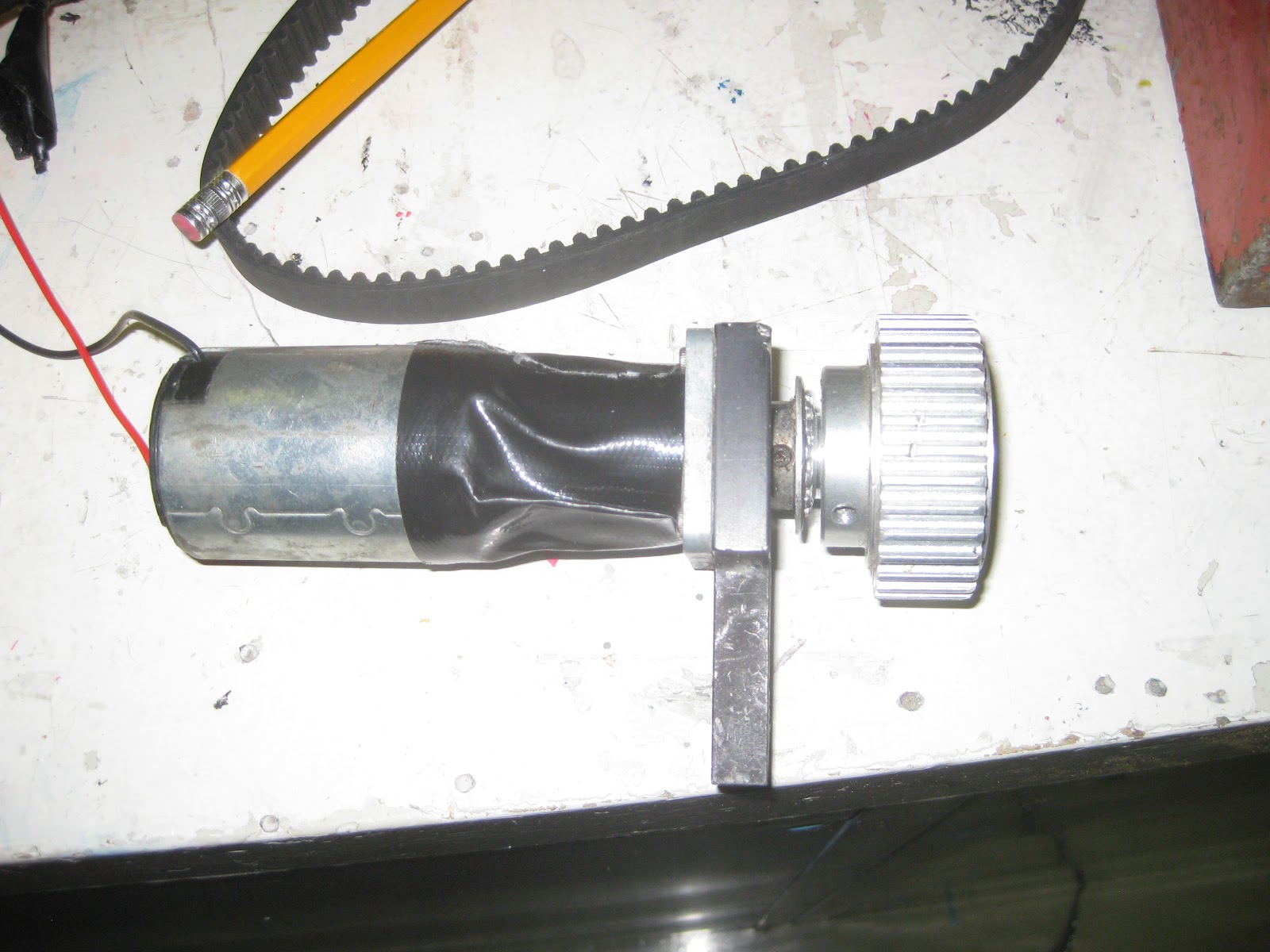
This project is going to have a semi-humanoid final look.  So I thought we would try having the machine pivot at the "waist" between two modules.  This is a low speed, high torque gear motor that I got in a bulk lot.  It was off some kind of automation machinery.  The big silver gear on the top is one of many, many parts I have been using from an elaborate power wheelchair that I was given years ago for robotic parts.  I told the good folks that donated it that my robotics projects are sort of like the Native Americans and the buffalo....eventually we find a way to use everything from the snout to the tail.

The upper module of the swivel section...

Upper and lower modules of the swivel section.  The gear motor will drive a pulley attached to the bottom of the upper section.  You will note a lot of two by four sections in use.  These are scrapped from an earlier incarnation of the small robot arena....I have been keeping them around for ten years looking for a use!  One of the things that slows our progress of late is that we have no shop access.  The only power saw I trust middle schoolers with is wimpy enough that cutting two by fours with some precision is a slow process.

An M&M dispensing device.  Solid work by a student who can build things without my constant supervision.  I did help with the testing.  As reliability is important this needs to be done until I have had enough M&Ms.  More on this in the weeks to come.
You need somebody who can look at the above and see circuits instead of spaghetti.  I am lucky this time to have two lads who appear capable at wiring the electronics.  At least they can figure out when things do not work, and that is the first step to understanding why they don't.  Here is one of my electronics guys down in the guts of the drive module.  One speed controller for each side of wheels, with the third one for the swivel motor. 

Off next week for spring break.  Three more official sessions to go before "show time".